April 10, 2026
Orthodox Easter Truce: What Will It Be Like? Putin Announced a Pause in Fighting After Several Calls from Zelensky for a Ceasefire
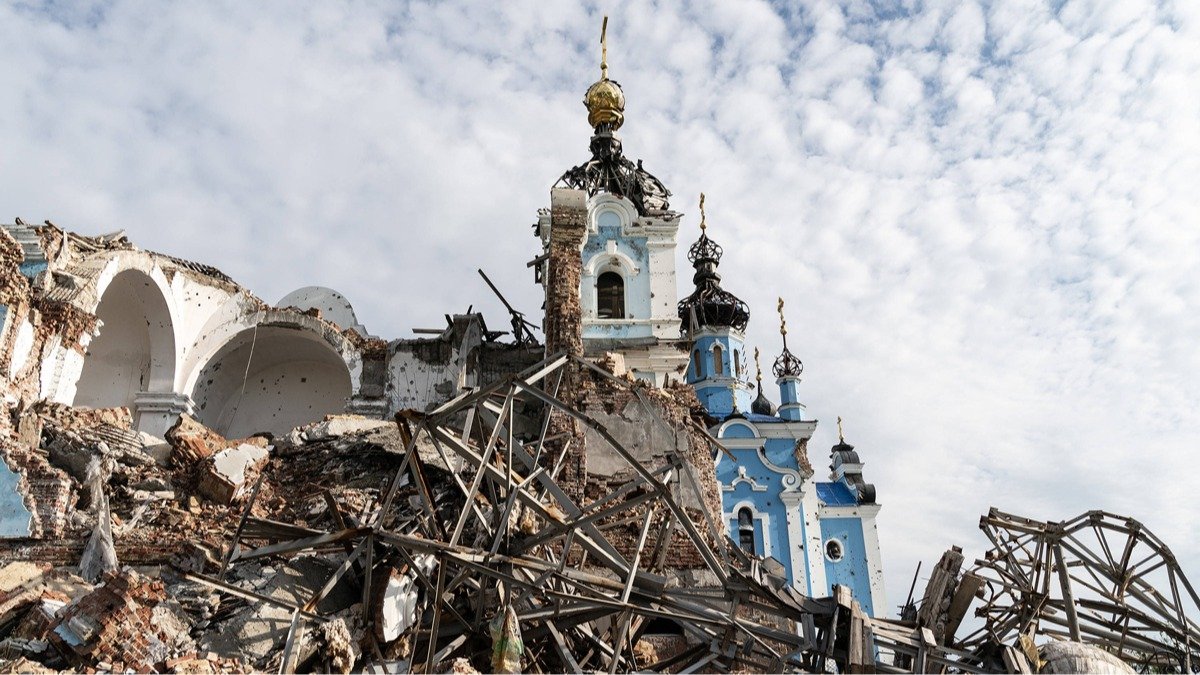
On the evening of April 9, Vladimir Putin ordered a ceasefire for Orthodox Easter. This came after repeated similar calls from Vladimir Zelensky. Ukraine, according to the Ukrainian president, "will act accordingly." Experts interviewed by "Novaya-Evropa" see Putin's proposed truce not so much as a humanitarian gesture but as a military necessity for Russia, and they warn: the main thing for the Russian army now is to safely bring up forces to the front lines. A view of a temple destroyed during hostilities in the village of Bohorodychne, Donetsk region, Ukraine, 2023. Photo: Lev Radin / Pacific Press / Sipa / Scanpix / LETA. Vladimir Putin announced the Easter truce at the very last moment - late in the evening of April 9. Earlier that Thursday, Kremlin press secretary Dmitry Peskov claimed that "no decisions" on an Easter truce had been made by "the supreme commander-in-chief." As stated in a statement on the Kremlin website, the Russian side promised to stop hostilities from 16:00 on April 11 until the end of April 12. Russian Defense Minister Andrei Belousov and Chief of the General Staff of the Russian Armed Forces Valery Gerasimov were given orders to stop hostilities in all directions, as well as to "be prepared to suppress possible provocations from the enemy, as well as any of its aggressive actions." "We proceed from the fact that the Ukrainian side will follow the example of the Russian Federation," the message reads. Ukrainian President Vladimir Zelensky noted that he had already proposed declaring a truce for Easter and stated that Ukraine "is ready for mirror steps": "We proposed a ceasefire for the Easter holidays this year and will act accordingly. "People need Easter without threats and with a real movement towards peace, and Russia has a chance not to return to strikes after Easter," he wrote. Russia announced its own truce after repeated calls from Zelensky. The Ukrainian leader proposed a truce as early as March 30, on the eve of Catholic Easter. "We have supported any formats for ending the war, you know this, we are ready for a ceasefire during the Easter holidays," said the President of Ukraine. At the same time, he emphasized that "normal people who respect life" talk about a ceasefire and the end of the war forever, not for a few days. In response to this, on March 31, the Kremlin stated that they had not seen "a clearly formulated initiative for an Easter truce." According to him, Zelensky "must take responsibility and make the right decision for us to achieve peace, not just a ceasefire." On the same day, the Ukrainian leader promised to ask the US to convey the proposal for an Easter truce to Russia and to seek a mutual cessation of attacks. A day later, on April 1, the Russian army shelled Ukraine with drones. The city of Lutsk was also hit: as Zelensky then said, Russian troops destroyed food warehouses and a "Nova Poshta" terminal, and a residential building was also damaged. "We proposed a ceasefire for Easter - in response, we receive "Shaheds." We also proposed a ceasefire specifically for energy facilities - the Russians ignore this and again try to target our substations and transformers," he wrote. Despite the shelling and lack of response from Russia, on April 3, Zelensky confirmed that the truce proposal remained in effect. A police officer records the consequences of a Russian drone strike in Lutsk, Ukraine, April 1, 2026. Photo: SES of Ukraine. "The Russian army will safely resupply the front with fresh personnel for more than a day." During last year's truce, a decrease in the intensity of fire was indeed recorded in some sectors of the front, but a complete lull was not achieved, military analyst and former SBU employee Ivan Stupak noted in an interview with "Novaya-Evropa." According to him, this experience showed that "a truce is used in its own interests by both warring parties: the military conduct rotations, bring up reserves, deliver ammunition, and strengthen positions." Alexander Kovalenko, a military-political observer for the "Information Resistance" group, adds in an interview with "Novaya-Evropa": during the respite, the parties will be able to evacuate bodies of the dead from the battlefield and safely transfer fresh units to the front. The Armed Forces of Ukraine will not blindly and unconditionally observe the proposed truce, Kovalenko stated. If Russian troops continue offensive actions in some sectors, Ukraine will respond and begin to repel Russian attacks, he explained. "In his opinion, for the Russian side, the truce carries not goodwill, but a propaganda and manipulative meaning: the Russian authorities are trying to present Putin as a peacemaker and thus improve his image, the expert added. The analyst emphasized that Russia may demand unconditional adherence to the truce from Ukraine, but at the same time continue active operations, redeploy forces to the front line, and possibly conduct attacks wherever it is convenient for it. "At the same time, Putin will, of course, blame the Armed Forces of Ukraine for the violations," he added. Russian servicemen during combat training in the Zaporizhzhia direction, Ukraine, March 25, 2026. Photo: Alexey Maishev / Sputnik / Imago Images / Scanpix / LETA. The Easter truce is a "gift for Putin." From a military point of view, the Russian army needs a pause in the fighting more, Stupak believes. In addition, the expert drew attention to the approaching May 9: the Russian army, in his opinion, has very little time left to achieve any victory by the holiday. "According to military laws, a short-term truce is primarily beneficial to the attacking side," military expert and retired Ukrainian Armed Forces Colonel Roman Svitan told "Novaya-Evropa." He noted that it is unclear to him why Zelensky first proposed a ceasefire in such a situation, and suggested that he might be trying to boost his ratings. The expert emphasized that now, in his opinion, Russia will have the opportunity to bring up reserves and conveniently position forces and assets for further offensive operations. "In fact, conditions have been created under which the Russian army will safely resupply the front with fresh personnel for more than a day," he added. During hostilities, Russian soldiers in most cases cannot calmly cover the distance from the rear to the front, as the Ukrainian army controls the zone 20-30 kilometers deep into Russian-occupied territory using drones, Svital explained. In addition, according to him, based on the experience of past truces, it can be assumed that in some sectors, the Russians will continue offensive actions or attempt to infiltrate Ukrainian defenses. "In fact, the ceasefire has become a gift for Putin," Svitan believes. He suggested that after the truce ends, the Russian army will receive reinforcements, prepare, and attack again, and the Armed Forces of Ukraine will lose many people. The next truce will likely be announced before May 9. By May 9, Putin may also propose a new truce for the holidays, Kovalenko suggested. At the same time, in his opinion, this ceasefire may be longer than the Easter one, and Russian troops will have more opportunities to accumulate forces and assets in the most active sectors of the front. According to Svitan, the Russian authorities are tasked with capturing some significant settlement by May 9 and reporting victory. Konstantinovka may become such a city: "The Russian army will not be able to capture it completely. But the offensive will continue, and, as usual, they will report upstairs that Konstantinovka has been occupied and its garrison destroyed," the expert concluded. Previous truces: the intensity of fighting decreased, but the parties claimed violations of agreements. This will be the fourth truce since the beginning of Russia's full-scale invasion of Ukraine. The first was announced in 2023 for the Christmas holidays after a call from Patriarch Kirill. According to Zelensky, Russia wanted to use Christmas "as a cover" to temporarily halt the advance of the Armed Forces of Ukraine in Donbas and "bring up equipment, ammunition, and mobilized personnel closer." Despite the truce proposal for Christmas, the parties then reported attacks on each other. For example, the General Staff of the Armed Forces of Ukraine stated that the Russian army carried out a missile strike and 20 shelling attacks from multiple launch rocket systems, and that Ukraine itself carried out strikes on units of Russian troops. And the governor of annexed Sevastopol, Mikhail Razvozhayev, reported a downed drone at night. Traces were also announced in 2025. The first was announced unilaterally by Putin on the occasion of Easter - from 18:00 on April 19 to 00:00 on April 21. In that year, Catholic and Orthodox Easter coincided and were celebrated on the same day. Zelensky, in response, promised to "act in a mirror way" and proposed a ceasefire for at least a month. The President of Ukraine also noted that in the conditions of hostilities and Russia's disregard for the proposal for a long-term truce, there is "no trust in words from Moscow," and called the proposal "another attempt by Putin to play with people's lives," but later effectively agreed to it. As "Novaya-Evropa" wrote, throughout the Easter holidays, the parties accused each other of violating agreements, attacks, and shelling, but there were places where the truce was observed. In addition, no air attacks on Ukraine were reported that night. The second "three-day truce" was proposed by Putin at the end of April and timed to the 80th anniversary of the victory in the Great Patriotic War. Zelensky, in response, called the Russian Federation's proposal "another attempt at manipulation" by the Kremlin, and also emphasized that for negotiations, a ceasefire of at least 30 days is necessary. In his opinion, Putin only wanted to "ensure silence during the parade" on May 9. "We value people's lives, not parades," the Ukrainian leader added. As "Novaya-Evropa" reported at the time, the intensity of fighting on the front indeed decreased during this period, and Kyiv and Moscow calmly received foreign guests. At the same time, both sides, as during the "Easter truce," accused each other of violations and continued attacks. Kovalenko agrees in a conversation with "Novaya-Evropa" that last year's truce was imitative: "In certain sectors of the front, Russian troops indeed stopped attacking, but at the same time, they developed intensive reconnaissance activities, conducted reconnaissance, entrenched themselves in positions, carried out engineering and barrier work, and also replenished the personnel of depleted units. In other directions, the fighting only intensified."
TL;DR
- Russia announced an Easter truce from April 11-12, coinciding with Orthodox Easter.
- The decision followed multiple appeals from Ukrainian President Zelensky for a ceasefire during the holidays.
- Experts suggest the truce is a strategic military move for Russia to resupply troops, not a humanitarian act.
- Ukraine stated readiness for reciprocal steps but historically has accused Russia of violating truces.
- Past truces have seen reduced fighting in some areas but were often marked by mutual claims of violations.
Continue reading the original article