April 11, 2026
Good Omens. Putin went for a Easter ceasefire to attend a service? And why was the idea of a ceasefire accepted without the Russian Orthodox Church?
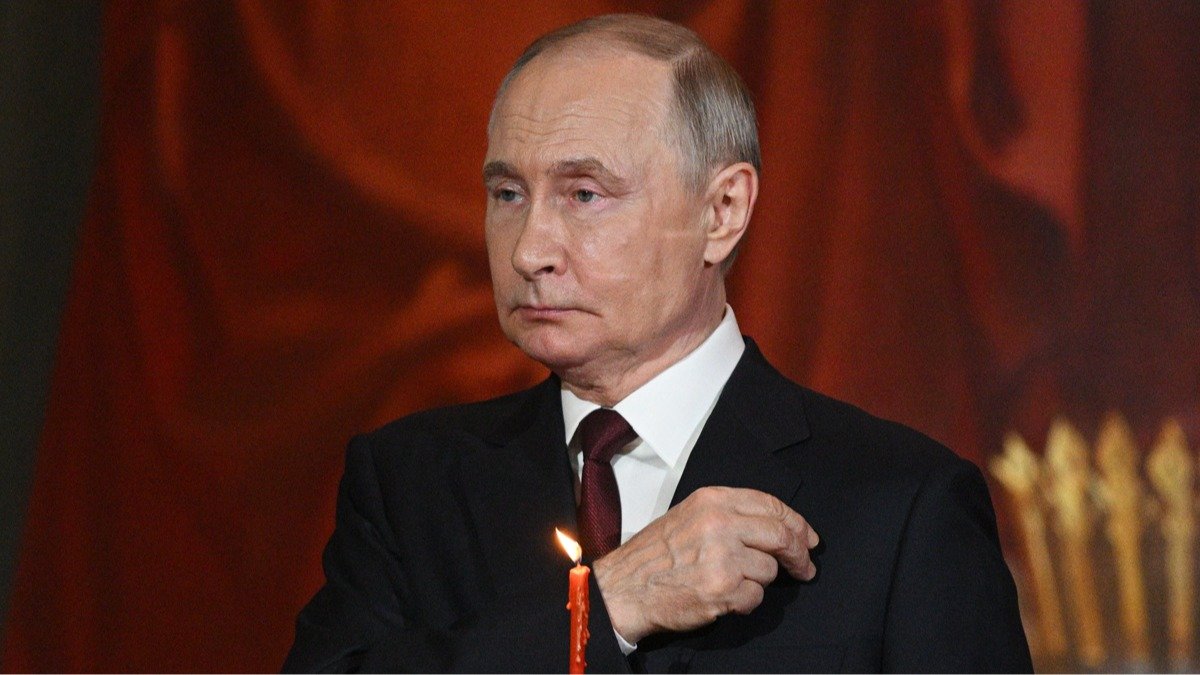
Vladimir Putin at the festive Easter service in the Cathedral of Christ the Saviour in Moscow, April 20, 2025. Photo: Ramil Sitdikov / Sputnik / Kremlin / EPA. After the Kremlin effectively rejected Ukraine's initiative for an Easter ceasefire, Vladimir Putin himself announced such a ceasefire on the evening of April 9 for the period from 4 p.m. on April 11 until "the end of the day" (exact time not specified) on April 12. The approximately 30-hour ceasefire is tied to the church calendar: at 4 p.m. on Holy Saturday, April 11, the traditional broadcast of the "descent of the Holy Fire" in the Church of the Holy Sepulchre in Jerusalem ends, and April 12 is Easter itself, the main Christian holiday, which usually sees peak church attendance. This year, Catholics celebrated Easter a week earlier, on April 5, but despite the fact that the official Orthodox Church of Ukraine (OCU) switched to the new calendar style and began, for example, to celebrate Christmas on December 25, the formula for calculating the date of Easter in the OCU remained the same and does not differ from the Russian one. " Usually, the main Easter service - the bright matins - begins at midnight, but under martial law and curfew, it will be held early in the morning in most Ukrainian churches. In Russian churches of the ROC, it is still held at night, so under a ceasefire, their parishioners will feel calmer, and Putin may decide to visit the Cathedral of Christ the Saviour. (This is his long-standing tradition, but during the "NWO" for security reasons, Putin spends little time at the Easter service.) However, the Kremlin, when announcing the ceasefire, made it clear that it would cease in case of "provocations" or "any aggressive actions" from the enemy. The Russian leadership also proceeds from the fact "that the Ukrainian side will follow the example of the Russian Federation." But it is more accurate to say that the Ukrainian side will simply have the opportunity to fulfill its intention to stop hostilities on Easter, which Volodymyr Zelensky announced back on March 30, later securing the support of the Ecumenical Patriarch Bartholomew. Initially, Moscow perceived the Ukrainian initiative with hostility, accusing Zelensky of "unclear wording." Peskov repeated the old mantra: a stable peace (on Russian terms) is needed, not a ceasefire. Propaganda also actively explained why, in the conditions of the supposedly beginning large-scale offensive of the Armed Forces of the Russian Federation, an Easter ceasefire is a "trap." Against this informational background, Putin's decision sounded somewhat unexpected. "People need Easter without threats and real movement towards peace," the President of Ukraine wrote in response, "and Russia has a chance not to return to strikes after Easter." This is not the first experience of an Easter ceasefire between Russia and Ukraine: last year it lasted for 30 hours on April 19-20. True, the parties endlessly accused each other of provocations and violations of the ceasefire. For example, the President of Ukraine, citing the General Staff of the Armed Forces of Ukraine, reported 2935 cases of violation of the ceasefire regime by the Armed Forces of the Russian Federation. One of the paradoxes of the current war, which has become the most brutal of the 21st century, is that a significant part of the combatants on both sides identify with the same Orthodox tradition. Moreover, in February 2022, the absolute majority of Orthodox parishes in Ukraine were under the canonical jurisdiction of the Moscow Patriarchate, i.e., they were the flock of Patriarch Kirill (Gundyaev). He effectively renounced this flock in the first days of the "NWO" and has refrained from praying for Ukraine or simply expressing sympathy for the destruction of Ukrainian churches or the deaths of clergy and laity from missile and drone strikes for over four years. At the same time, Kirill instantly reacts to Ukrainian strikes on Russian military-industrial complex facilities, readily calling them "terrorist" and expressing condolences for the deaths of Russian citizens. This practice sends a "philosophical" signal to the world: Ukrainians, even if they call themselves Orthodox, are not people in the same sense as Russians are. In his efforts to justify aggression, the patriarch goes beyond official Russian propaganda, refusing to question the goals and methods of waging this war, giving it a sacred and mystical character. It is Kirill who owns the dubious concept of the "Russian world" as a divine force intended to hold back world evil, including by force of arms, wherever the great leader of the "Russian world" deems it possible. The head of the ROC mercilessly punishes even those clergy who dared to replace the word "victory" with the word "peace" in a special prayer dedicated to the "NWO" by stripping them of their rank and excommunicating them from the church. In 2022, Kirill ignored the initiative for an Easter ceasefire put forward by Pope Francis and has not maintained direct contact with the Holy See since then. Francis's view on issues of war and peace coincided with the repressed priests: "We are preparing to celebrate the victory of the Lord Jesus Christ over sin and death - over sin and death, not over someone and against someone. Today the war continues, because people want to win in this way, worldly; but in this way, one can only lose." The current Pope Leo XIV expresses himself more diplomatically, but no less unequivocally. In this year's Easter message, condemning the war, he exclaimed: "We cannot continue to be indifferent! And we cannot resign ourselves to evil!" The political position taken by the leadership of the ROC after the start of full-scale hostilities in Ukraine has many paradoxical manifestations. On the eve of this Easter, April 10, the Synodal Department for Relations between the Church and Society and the Media issued an unexpected statement against... Easter religious processions. Not those that are held as part of the liturgical charter around churches before the start of Easter matins. But "grassroots," popular ones, "organized by unidentified persons." This year, announcements of such processions, also called "Procession of Faith, Steps of Freedom," have turned into a flash mob that has swept the entire country - from Moscow to Vladivostok. According to the official version, it is a "provocation by foreign special services," but according to the unofficial version, it is a search for new forms of protest in conditions where protesting is prohibited. In anonymous announcements posted on social networks (the administration of "VKontakte" has already removed them), believers were invited to glorify the resurrected Christ on the streets of their cities, while also stating the inadmissibility of restricting freedom of speech through Internet blocking. The hint is that the news of the Resurrection would not have spread throughout the land if the authorities of the pagan Roman Empire or the atheist USSR had the opportunity to block information dissemination as effectively as the Russian authorities. But, despite all the bans, Easter in Russia is becoming politicized - including, through the efforts of Patriarch Kirill himself. Many believers have not yet recovered from the shock of his Easter sermon last year, in which the head of the ROC reduced Christ's Resurrection to Victory Day. It will be natural and justified if, in such conditions, living religious feeling in Russia begins to merge with protest sentiments, because true Christianity is a religion of freedom. "For freedom you have been called, brothers," wrote the Apostle Paul (Gal. 5:13). Patriarch Kirill during a service in the Cathedral of Christ the Saviour, Moscow, April 20, 2025. Photo: Oleg Varov / Press Service of the Patriarch of Moscow and All Rus'.The words "Peace be with you" were the first that Christ spoke upon coming to his disciples after the Resurrection (Matt. 20:26). Therefore, from ancient times, in the Christian tradition, Easter was perceived as a holiday of peace, during which it was necessary to cease military actions. The Easter truce is an ancient tradition that was observed even in the dark medieval times and even in the secular 20th century. As "Novaya Gazeta Europe" reported, in the Catholic Church, the concept of "Truce of God" (Treuga Dei) in honor of Christ's Resurrection was established by the Council of Toulouse in 1027, and at the end of the 11th century, Pope Urban II issued a bull excommunicating Christians who continued to fight other Christians during major holidays and fasts. In the Orthodox tradition, the participation of believers in war is "in theory" unequivocally condemned: it is completely forbidden for clergy and monks, and for laypeople it leads to a three-year excommunication from communion and church fellowship as a whole (rule 13 of Basil the Great). " The current "Social Concept" of the ROC, written in the late 1990s under the strong influence of the social teaching of the Catholic Church, introduces a differentiation between "just" (defensive) and "unjust" (aggressive) wars. However, it stipulates that in any case, "war is evil." It is difficult not to recall a touching episode from the history of World War I, when in 1916 Easter coincided for Russians (Orthodox) and Austrians (Catholics). According to the memoirs of General Vasily Cheslavsky, who commanded the Ingermanland Regiment, the initiative came from the Austrians and Germans, who delivered a dispatch through intermediaries to the regiment's headquarters with the following content: "We are Christians - just like you. On such holy days for Christians, let us not kill each other." "On the first day of Easter," the general recalled, "a group of Austrians came out of the enemy trenches, carrying bottles instead of weapons. Noticing this, the Cossacks took Easter bread, sausages, and lard and went to meet the enemy, where a joint breaking of the fast took place." It is completely impossible to imagine something like this in the modern Armed Forces of the Russian Federation. And this is a convincing answer to all the arguments of the apologists of the "holy war."
TL;DR
- Russia's President Putin announced a 30-hour Easter ceasefire, from April 11-12, after initially appearing to dismiss Ukraine's similar initiative.
- The ceasefire aligns with the timing of Orthodox Easter celebrations and the traditional 'descent of the Holy Fire'.
- The article highlights the Orthodox Church of Ukraine's (OCU) adherence to the traditional Easter calculation, despite adopting a new calendar for other holidays.
- It discusses Patriarch Kirill's controversial stance, his perceived distancing from Ukrainian parishioners, and his justification of the war, contrasting it with Pope Francis's views.
- The text also touches upon unexpected statements from the Russian Orthodox Church discouraging public Easter processions and the historical significance of Easter truces.
- A historical anecdote from WWI illustrates a past instance of shared breaking of fast between opposing soldiers on Easter.
Continue reading the original article