April 13, 2026
Easter ceasefire met with shelling. Russia and Ukraine accused each other of violating agreements, but the intensity of fighting did decrease.
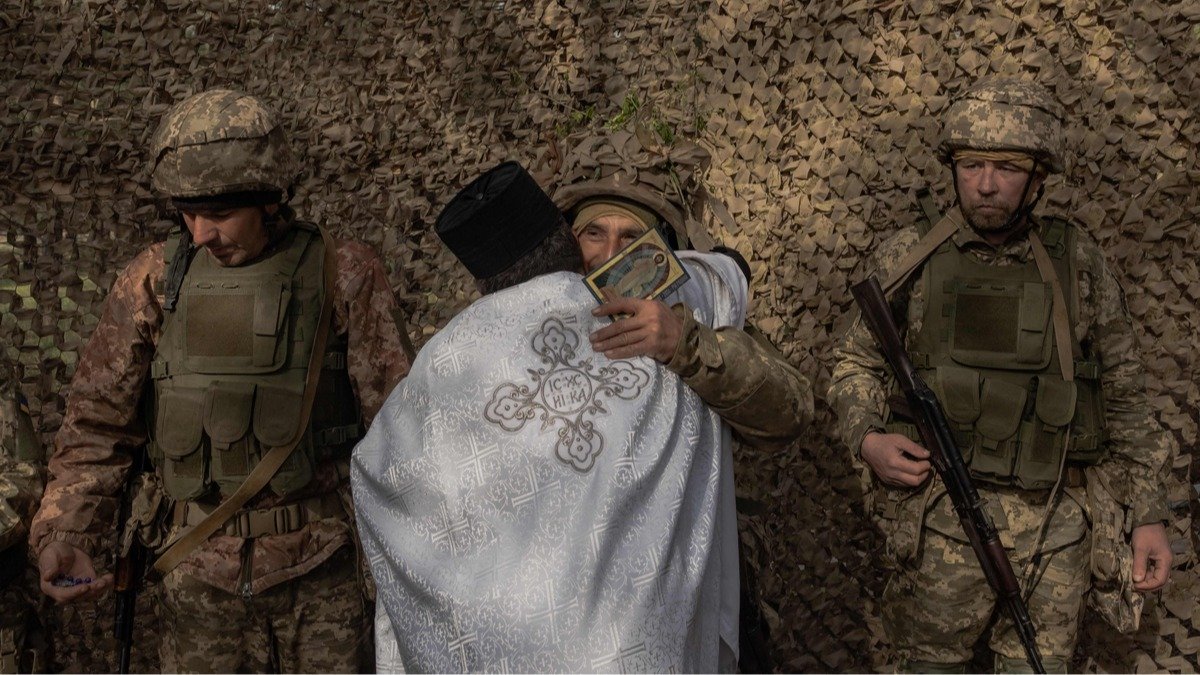
The Easter ceasefire has ended. The ceasefire, announced by Vladimir Putin following several similar calls from Volodymyr Zelensky, was supposed to be in effect from 4:00 PM on April 11 to midnight on April 12. In reality, there was no ceasefire on the front lines: shelling, drone attacks, and assaults continued, as noted by experts interviewed by 'Novaya-Europe.' However, according to them, rear cities in Ukraine received a respite, with almost no missile or long-range strikes. 'Novaya-Europe' reports on the outcomes of the Easter ceasefire. A priest and Ukrainian Armed Forces servicemen during an Easter prayer service in the Kharkiv region, Ukraine, April 12, 2026. Photo: Roman Pilipey / AFP / Scanpix / LETA. Both Ukraine and Russia accused each other of violating the agreements throughout the Easter ceasefire. On the morning of April 13, the General Staff of the Armed Forces of Ukraine stated that Russia had violated the ceasefire 10,721 times, while the Russian Ministry of Defense claimed Ukraine had done so 1,971 times. Each side asserts that it strictly adhered to the ceasefire and only repelled attacks. As 'Novaya-Europe' reported, the same situation occurred during last year's Easter ceasefire. Attacks on Ukrainian territories According to the General Staff of the Armed Forces of Ukraine, Russian forces attacked Ukrainian positions and shelled the country's territories with drones and aerial bombs during the 'Easter ceasefire.' The department acknowledges that no long-range missile or aerial strikes, nor attacks by Shahed-type kamikaze drones, were recorded. However, according to the Armed Forces of Ukraine, the Russian army carried out massive artillery shelling, assault actions, and attacks with other types of drones. For instance, in the border areas of the Sumy region, according to local authorities, drone attacks were recorded for almost three consecutive days. Late on April 11, during the Easter ceasefire, a drone struck an ambulance in the Hluche community, injuring three medics (aged 25, 52, and 56). Two residents of the Donetsk region died, and another was wounded by Russian shelling on April 12, despite a decrease in the intensity of shelling, reported the head of the Donetsk Regional Military Administration, Vadym Filashkin. The Kharkiv Regional Prosecutor's Office reported that on the morning of April 12, despite the Easter ceasefire, the village of Zolochiv was attacked by drones four times, injuring two civilians. In the afternoon, a car evacuating people from a dangerous area was hit by a drone in the village of Lyutivka, wounding a 70-year-old man. Additionally, according to the Joint Forces Operation of the Armed Forces of Ukraine, on the evening of April 11, Russian forces shot four prisoners of war near the village of Vetryane in the Kharkiv direction. This information is corroborated by the OSINT project DeepState. The Ukrainian Prosecutor General's Office has launched an investigation. In the Zaporizhzhia region, two villages were hit on April 11, according to the police. In Novoaleksandrivka, a drone attack targeted police officers, wounding 10 people. In Maryanivka, a guided aerial bomb was dropped, injuring an elderly woman. Attacks on Russian territories The Russian Ministry of Defense accuses Ukraine of attacking Russian positions in occupied territories (Donetsk, Zaporizhzhia, and Kherson regions), as well as drone strikes on the Kursk and Belgorod regions and shelling of border areas. According to the governor of the Kursk region, Alexander Khinshtein, a drone attacked a gas station in the city of Lgov on April 11 after 4:00 PM, during the announced 'Easter ceasefire.' Three people, including a one-year-old child, were injured and taken to the hospital. Three cars were damaged at the scene. According to the governor of the Belgorod region, Vyacheslav Gladkov, on April 12, during the announced 'Easter ceasefire,' a drone attacked a passenger car on the road between the villages of Yasnye Zori and Oktyabrsky. A man was injured, suffering blast trauma and shrapnel wounds to the chest. After receiving medical attention, he was released for outpatient treatment. Firefighters at the site of building damage after a Russian drone attack on the village of Zolochiv, Kharkiv region, Ukraine, April 12, 2026. Photo: Kharkiv Regional Prosecutor's Office. Experts: Fighting did not stop on most of the front line A full ceasefire did not occur, concluded military-political observer for the 'Information Resistance' group, Oleksandr Kovalenko, in a conversation with 'Novaya-Europe.' Nevertheless, he stated that 'a ceasefire took place in certain areas.' Moreover, according to the expert, the Russian side used the ceasefire period to remove the bodies of fallen soldiers, strengthen recently occupied positions, conduct engineering work, bring personnel to the front line, and conduct reconnaissance. The expert added that replenishment of Russian army units was observed along the entire front line, and Ukraine did not impede these activities. Military expert and retired Ukrainian Armed Forces Colonel Roman Svitan also stated in a conversation with 'Novaya-Europe' that 'the ceasefire was necessary for Russia to rotate units and deliver equipment and ammunition to the front line.' According to Kovalenko's assessment, combat clashes did not cease on most of the front line. During the ceasefire, the expert claims, the Russian army used over 9,000 drones to attack Ukrainian Armed Forces positions. 'The Lancet, Molniya-2, and Italmaz UAVs were most frequently used,' the observer specified. He also reported that Russians carried out 119 assault actions, which is below the average (typically up to 150 assault attempts per day). Svitan agreed with Kovalenko, stating that 'there was effectively no ceasefire on the front line.' According to him, the Russian army used artillery, small arms, and drone attacks. The expert noted, however, that Ukraine's rear areas could rest, with virtually no shelling of civilian cities. However, immediately after the ceasefire ended, during the night, the intensity of attacks began to pick up again. Damaged passenger car in Lgov, Kursk region, April 11, 2026. Photo: Alexander Khinshtein / Telegram. Refusal to extend the ceasefire Zelensky proposed extending the ceasefire after April 12. 'Ukraine has repeatedly proposed this. And it would be good if it really worked. Easter should be a time of security, a time of peace. It would be right for the ceasefire to continue,' the Ukrainian president stated in a video address on the evening of April 11. According to him, if Russia decides to resume hostilities after Easter, 'it will once again demonstrate to the whole world and the United States who and what truly wants.' The war after the Easter ceasefire will continue 'until Zelensky can find the courage to make peace with Russia,' stated Kremlin spokesman Dmitry Peskov the previous day. According to him, Russia wants 'sustainable peace' and is ready for it 'today,' but it can only come 'when we ensure our interests.' As Kovalenko noted in his conversation with 'Novaya-Europe,' Russia had no plans to extend the Easter ceasefire for a longer period. He added that it was good that residents of rear areas of Ukraine felt the ceasefire because there were no drone raids or missile attacks. However, cities close to the front line hardly felt it, the interviewee noted. 'I can only call this ceasefire a slight reduction in combat activity and a simulation of peace on the Russian side,' Kovalenko concluded. A Ukrainian Armed Forces serviceman carries a box of Easter cakes and food after a holiday service in the Kharkiv region, Ukraine, April 12, 2026. Photo: Roman Pilipey / AFP / Scanpix / LETA. Shelling continues on the morning of April 13 Immediately after the ceasefire ended, Kovalenko observed, combat operations fully resumed. According to him, there were MLRS shelling and drone attacks, artillery and aviation were used, and Russia also bombed Ukrainian Armed Forces positions with glide bombs. The Air Force of the Armed Forces of Ukraine reported that since midnight, Russia launched 98 attack UAVs of various types, with 87 being shot down. Also, according to the prosecutor's office, two women were hospitalized due to airstrikes in the Kharkiv region. Furthermore, as stated by the Ministry of Internal Affairs of Ukraine, the Russian army attacked a residential building in Kramatorsk, from under the rubble of which rescuers recovered the body of a deceased woman. According to Ukrainian authorities, the Kherson, Kirovohrad, Dnipropetrovsk, and Chernihiv regions of Ukraine were attacked. The Russian Ministry of Defense announced that since midnight, it had shot down 33 Ukrainian fixed-wing drones over the Belgorod, Kursk, Rostov, Bryansk, and Smolensk regions, and Crimea. The number launched was not specified.
TL;DR
- The Easter ceasefire, announced by Russia and called for by Ukraine, was largely ineffective on the front lines, with both sides accusing each other of violations.
- While long-range missile and drone attacks on Ukrainian rear cities decreased, fighting, including shelling and drone attacks, continued in front-line areas.
- Experts believe Russia used the ceasefire period for troop rotations, resupply, and reconnaissance, while Ukraine did not impede these activities.
- Both Ukrainian and Russian authorities reported casualties and damage due to enemy actions during the ceasefire period.
- Ukraine proposed extending the ceasefire, but Russia indicated it was not interested in a longer truce, with hostilities resuming immediately after April 12.
Continue reading the original article