April 14, 2026
“The task is to return the country to the EU's course.” What does Magyar's victory over Orbán mean for Hungary? How will relations with Russia and Ukraine change? Expert Szanja Tepavčević explains
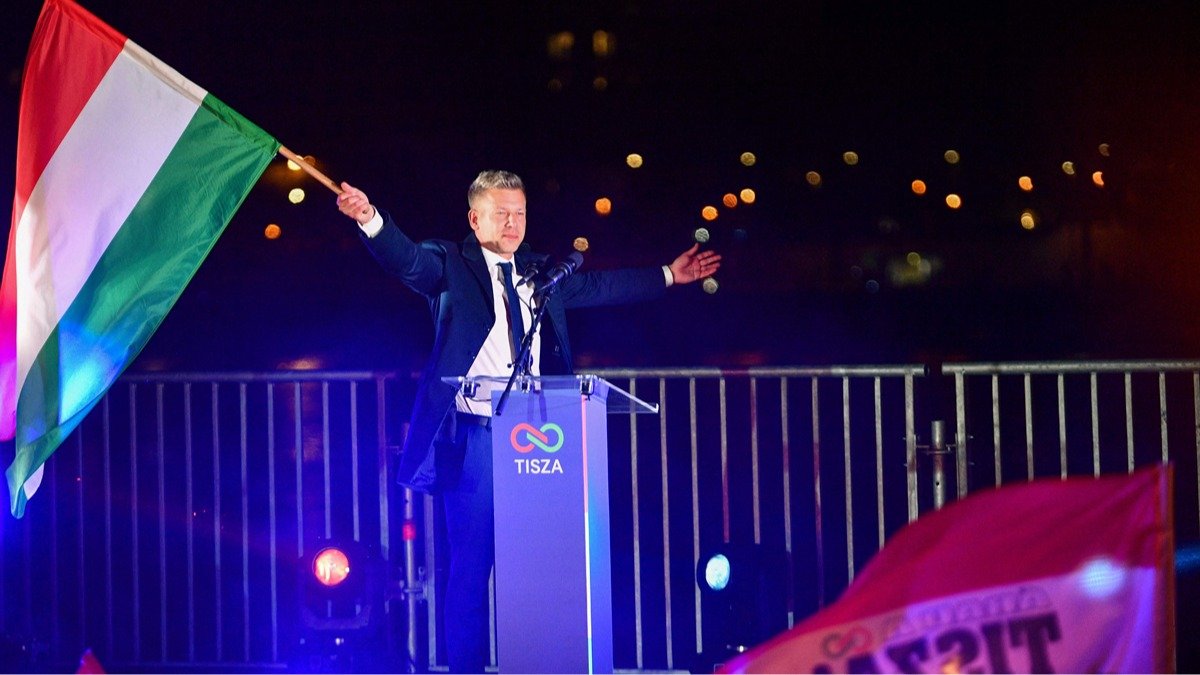
The opposition party TISSA, led by Péter Magyar, has won the parliamentary elections in Hungary. The ruling Fidesz party, led by Viktor Orbán, has lost its majority and admitted defeat. Magyar has already announced his intention to adjust the country's foreign policy, including relations with the EU, Ukraine, and Russia. "New Europe" spoke with international relations expert Szanja Tepavčević about whether this marks the end of the Orbán era, whether the election result was a protest vote, and what changes to expect in Hungary's domestic and foreign policy. Leader of the TISSA party, Péter Magyar, celebrates victory in the parliamentary elections, Budapest, Hungary, April 12, 2026. Photo: Ferenc Isza / AFP / Scanpix / LETA. Can we talk about the end of the Orbán era? Szanja Tepavčević. expert in international relations "Given that TISSA received so many votes that the party will have as many as 138 seats in parliament, this is indeed a majority. Before that, Fidesz held 135 seats, even fewer than TISSA has now won. This is a huge victory, a huge change. And it truly signifies some kind of end to Viktor Orbán's era. But this does not mean he will disappear from Hungary's political scene altogether – he will remain in opposition along with his coalition partner, with whom he has always run in elections: the Christian Democratic People's Party. They have always been coalition partners and remain so. Accordingly, together they will hold 55 seats." Can you imagine the difference: from 135 seats to only 55. This is truly a major defeat for Orbán. But he is a very influential person and has created a system that not only supports him but also largely runs on its own. How successfully Péter Magyar will be able to change, straighten out, and renew all of this remains to be seen. It will not be easy, especially concerning the judicial system, as Orbán has subjugated it to himself over the years. Furthermore, there are virtually no independent media left in Hungary – many were bought by Orbán's circle. An interesting fact: in all the time since Péter Magyar left Fidesz for the opposition, he has never appeared in any state media. He was never invited, he never spoke anywhere. And this makes his victory even more significant: he achieved it through a rather difficult path. The gap between Orbán and Magyar in the nationwide lists is not as large as in the single-member constituencies between Fidesz and TISSA. How did this happen, and is it related to dissatisfaction with local corruption? Both are absolutely inseparable, they are interconnected. In principle, Hungary has one city with over a million inhabitants – Budapest, and the next largest city has 200,000 people, then smaller and smaller. In principle, all relatively large cities have traditionally voted against Fidesz in the last three elections, including the one held on April 12, because they feel and have always felt the negative consequences of the government's power. Small towns have also not felt good, but at least until now they were quite forgotten. And when Fidesz placed its people there, and these people won, some money started coming in, and the economy began to develop. Given that the main money naturally came from European funds, it turns out that along with Fidesz and European funds, some of these places, of course, benefited for a time. But they too have lost more than they have gained in the last four years. And precisely four years ago, in the previous elections, it was expected that Fidesz would lose in Budapest. After the elections, the atmosphere there was quite gloomy, while in the provinces everyone celebrated, everyone was very happy. And this difference was felt very strongly and clearly. Participants of the TISSA party's National March on Heroes' Square in Budapest, Hungary, March 15, 2026. Image taken from a drone. Photo: Zoltan Mathe / EPA / Scanpix / LETA. Is Magyar's victory more of a protest against Orbán or a genuine demand for a change of course? Exactly the latter. Why? Because, as I've already said and as is probably known to everyone, Péter Magyar is not an ideological opponent of Orbán. In what does he oppose him? He opposes him precisely because this structure and regime have become too corrupt, too authoritarian. They started to act against the European Union, as if the European Union had specifically come and occupied them, as if the people themselves had not decided. And this is all part of Orbán's paradigm, all this behavior, all this policy, especially foreign policy, looked like this. And, consequently, few people liked it. But overall, Hungary is not a liberal society; the country is far from it. And, unfortunately, there is no demand for a strong liberal political structure. I can note that there is practically none left in parliament now. There will be no liberal party in the new parliament, let alone anyone to the left. And, in principle, the position from which Péter Magyar and the TISSA party are now proceeding is approximately the same position as Fidesz was in 2010. That is, as you understand, he is not an ideological opponent, if you look at the root of the matter. " Viktor Orbán and Fidesz have simply moved very far to the right, into populism, very far from the values on which the European Union is based. And Magyar's task is to return this to some normal, acceptable course for the European Union and, in principle, for Hungary and Hungarians. The problem is also that no one before him could create such a movement to form a really strong opposition or even a coalition against Fidesz. And he succeeded precisely because he was an insider. Precisely because he was in Fidesz for many years, knew this structure from the inside, could show its underbelly, and was able to leave it and become its opponent. What happened in Hungary 2.5 years ago was a rupture within the elite itself. This is something we all watched for a long time: whether this would happen in Russia. That is, we thought: perhaps Prigozhin would become such a factor, or Chubais, or someone else. But it's already too strong a totalitarian regime for something like that to just happen. But here, the regime was hybrid: yes, it was already authoritarian, but not completely closed. The system was still relatively young; it could be somehow destroyed, somehow changed from within. That's essentially what happened. And this was a lesson that Magyar learned from his predecessor – it was Péter Márki-Zay. He was also a conservative politician – Orbán's main opponent in the 2022 parliamentary elections. The movement started from this, but Márki-Zay failed to create the coalition and movement that Magyar has now created. But he helped him, advised him on how to avoid mistakes. Péter Márki-Zay at a pre-election rally in Budapest, Hungary, April 2, 2022. Photo: Szilard Koszticsak / EPA. How will Hungary's relations with the EU change? Regarding Hungary's foreign policy, it's important to see what Magyar's first foreign trip will be. Péter Magyar already has three trips planned. The first is to Poland. This is symbolic because Poland went through a very similar situation. There were huge problems with the Law and Justice party there too. For Poland, Law and Justice is like Fidesz for Hungary: a conservative far-right party. And, consequently, that changed in the last elections, and Donald Tusk returned. The next trip will be to Austria, a neighboring country, where conservatives are also in power. And only the third trip will be to Brussels, where, consequently, further negotiations and discussions will take place. What can be said for sure is that Hungary's foreign policy will not be anti-European. In the European Union, politicians are generally divided into two groups: federalists, who want greater integration and to see a "United States of Europe" someday, and intergovernmentalists, who see it as a union of states. Both Orbán and Magyar belong to the second bloc. And within this bloc, there are further distinctions: Eurosceptics and those who allow for more integration and cooperation. Péter Magyar belongs more to the moderate Eurosceptics. Therefore, we can expect a softening of Hungary's foreign policy towards greater cooperation with European institutions, with the EU as a whole, and with EU countries – more than has been the case so far. And there will be less close cooperation with third countries. But we cannot expect it to be a completely opposite policy to the one pursued by Viktor Orbán, especially in the last 10 years. Magyar speaks of "pragmatic contacts" with Russia and gradual reduction of dependence. How realistic is this and what might it look like? The European Union is very dependent on energy resources; it does not have its own energy sources and must import them from other countries for its economy to function. In particular, the EU has an energy dependence on Russia. Reducing this dependence is a long-term process. It began around the mid-2000s, with the idea emerging around 2005. Then there was market liberalization, and energy prices changed in 2010-2011. In addition, there is infrastructural dependence. In this regard, Hungary and Slovakia lag behind the rest of the European Union precisely because this infrastructure was built during Soviet times, especially for oil. " All capacities in Hungary and Slovakia are designed precisely for the oil they import from Russia. That is why there is so much noise and so many problems around the "Druzhba" pipeline. And Magyar sees that this will need to change. Of course, it will take time, and during this time, some pragmatic relations with Russia will need to be maintained because the oil flow comes from there. And Hungary will have to continue to receive this Russian oil for some time, process it, and sell it further. At the same time, his victory may signify the end of the unwillingness to move away from this, at least gradually, but clearly not the end of the process itself. Péter Magyar during a press conference in Budapest, Hungary, April 13, 2026. Photo: Tibor Illyes / EPA. How, in your opinion, will Budapest's policy towards Ukraine change? 90 billion euros in loans to Ukraine from the European Union were blocked precisely because of Hungary's veto. And this raises the question: why is this happening, why is Viktor Orbán constantly blocking it? On the one hand, because the European Union has imposed sanctions on Hungary – on the receipt of European funds, money, and so on. And to a large extent, the economic situation in Hungary, which has worsened, especially in the last two years, turning into a kind of recession, is precisely due to this. And this, naturally, also played a role in Orbán's election defeat. He constantly tried to get access to these funds, but, partly due to corruption, he did not succeed. And primarily because the rule of law was violated: control over courts, control over media, usurpation of autonomy from higher education institutions, academies. And because of all this, sanctions were imposed, and Hungary has not received aid for some time because the rule of law has been repeatedly violated in various forms. And now what should happen: since they lost the elections, a person has come who is not corrupt, who guarantees compliance with the rule of law. And, consequently, when this is done, at least formally, then this package will be unblocked, and the EU will no longer hold everything hostage because of the loan to Ukraine. Everyone naturally hopes that this will happen quickly. After his victory, Péter Magyar announced that he would not obstruct the provision of a 90 billion euro loan from the European Union to Ukraine. Previously, such a loan was blocked by Orbán. Magyar also clarified that the country would not participate in financing this loan, allowing the EU to approve it without Hungary's contribution. However, one should not expect relations between Ukraine and Hungary to improve significantly. Similarly, one should not expect that under Prime Minister Magyar, Hungary will start participating in loans or somehow financially assist Ukraine – this will not change radically from the EU's side either. It would be too naive to expect this, and it is not part of Péter Magyar's plan. I hope that relations with Ukraine will become more diplomatic, more normal, not in a "thug" style as they have been until now.
TL;DR
- Péter Magyar's TISSA party has won the Hungarian parliamentary elections, unseating Viktor Orbán's Fidesz party.
- The election results indicate a significant shift, potentially marking the end of the Orbán era in Hungarian politics.
- Magyar intends to revise Hungary's foreign policy, particularly concerning the EU, Russia, and Ukraine.
- The victory is seen not just as a protest vote but as a genuine demand for a change in course, addressing corruption and authoritarianism.
- Hungary's relations with the EU are expected to soften, with a move towards greater cooperation, though Hungary will remain within the intergovernmentalist bloc.
- The approach to Russia will involve pragmatic engagement and a gradual reduction of energy dependence, influenced by existing infrastructure.
- Hungary is expected to unblock EU aid to Ukraine, though direct financial support from Hungary to Ukraine is unlikely.
- The political landscape has changed dramatically, with Fidesz's seats drastically reduced, while TISSA gains a parliamentary majority.
Continue reading the original article