government
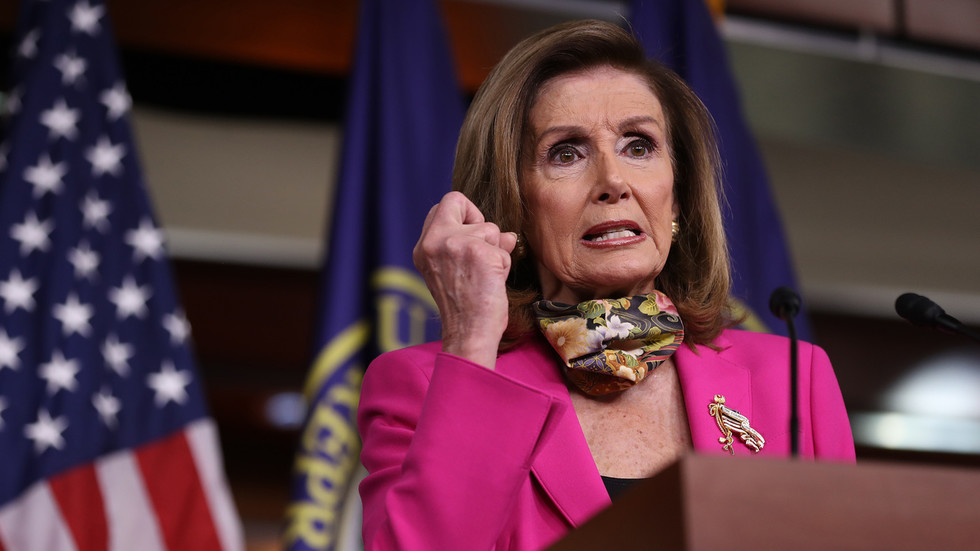
Pelosi scolding Democrats over push to hold Clintons in contempt in Epstein case
Nancy Pelosi has rebuked Democrats over supporting a vote to hold the Clintons in contempt over refusal to testify on the Epstein probe
4 months ago
The House Oversight Committee has voted to advance resolutions to hold former President Bill Clinton and former Secretary of State Hillary Clinton in contempt of Congress in connection with its ongoing investigation into Jeffrey Epstein and his network. Coverage from both government-aligned and opposition-leaning outlets agrees that the committee’s action is tied to subpoenas seeking testimony and documents from the Clintons, that the Clintons did not comply as demanded, and that the committee’s stated rationale is that no one is above the law in a congressional inquiry. Both sides also report that Democratic figures, including former House Speaker Nancy Pelosi, have weighed in on the timing and wisdom of the contempt move, and that the probe is framed around Epstein’s ties to numerous high-profile individuals across party lines.
Across the spectrum, outlets broadly concur that the contempt effort is occurring against the backdrop of longstanding scrutiny of Epstein’s relationships with political, business, and social elites, and amid public pressure for fuller disclosure of official investigative files. They also agree that institutional processes are central: the role of House committees in oversight, the Justice Department’s control over investigative records, and the legal significance of negotiations over compliance with subpoenas. Reporting on both sides acknowledges that prior contempt fights involving Trump allies and other high-profile witnesses serve as a reference point for how Congress uses this tool and how it may shape future reforms or standards for cooperation in politically sensitive probes.
Motives for the contempt vote. Government-aligned coverage tends to present the committee’s move as a principled assertion of congressional oversight authority, emphasizing the formal subpoena process and the claim that no individual should receive special treatment. Opposition coverage is more likely to cast the vote as politically motivated, suggesting it is designed to score partisan points or to deflect from other controversies rather than to genuinely illuminate Epstein’s network. While both acknowledge the same procedural steps, they diverge sharply on whether the primary driver is rule-of-law consistency or partisan theater.
The Clintons’ level of cooperation. Government-aligned sources highlight the committee’s view that the Clintons have failed to adequately comply, stressing missed deadlines or perceived gaps in testimony and records. They report Pelosi’s argument about ongoing negotiations but frame it as secondary to the need for firm enforcement of subpoenas. Opposition outlets tend to foreground the Clintons’ assertion that they have already provided relevant information and that the subpoenas are overbroad or invalid, portraying the contempt threat as punitive despite partial or good-faith cooperation.
Comparisons to Trump-era contempt fights. Government-aligned reporting often echoes Pelosi’s rejection of direct equivalence with past contempt cases involving Trump allies, suggesting that each case has distinct legal and factual contours. These outlets may frame the current dispute as narrower and more process-focused than prior standoffs tied to active executive-branch privilege claims. Opposition coverage, by contrast, emphasizes parallels, arguing that Republicans who resisted or minimized contempt against Trump associates are now weaponizing the same tool against political opponents, and using that contrast to question the majority’s consistency.
Significance of the Epstein angle. Government-aligned accounts emphasize Epstein as a legitimate focus of bipartisan concern and depict the Clintons’ association with him as a necessary line of inquiry among many involving powerful figures. They tend to stress that the committee is pursuing information wherever it leads, with the Clintons being one part of a broader effort to clarify Epstein’s networks and any institutional failures. Opposition outlets are likelier to argue that Republicans are selectively spotlighting the Clintons’ ties while downplaying other figures, including those closer to their own party, and thus treating the Epstein scandal as a vehicle for reviving old narratives about the Clintons rather than as an even-handed investigation.
In summary, government coverage tends to frame the contempt vote as a rules-based, process-oriented step to enforce congressional oversight in a high-profile investigation, while opposition coverage tends to portray it as a selectively applied, politically driven escalation that exploits the Epstein scandal to target the Clintons.