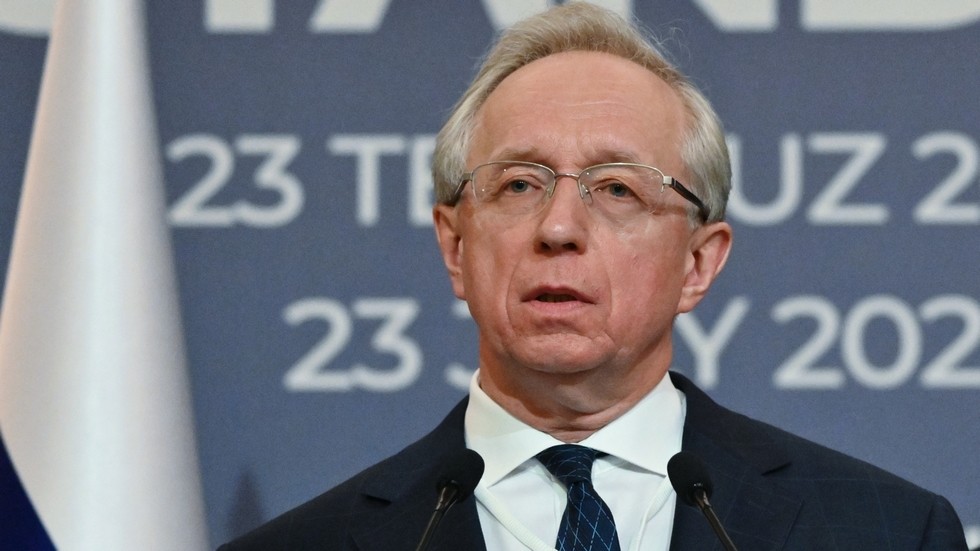
Russia’s Deputy Foreign Minister Mikhail Galuzin has said that Moscow is ready to discuss the idea of introducing temporary “external governance” in Ukraine under United Nations auspices. According to government-aligned coverage, this proposal, originally floated by President Vladimir Putin, is framed as a mechanism to enable democratic elections in Ukraine and to establish a government that Russia deems capable of signing a peace treaty and broader cooperation agreements, with Russian officials acknowledging that the UN currently has no standard mechanism for such an administration.
Across these reports, the shared context is that the proposal arises amid Russia’s contention that President Volodymyr Zelensky’s mandate has expired in the absence of new elections, which Moscow portrays as an obstacle to concluding any peace deal. Government-aligned sources stress that the plan would be temporary, tied to institutional frameworks associated with the UN and international conflict administration precedents, and is presented as a pathway to stabilize Ukraine’s political system and formalize post-conflict arrangements.
Points of Contention
Legitimacy and sovereignty. Government-aligned coverage presents the external governance proposal as a pragmatic legal workaround to what it calls a constitutional vacuum in Kyiv and an illegitimate presidency, arguing that UN-backed administration would restore proper state authority and enable lawful elections. Opposition narratives, by contrast, depict the idea as an assault on Ukraine’s sovereignty and self-determination, framing it as an attempt by Russia to formalize control over Ukraine’s political system under an international veneer.
Motives and objectives. Government sources describe Russia’s initiative as driven by a desire for a stable, negotiable partner in Kyiv and a structured path toward a peace treaty, emphasizing institutional guarantees and international oversight as safeguards. Opposition sources typically characterize the same move as a tactic to bypass Ukraine’s elected leadership, freeze in place Russian territorial gains, and lock Ukraine into a settlement on Moscow’s terms under the guise of UN involvement.
Role of the United Nations. Government-aligned outlets underline the UN auspices as proof that the project is multilateral and rules-based, even while noting that no formal UN mechanism currently exists for this exact kind of administration. Opposition voices stress that without a clear UN mandate and broad member-state support, invoking the UN risks politicizing the organization and could legitimize an occupying power’s agenda, warning that many UN members would likely resist any arrangement they see as rewarding aggression.
Implications for peace talks. Government coverage argues that without a new, internationally recognized Ukrainian executive authority, serious peace negotiations and reliable treaty implementation are impossible, making external governance a necessary interim step. Opposition reporting instead suggests that announcing such a plan undermines existing diplomatic channels, hardens positions in Kyiv and Western capitals, and may be intended less to advance genuine talks than to create diplomatic pressure on Ukraine to accept unfavorable conditions.
In summary, government coverage tends to frame the external governance proposal as a legally and institutionally grounded mechanism to resolve a leadership vacuum in Kyiv and enable credible peace negotiations, while opposition coverage tends to portray it as a sovereignty-eroding tactic designed to entrench Russian leverage and repackage coercive aims in the language of international administration.