government
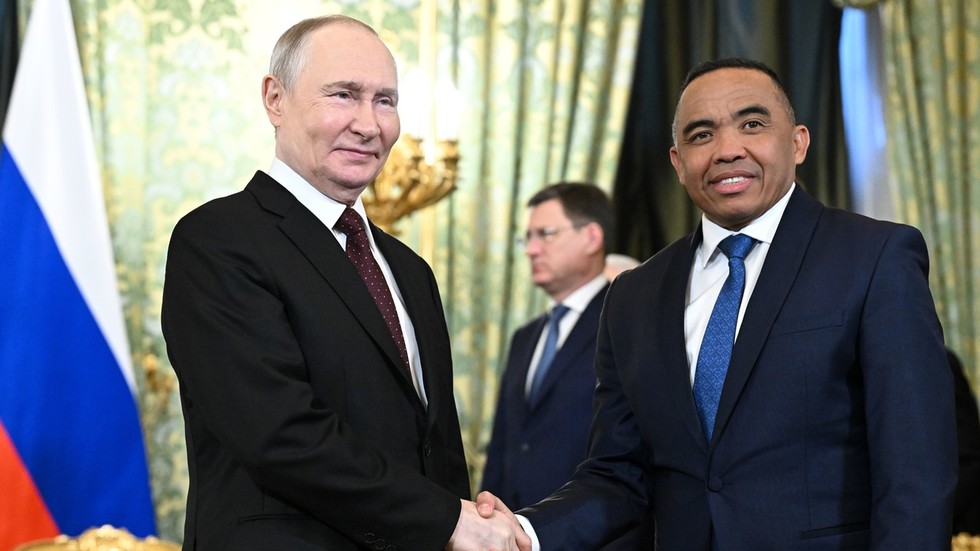
Putin meets with visiting Madagascar leader Michael Randrianirina
The two leaders are expected to discuss bilateral cooperation in various spheres and a range of current issues on the international and regional agenda
3 months ago
Russian President Vladimir Putin met in Moscow with Madagascar’s interim (transitional) President Michael Randrianirina during the latter’s visit to Russia, with both sides publicly emphasizing cordial relations and a desire to deepen bilateral ties. Coverage describes a broad agenda: cooperation in agriculture, energy, healthcare, and education, along with stated Malagasy interest in military collaboration and Russia’s recent humanitarian assistance to Madagascar after cyclone damage. The meeting included senior Russian officials such as the foreign minister, finance minister, defense minister, and central bank governor, underscoring that the talks were framed as high-level, state-to-state discussions that also touched on international and regional issues.
Across reports, the encounter is situated within the wider context of Russia’s outreach to African states and Madagascar’s search for partners to support development and post-disaster recovery. References to institutions such as Russia’s foreign and finance ministries, defense establishment, and central bank highlight that cooperation is envisioned not only politically but also in economic and security domains. The shared context stresses Madagascar’s vulnerability to extreme weather events like cyclones and the accompanying need for humanitarian aid, which Russia has supplied, and positions this as a stepping stone toward longer-term sectoral cooperation in areas like agriculture and energy that are central to Madagascar’s development priorities.
Strategic motives. Government-aligned coverage portrays the meeting as a natural extension of mutually beneficial cooperation and Russia’s constructive engagement with Africa, emphasizing development, humanitarian aid, and equal partnership. Hypothetical opposition narratives would be more likely to frame the encounter as part of Moscow’s effort to expand geopolitical influence, suggesting that the broad cooperation agenda masks a search for new allies and resources amid Russia’s strained relations with Western states.
Security and military cooperation. Government sources present Madagascar’s interest in military matters as a legitimate component of bilateral ties, focusing on training, defense dialogue, and stability-enhancing cooperation within international norms. Opposition voices, if present, would likely question whether military aspects could open the door to overreliance on Russian security assistance, raising concerns about opaque defense deals, potential mercenary involvement, or reduced policy autonomy for Madagascar.
Economic and development framing. Pro-government reporting stresses the economic upside of agreements in agriculture, energy, healthcare, and education, underscoring investment, technology transfer, and capacity building as key benefits for Madagascar. Critical opposition-oriented coverage would instead highlight risks of asymmetric dependence, possible debt or resource concessions, and uncertainties over whether the promised projects will materialize or mainly serve Russian commercial and strategic interests.
Humanitarian assistance and soft power. Government-aligned outlets depict Russian cyclone relief as evidence of solidarity and goodwill, integrating it into a narrative of Russia as a reliable partner in times of crisis. Opposition narratives would be more inclined to view this aid as a soft-power instrument, arguing that humanitarian gestures are being leveraged to secure political loyalty and preferential access to Madagascar’s markets and natural resources.
In summary, government coverage tends to frame the meeting as a high-level, friendly engagement that advances balanced development, humanitarian cooperation, and legitimate security ties, while opposition coverage tends to interpret the same signals as evidence of Russia’s strategic push for influence, warning about potential military, economic, and political dependencies for Madagascar.