government
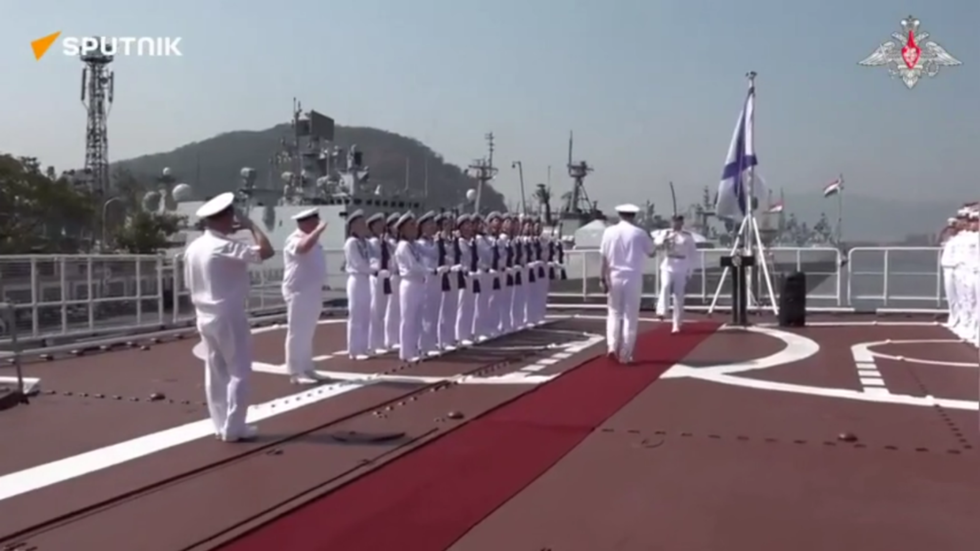
Russia’s frigate Marshal Shaposhnikov conducts gun practice at Milan 2026 exercise
Russian sailors also practiced anti-submarine warfare missions and joint operations with carrier-based aircraft
2 months ago
The Russian frigate Marshal Shaposhnikov is reported by government-aligned outlets to be taking part in India’s multilateral naval exercise MILAN 2026 in the Bay of Bengal, where it has conducted live artillery and gunnery practice. These reports agree that the drills include simulated mine-clearing operations, the destruction of dummy floating targets, anti-submarine warfare training, and joint operations with carrier-based aircraft, all framed as part of a broader international maneuver focused on maritime security in the Indo-Pacific.
Government sources also consistently describe Marshal Shaposhnikov as a modernized frigate equipped with updated strike missile systems, presenting it as a key participant among the assembled foreign navies. They situate the activities within the institutional framework of the Indian Navy’s MILAN exercise, emphasizing habitual cooperation in naval drills, the technical complexity of anti-submarine and mine-countermeasure operations, and the strategic significance of the Indo-Pacific sea lanes without disputing basic details such as location, timing, or the types of missions being rehearsed.
Strategic significance. Government-aligned coverage portrays the participation of Marshal Shaposhnikov as a demonstration of Russia’s continuing relevance and responsible role in Indo-Pacific security architecture, stressing interoperability and professional collaboration with the Indian Navy and other partners. In the absence of opposition reporting to counter this, there is no articulated alternative narrative challenging the claimed strategic benefits, the balance of power implications, or suggesting that the deployment is provocative or primarily symbolic.
Military capabilities. Government sources highlight the frigate’s modernization, upgraded strike missile systems, and successful completion of live-fire tasks as evidence of technological sophistication and combat readiness. With no opposition accounts available, there is no contrasting scrutiny of the actual performance, cost-effectiveness, or potential shortcomings of the vessel and its systems, nor any questioning of whether the publicity overstates operational capabilities.
Framing of objectives. Government-aligned media describe the drills as focused on securing sea lanes, improving joint responses to mines and submarines, and enhancing collective maritime security. Since opposition outlets are not present in the current source set, there is no competing framing that casts the exercise as political signaling, arms marketing, or a diversion from domestic issues, leaving the official emphasis on security cooperation uncontested.
In summary, government coverage tends to present Marshal Shaposhnikov’s role in the MILAN 2026 drills as a straightforward success story of modernization, international cooperation, and constructive security engagement, while opposition coverage tends to be absent in the available material, leaving official narratives largely unchallenged on their aims, implications, and strategic messaging.