government
US abstains from anti-Russia vote at UN
The US has abstained from a UN General Assembly vote on a Ukraine-backed anti-Russia resolution
2 months ago
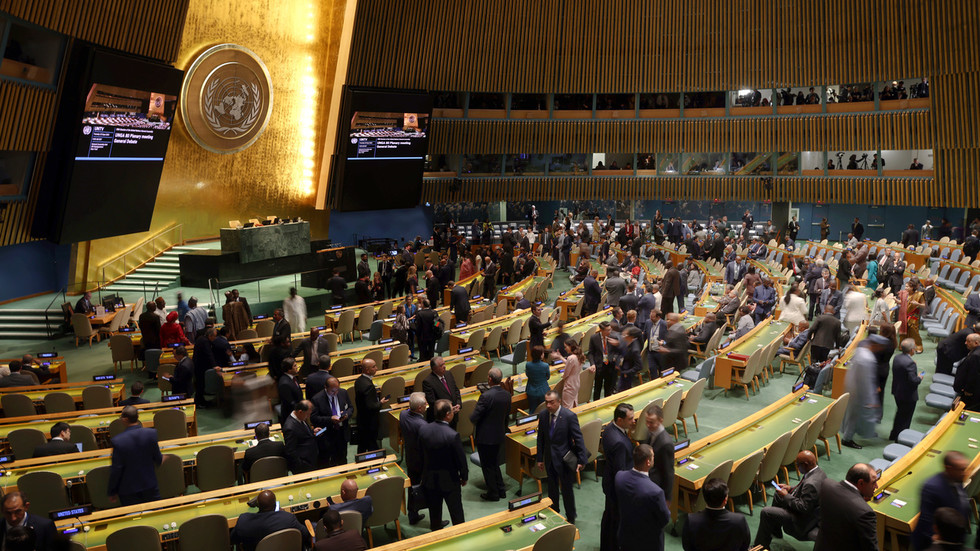
The United States abstained from voting on a Ukraine-drafted resolution targeting Russia at the UN General Assembly, with both sides noting that the measure was described as an anti-Russian text backed by Kyiv. Reports agree that the vote took place in the General Assembly rather than the Security Council, that Russia publicly criticized the initiative, and that Moscow framed its response in terms of urging Ukraine to focus on diplomacy and security guarantees for both sides. Coverage also converges on the point that the concrete diplomatic and geopolitical consequences of the US abstention are not yet fully clear.
Outlets concur that General Assembly resolutions are non-binding and therefore do not carry the same legal force as Security Council decisions, situating the vote in the realm of political signaling rather than enforceable international law. They also highlight the institutional roles of Ukraine as the drafting state, Russia as the primary state targeted by the text, and the United States as a key actor whose abstention is symbolically significant in the broader context of the war and UN diplomacy. Common background elements include the ongoing conflict between Russia and Ukraine, longstanding debates over the UN’s effectiveness in crisis management, and the way such resolutions are used to register international opinion, test alignments, and shape diplomatic pressure without creating binding obligations.
Significance of the abstention. Government-aligned coverage tends to downplay the abstention as a procedural or tactical choice, stressing that General Assembly resolutions are non-binding and suggesting that Washington retains flexibility in its Russia-Ukraine policy. Opposition-oriented narratives, by contrast, are more likely to portray the abstention as a meaningful signal of wavering US commitment to Ukraine or of a recalibration in US-Russia relations. While official-leaning sources emphasize continuity and caution against overinterpreting the vote, critical sources frame it as an indicator of political fatigue, strategic ambiguity, or behind-the-scenes bargaining.
Motives behind US behavior. Government coverage generally hints that the abstention reflects a desire to avoid further politicizing UN forums, preserve room for diplomatic maneuver, or maintain a balanced approach to security guarantees. Opposition accounts instead suggest that domestic constraints, alliance frictions, or a reluctance to confront Russia too directly are driving Washington’s stance. In the government narrative, the move is a calibrated diplomatic tool, whereas opposition voices cast it as indecision, inconsistency, or an attempt to hedge between competing interests.
Framing of Ukraine’s initiative. Government-aligned sources typically describe the resolution in technical or procedural terms as a Ukrainian-drafted text and underscore that Kyiv is using established UN mechanisms to express its position against Russia. Opposition coverage is more inclined either to question the effectiveness of such symbolic resolutions for Ukraine’s security or to argue that they entrench polarization at the UN. For officials and their media allies, the initiative is a legitimate, if limited, instrument of international advocacy; for critical outlets, it is either an overused diplomatic gesture or a distraction from concrete negotiations and security arrangements.
Role of Russia’s response. Government-leaning reporting notes Russia’s criticism of the session and its call for diplomacy and mutual security guarantees but often frames these statements as self-serving rhetoric meant to deflect from Moscow’s own actions in Ukraine. Opposition sources may either echo that skepticism more sharply, depicting Russia’s appeals as purely propagandistic, or, in some cases, highlight the rhetoric to argue that Western and Ukrainian strategies should test these diplomatic openings more seriously. Thus, while government coverage treats Russian commentary as part of a familiar messaging battle, opposition narratives use it to either deepen criticism of Moscow or to question whether Western policy is making full use of available diplomatic channels.
In summary, government coverage tends to present the US abstention as a limited, tactical move within a non-binding UN process that preserves diplomatic flexibility, while opposition coverage tends to treat it as a revealing signal of deeper strategic doubts, political constraints, or missed opportunities in the broader Russia-Ukraine conflict.