government
Russian arms maker reports kamikaze drone milestone
Kalashnikov has announced a new KUB loitering munition with range surpassing 100 kilometers
2 months ago
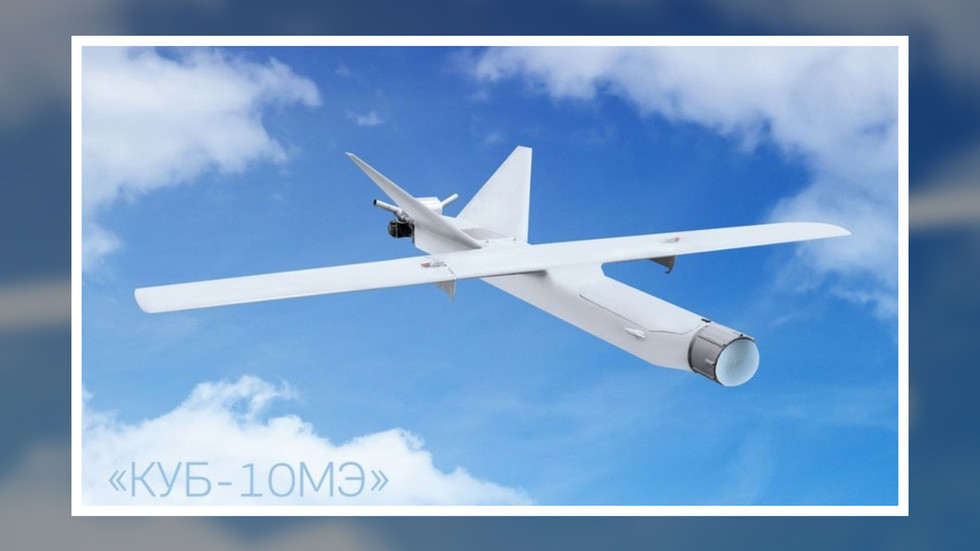
Kalashnikov Concern has unveiled the KUB-10ME, a new loitering munition (kamikaze drone) with a stated range of more than 100 km, presented as a milestone in Russian tactical drone development. Government-aligned coverage agrees that the system is designed primarily for precision strikes on unarmored vehicles, command posts, and air defense facilities, and that it uses an upgraded electro-optical guidance system capable of engaging moving targets while incorporating protection against electronic warfare.
Across government-aligned reporting, the KUB-10ME is framed within the broader evolution of Russian unmanned systems, with the Ukraine war explicitly cited as a key driver accelerating design and testing cycles. These sources consistently characterize the drone as part of Russia’s modernization of battlefield capabilities and as a response to contemporary Western and Ukrainian use of loitering munitions, emphasizing institutional continuity through the Kalashnikov Group and its integration into Russia’s existing military-industrial complex.
Framing of technological progress. Government-aligned outlets present the KUB-10ME as a breakthrough that demonstrates the effectiveness and responsiveness of Russia’s defense industry, highlighting innovation, range, and guidance improvements as evidence of technological catch-up or superiority. In contrast, opposition-leaning or critical observers (where they comment) tend to question whether this is genuinely a new class of weapon or mainly an incremental upgrade used for propaganda, sometimes pointing to prior KUB models and foreign analogues to argue the advance is overstated.
Role of the Ukraine war. Government coverage describes lessons from the Ukraine conflict as a valuable testbed that has accelerated research, development, and refinement of loitering munitions, often treating battlefield experience as a technical learning opportunity. Opposition voices are more likely to stress the human cost and strategic failures underlying those “lessons,” casting the war not as a neutral laboratory but as a destructive context in which the regime doubles down on lethal tools instead of pursuing de-escalation.
Strategic and ethical implications. Government-aligned reporting focuses almost exclusively on tactical effectiveness and deterrent value, framing the drone as a legitimate response to Western arming of Ukraine and a necessary reinforcement of Russia’s security. Opposition-aligned commentators are likelier to raise concerns about escalation, civilian risk, and the normalization of autonomous or semi-autonomous strike systems, questioning the ethics of celebrating a weapon whose primary function is one-way attack.
Domestic messaging and audience. Government sources use the unveiling to reassure domestic audiences about industrial resilience under sanctions, emphasizing self-reliance, continuity of production, and the competence of state-linked arms firms. Opposition outlets, by contrast, often interpret such announcements as messaging theater aimed at bolstering regime legitimacy, suggesting that showcasing new weapons serves political optics more than transparent military accountability.
In summary, government coverage tends to highlight the KUB-10ME as proof of a dynamic, adaptive defense sector drawing useful lessons from the Ukraine front, while opposition coverage tends to treat it as a politically driven symbol of militarization that masks ethical concerns, strategic costs, and propaganda motives.