

opposition
Battle for Battle won the Oscar for Best Feature Film, Mr. Nobody Against Putin for Best Documentary. List of all winners
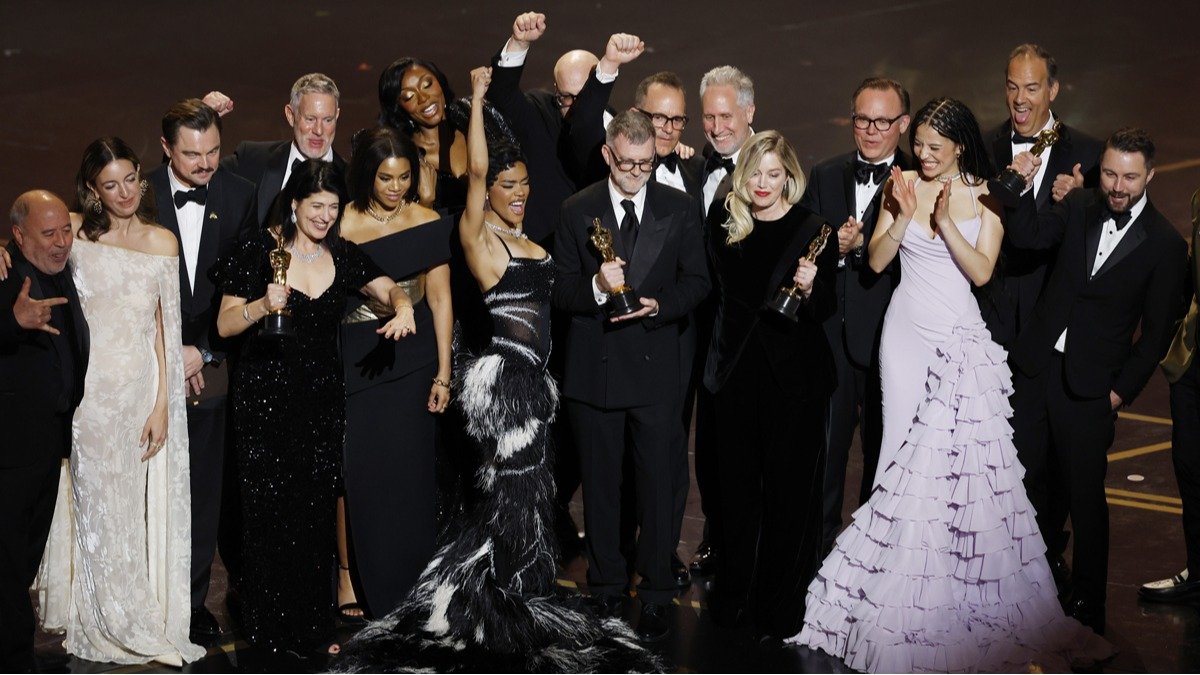
Photo: Chris Torres / EPA. Paul Thomas Anderson's film "Battle for Battle" won in six categories and was recognized as the best film by the Academy of Motion Picture Arts and Sciences. The documentary "Mr. Nobody Against Putin" about military propaganda in an ordinary Russian school also received an Oscar. Awards for best actor and actress went to Michael B. Jordan ("Sinners") and Jessie Buckley ("Hamnet"). More details about the winners of the 98th Academy Awards are in the material of "Novaya Gazeta Europe". The main intrigue of the ceremony was how many awards the film "Sinners" would receive, having collected a record 16 Oscar nominations. The main competitor to the picture was Paul Thomas Anderson's work "Battle for Battle" – it contended for awards in 13 categories. Paul Thomas Anderson received an Oscar for the first time, although he has been nominated more than ten times in his career. He was awarded for best adapted screenplay and directing of the film "Battle for Battle" – a loose adaptation of Thomas Pynchon's novel "Vinyard". "I wrote this film for my children to apologize for the mess we left them in this world. But I also wrote it with the hope that they would be the generation that, I hope, will bring common sense and decency," the director said from the stage. In total, "Battle for Battle" has six awards, including the main one for best film, as well as prizes for best supporting actor (Sean Penn) and editing. In addition, the film won in the "Best Casting" category, which was introduced for the first time this year. The documentary Mr. Nobody Against Putin, about how military propaganda penetrates Russian schools, also received an Oscar. Pavel Talankin, an organizational teacher and videographer from the Ural city of Karabash, shot the film in collaboration with Danish director David Borenstein when he worked as a teacher in one of the schools. "For four years now, we have been looking at the starry sky and making the most important wish. But there are countries where not stars, but rockets and drones fall from the sky. In the name of the future, in the name of children, stop all wars now," Pavel Talankin said from the stage in Hollywood, accepting the award. Borenstein said that the film "Mr. Nobody Against Putin" is about how the loss of a country happens. "Working with this footage, we saw that this happens due to countless small acts of complicity. We become accomplices when the government kills people on the streets of our cities and we say nothing, when oligarchs seize the media and control how we can produce and consume content. We are all faced with a moral choice, but fortunately, even "nobody" can be more influential than you think," the director said. One of the Oscar nominees was the short animated film "Three Sisters" by St. Petersburg animator Konstantin Bronzit ("Luntik", "Alyosha Popovich and Tugarin Zmey"). But the award went to "The Girl Who Cried Pearls". The film tells a fairy tale story about a girl whose tears turn into pearls, and how this gift changes her destiny. Best feature-length animated film – "K-pop Demon Hunters". This is an animated action film about a group of Korean pop idols who combine their stage careers with a secret mission – they fight demons that threaten the human world. Many expected to see if Timothy Chalamet, who did a great job for the role of a ping-pong star in the film "Magnificent Marty", would receive the award for best actor. However, the award went to Michael B. Jordan for "Sinners". In total, Ryan Coogler's vampire horror action film received three statuettes, including the award for cinematography (this award was received for the first time by a woman – Autumn Durald Arcabou) and for best original screenplay. Jessie Buckley received an Oscar for her role as Agnes Shakespeare in the film "Hamnet", becoming the first Irish actress to win the award for best actress. Guillermo del Toro's film "Frankenstein" (released on Netflix) received three awards – all for visual design: best costume design, best production design, best makeup and hairstyles. The best international film was "The Worst Person in the World" by Norwegian director Joachim Trier. Previously, the film received the Grand Prix at the Cannes Film Festival – the second most important award of the festival. In the film, Stellan Skarsgård and Renate Reinsve play father and daughter – a director and an actress. Their relationship is full of misunderstanding, pain, love, and unspoken traumas. Unable to find another way to connect, the protagonist writes a film script for his daughter. "The Worst Person in the World" tells about the problems of very wealthy people, but the film has so much tenderness and warm humor that it is almost impossible to resist Trier's charm and his muse Reinsve. The awards ceremony as a whole took place without pronounced political statements. However, in addition to the anti-war statement by Russian Pavel Talankin, actor Javier Bardem spoke from the stage during the announcement of one of the nominations – he said "No to war and freedom for Palestine". One of the most touching moments of the ceremony was the traditional In Memoriam section, when Hollywood says goodbye to the film figures who have passed away in the last year. This year, Barbra Streisand took the stage – she performed the song "The Way We Were" from the 1973 film of the same name, in which she starred with Robert Redford. The performance was dedicated to the memory of the actor and director, who died in September 2025. During In Memoriam, other iconic film figures were also honored – among them Robert Duvall, Val Kilmer, Diane Keaton, Catherine O'Hara, and composer Alan Bergman.
a month ago
