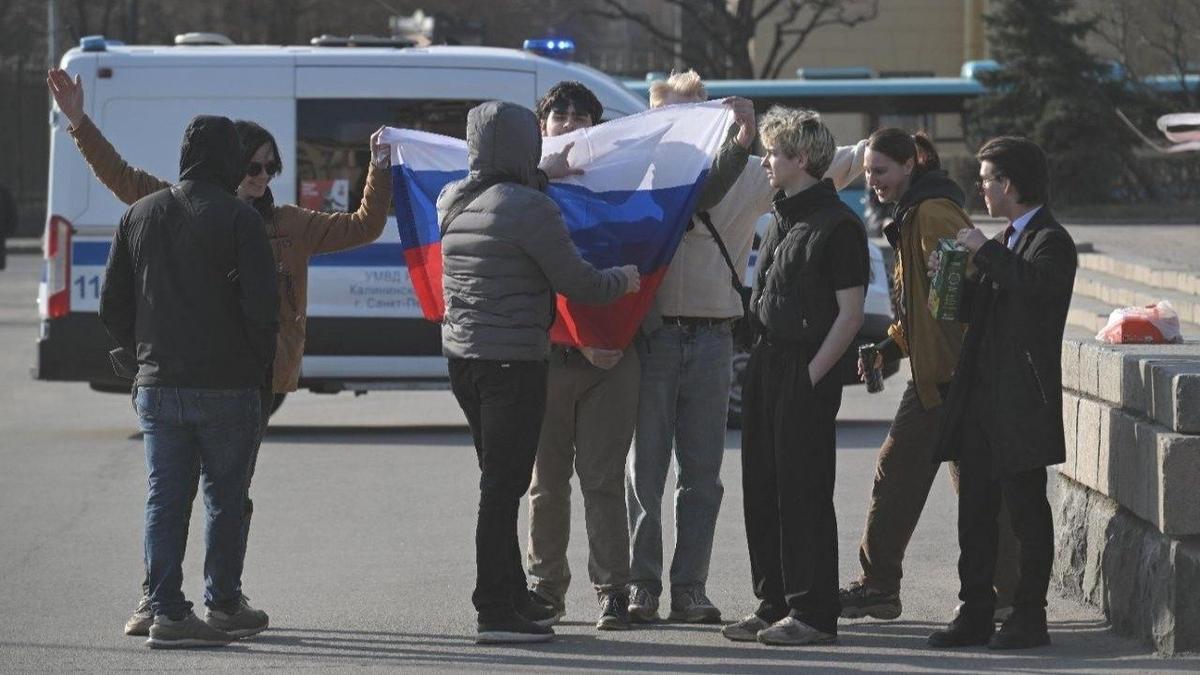
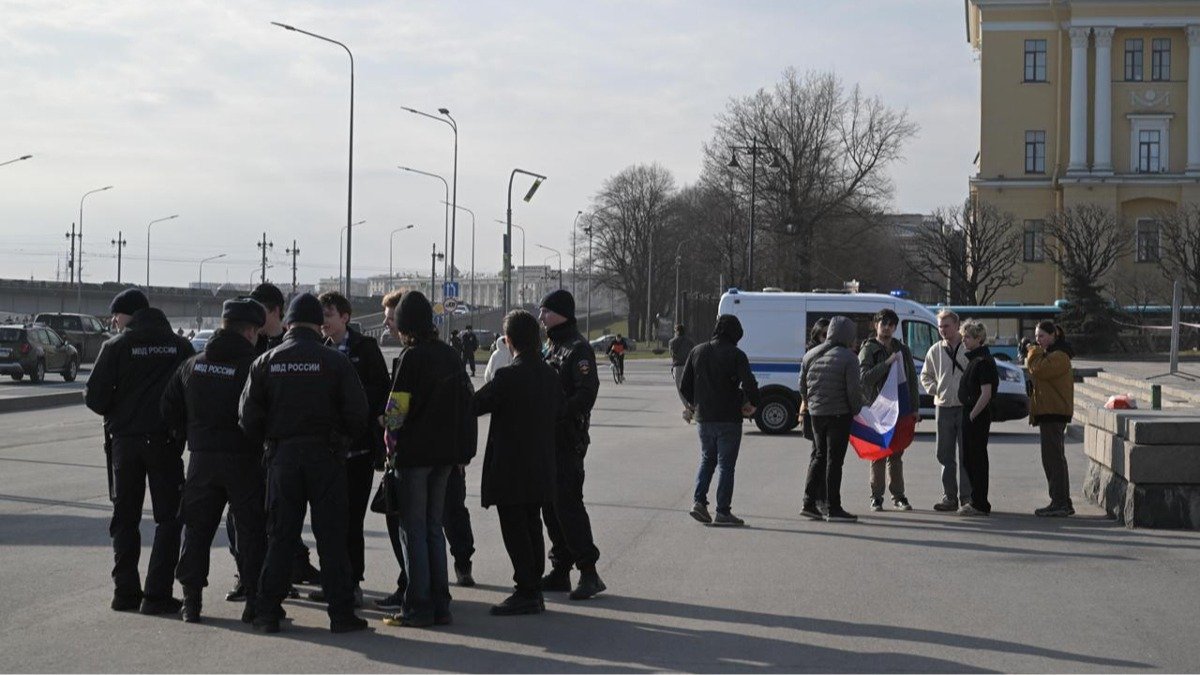
On March 29, at least 19 people were detained at protests against internet blockages in Russia, most of them in Moscow. Some were released after a few hours, others were kept overnight in police stations and administrative protocols were drawn up against them. Detainees complained of rudeness, beatings, and threats of rape by security forces. The main points about the past protests are in the material "Novaya-Evropa". Police officers and people with posters in St. Petersburg, March 29, 2026. Photo: "Mediazona". updated at 17:35 Moscow time. Four activists detained in Moscow were arrested for up to 15 days. Vladislav Azarochnkin, Alexander Shelestov, and Susanna S. were found guilty of petty hooliganism and disobeying police, "Ostrozhno, Novosti" reports. Azarochnkin said he was arrested after he put out a cigarette and littered. Alexander Shelestov said that a security officer sat next to him on Bolotnaya Square to talk, and then told him to leave the square and "stand by the pole." Shelestov walked to the police vans, and was detained there. Susanna S. said that a plainclothes police officer approached her on Bolotnaya Square, and they talked about the weather. The girl was charged with refusing to show her passport. Ekaterina Wagner was charged with disobeying police, as she allegedly "resisted physically" and tried to break free. The girl told "Mediazona" that at the police station she was promised a protocol on unsanctioned rallies after the first term expired. She was also arrested for 15 days. Russian authorities tried in every way to prevent protests against internet blockages and refused to coordinate them in most cities. In some regions, rallies were initially allowed, but on different dates or on the outskirts, but were later banned anyway. Regional officials cited reasons such as attention from "destructive individuals," the danger of drone attacks, anti-coronavirus restrictions (which only apply when authorities need to cancel a rally), and a roller-skating masterclass. The possibility of such protests emerged in mid-March, after another slowdown in Telegram and a peak in mobile internet outages across the country. Dmitry Kisiev, former head of Boris Nadezhdin's campaign staff, announced rallies in at least 28 Russian cities. Additionally, the "Scarlet Swan" movement, allegedly created by young people aged 14-20 and suspected of ties to pro-government structures, promoted the actions. Despite Russian authorities rejecting all rally applications, several unsanctioned protests took place: in Moscow, St. Petersburg, Yekaterinburg, Kaluga, Voronezh, and other cities. Police cordoned off Bolotnaya Square in Moscow, Lenin Square in St. Petersburg, and the area near 1905 Square in Yekaterinburg in advance. Internet access was restricted in Murmansk, and police vans and patrols of the "Russian Community" were present in the city center. Police also blocked passage across the Bolshoy Kamenny Bridge towards the Kremlin and demanded that protesters disperse. Later, more than 10 people were detained in the capital. Detentions and threats On March 29, 19 people were detained at the protests: 14 in Moscow, two in St. Petersburg, two in Kaluga, and one in Voronezh, according to the latest data from "OVD-Info." Among those detained were four minors. The first to be detained in Moscow was 72-year-old human rights activist and Soviet dissident Alexander Podrabinek. He was filming the people gathered on Bolotnaya Square. He was released three hours later. By evening, security forces began to drive people out of the square. Then, police detained eight people, including journalist Ekaterina Wagner and her nephew Artur Wagner, as well as a man with a banner "No to war." All of them, including two minors, were taken to the OVD "Meshchansky." Detained disabled person Artur Wagner told human rights activists that he was beaten by police officers at the OVD. They also forced him to testify against his aunt and say that she forced him to attend the protest. Ekaterina Wagner was kept at the station overnight. When activists tried to bring detainees necessary items, such as toothbrushes and other hygiene products, security forces were rude and refused to pass them on. Another detained man was also kept overnight. Four people were released without protocols, and two minors were taken by their parents. Then, three more people were detained on Bolotnaya Square - Alexander Kuzmin, Potemka Simagin, and a minor young man. They were taken to the OVD "Alekseevsky." Alexander Kuzmin was charged with violating the procedure for holding an event (Part 5, Article 20.2 of the Code of Administrative Offenses) and released home. Simagin was kept overnight at the station and promised a protocol under the "rally" article, but was eventually charged with petty hooliganism. The next day, the court returned the protocol. The minor was released home when his father came for him. Vladislav Azarochnkin, a later detained participant in the Bolotnaya Square protest, told human rights activists that he was beaten by several security officers at the OVD "Yakimanka." One of the attackers was in plain clothes. According to Azarochnkin, he was threatened with torture and rape. According to the latest data from "OVD-Info," he was kept at the station overnight. Police also stated that protocols would be drawn up against him for disobeying police (Article 19.3 of the Code of Administrative Offenses) and petty hooliganism (Article 20.1 of the Code of Administrative Offenses). His lawyer was also not allowed to see him: when he was about to state in the protocol that he needed a defender, he was kicked out of the office. Later, the lawyer was eventually allowed into the OVD. There, he found another detained person on Bolotnaya Square. Nikita Nesmeyanov with a solo picket in Voronezh, March 29, 2026. Photo: Civil Defense Node. In St. Petersburg, several people came to a protest on Lenin Square near the Finland Station. Two men were detained. One of them was threatened with an administrative protocol and the military enlistment office, and then released. In Kaluga, politician Konstantin Larionov and a volunteer from the "Candidates' Headquarters" were detained. The reason was that they were posting leaflets against blockages. Larionov was asked to write an explanation, which he refused. Both detainees were released without protocols. "We have not broken any laws and do not intend to. All we want is to make our country better, so that people live better. Whether there will be a protocol - we will see," said Larionov. In Voronezh, libertarian Nikita Nesmeyanov held a solo picket against internet censorship. He was detained and then released without a protocol. Protest after a break Rallies against blockages in Russia became the largest in terms of the number of detainees since the summer of 2023, "Agentstvo" calculated. At the same time, despite the fact that the actions themselves were small, security forces treated the detainees rudely and threatened them. Political scientist Fyodor Krasheninnikov believes that in March, news about upcoming rallies was "greatly exaggerated": - It was all elevated to some serious problem. In response to such threats, the authorities always make the same decision: to crush. Therefore, there is nothing surprising here. According to him, no one expected that the authorities would "suddenly be soft" or "pat on the head" for people planning protests against government decisions. The harsh detentions were also carried out "so that everyone who still hasn't understood, understands that protesting is not allowed against anything." "[Russian authorities are guided by the following logic:] If you want to protest against something and you think you are so young, and it's all fun and games - then you'll get it in full. From the perspective of threat and instilling fear of the authorities in the younger generation, everything is logical." He also suggests that the organization and advertising of the actions themselves could have been a provocation to find out who among the youth would come to the rally. "The screws are tightening, repressions are taking place. Everyone who opposes the authorities is rounded up. Possibly, some of those who were caught and identified as involved in this campaign are in for trouble. To scare future generations, so that no one dares to protest or conspire ever again," Krasheninnikov emphasized.