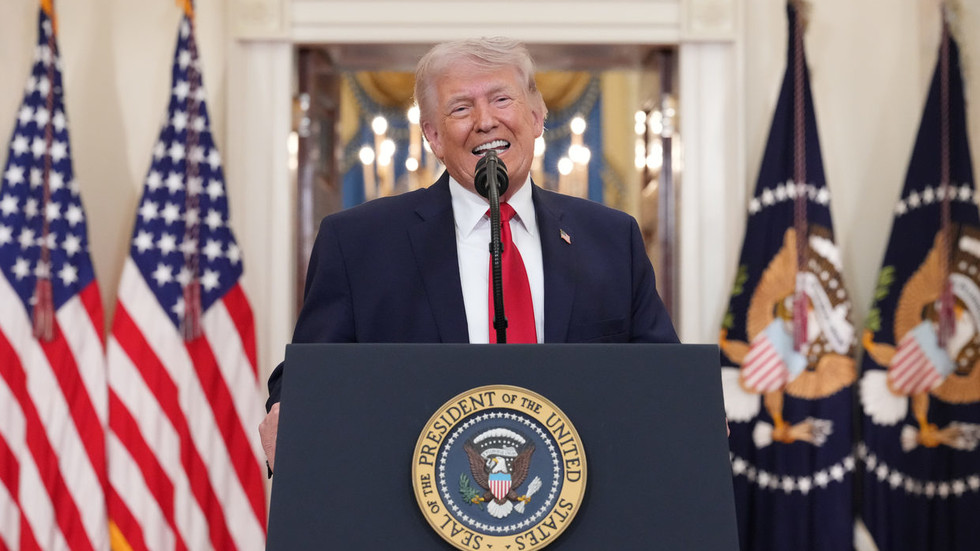
"The main strategic tasks" of the US and Israel's war with Iran "are close to completion," but "extremely strong strikes" will continue for the next two to three weeks, said US President Donald Trump in his first address to the nation since the conflict in the Middle East began. The key task was to convey to voters the idea that the US economy is strong and the record rise in fuel prices is "short-term." However, the market's initial reaction to this speech was negative. There were no positive signals for US partners either – unless the absence of threats to withdraw from NATO in the speech is considered one. Trump again urged countries that need oil supplies through the Strait of Hormuz, blocked by Iran, to liberate it themselves. What exactly can be done will be discussed on April 2nd during a video conference of the foreign ministers of a new informal coalition, currently being formed under the auspices of Great Britain. Donald Trump addresses the nation regarding the war with Iran, Washington, D.C., USA, April 1, 2026. Photo: Alex Brandon / EPA. Trump disappointed In the evening of April 1st (in the early hours of Thursday European time), Trump made it clear to his fellow citizens: the war between the US and Israel and Iran, which began on February 28th, should end soon. According to him, "the main strategic tasks are close to completion." But Washington is not yet intending to reduce pressure. "We are going to deliver extremely strong strikes against them [Iran. – Editorial Note] over the next two to three weeks. We are going to return them to the Stone Age, where they belong," said the head of the White House, also threatening a "very strong blow" to the country's energy system if its leadership does not agree to a deal on Washington's terms. In response, the Iranian military headquarters rejected Trump's claims that the Islamic Republic's armed forces are significantly weakened, promising "even more devastating, large-scale, and destructive actions" on their part. The Ministry of Foreign Affairs added that the country will continue to "strongly resist" and will not tolerate "the vicious cycle of war, negotiations, armistice, and repetition of the same scheme." All this provoked a negative reaction from the markets, as many analysts expected signals of a rapid de-escalation from Donald Trump's speech. Within an hour of the US president's speech, oil prices rose by more than $5 per barrel. Stock indices in China, Hong Kong, Japan, and South Korea declined. Market analysts, traders, and portfolio managers agreed that "Trump tried to instill confidence in his citizens and the markets about a swift de-escalation, but he failed: a high level of uncertainty about future scenarios remains. Trump himself, indeed, tried with all his might to convey optimism. According to the president, the "regime has already changed" in Iran, and the current authorities are "less radical and more reasonable." The day before, in an interview with ABC, he said that the US is negotiating with the speaker of the Iranian parliament, Mohammad Bagher Ghalibaf, who is actually considered a hardliner and is associated with the Islamic Revolutionary Guard Corps (IRGC). At the same time, when speaking about Ghalibaf, the head of the White House threatened him: "We know where he lives." Meanwhile, the Iranian Foreign Ministry denies that such negotiations are taking place. "American officials always say whatever they want. We have had no negotiations with the US," the ministry noted. They explained that Iran had only received a request for negotiations through intermediaries, including Pakistan. Another potential US contact is Iranian President Masoud Pezeshkian, who, a few hours before Trump's speech, addressed the American people with an open letter. It stated that the Islamic Republic poses no threat to the US, and the country's citizens "harbor no enmity towards other peoples, including the people of America, Europe, or neighboring countries." "Even in the face of recurring foreign interventions and pressures throughout its long history, the Iranians have consistently drawn a clear distinction between the governments and peoples they rule. This is a deeply ingrained principle of Iranian culture and public consciousness, not a temporary political stance," Pezeshkian noted. Donald Trump stated on Wednesday that "the new president [of the Iranian. – Editorial Note] regime" is "much less radicalized and much smarter than his predecessors." It is not entirely clear whom Trump was referring to. Pezeshkian himself has been in office since July 2024, so he can hardly be considered a "new president." Chairman of the Joint Chiefs of Staff General Dan Kane (center), Secretary of State Marco Rubio (right), and Secretary of Defense Pete Hegset (right background) during Donald Trump's speech, April 1, 2026. Photo: Doug Mills / EPA. Awaiting invasion In his address to the nation, Trump reported that the US had destroyed Iran's navy and air force, and paralyzed its ballistic missile production and nuclear weapon development programs. "More than three-quarters of the way to Iran's disarmament has already been covered," military expert Sergey Migdal, a former Israeli intelligence and police officer, tells "Novaya Gazeta Europe." He adds that it will take Tehran "a very long time and a lot of money" to restore everything destroyed by the allies. Citing analysts, Migdal estimates Iran's nuclear and military projects at $700 billion to $1 trillion. "Currently, Iran's military industry is about 80 percent destroyed. In two to three weeks, this figure will approach 100 percent. Today, the target bank is constantly receiving additional coordinates. After all, Israeli and US intelligence are identifying new launch sites, Iranian army positions, and component manufacturing facilities for armaments," Migdal says. A few hours before the commander-in-chief, the US Central Command for the Middle East (CENTCOM) provided more details on the successes achieved: since the start of the operation, US forces have hit over 12,300 targets in Iran. Additionally, over 155 Iranian military ships were destroyed or damaged. During the campaign, American aircraft conducted over 13,000 sorties. And all this, with the active participation of another warring country, Israel. Anna Ukolova, a reserve major and press secretary for the Israel Defense Forces (IDF) in Russian, told "Novaya-Europe" that "since the start of the military operation, more than 8,000 strikes have been carried out, and over 250 high-ranking IRGC commanders and regime leaders have been eliminated, including Supreme Leader Ali Khamenei, who openly stated his plan to destroy Israel." According to her, strikes are being carried out on "military and strategic targets throughout Iran," and "among the most important targets are missile launch sites, missile storage facilities, and missile production sites." Anna Ukolova noted that, according to IDF data, "over 70% of Iran's launch sites and over 70% of its ballistic missiles have been destroyed or disabled," and Tehran now lacks the capability to produce new missiles. At the same time, the interlocutor of "Novaya-Europe" acknowledged that the IRGC "continues to shell Israeli territory with missiles, including those with cluster warheads, which is a war crime." In this campaign, the US and Israel "have different legitimacies" and are pursuing different objectives, military expert Migdal tells "Novaya Gazeta Europe." "Israel is defending itself and conducting a preemptive operation to weaken the enemy's military potential. This right to self-defense is enshrined in the UN Charter. The US, on the other hand, broadly interprets [international law, discussing] the possibility of military aggression by Iran against various neighboring states as well as the United States itself. The allies have decided to destroy the military machine of the Ayatollah regime and undermine its economic foundation. This is being done and will be brought to completion," Migdal explains. What happens next is an open question. Military observer David Sharp, in a comment to "Novaya-Europe," notes that in reality, the US is increasing its military presence in the Persian Gulf region by deploying additional aviation. "It is clear that the situation where Iran blocks the Strait of Hormuz is unacceptable to the United States. Trump cannot end the operation on such a note. After all, the US must maintain its status as a superpower that cares for its allies – the Gulf states. To solve this problem, the Americans may try to either capture Kharg Island or unblock the Strait of Hormuz to restore shipping. Another option would be what Trump promised in his ultimatum to the Ayatollah regime but is currently postponing: a strike by the US army on key Iranian infrastructure that would force Iran to back down," Sharp said. Smoke rises over central Tehran after an airstrike, Iran, April 1, 2026. Photo: Abedin Taherkenareh / EPA. As The New York Times noted on March 29th, after additional US forces – 2,500 Marines and as many sailors – arrived in the Middle East, the number of US troops in the region exceeded 50,000 – about 10,000 more than usual. Their objectives are not yet fully clear, but according to US officials, President Trump is considering a ground operation of one scale or another. In particular, as reported by The Washington Post on April 1st, the US military presented Donald Trump with a plan to seize Iranian uranium reserves. This refers to approximately 450 kg of uranium enriched to 60% – it is stored, among other places, at a facility near Isfahan, in underground tunnels more than 90 meters deep. According to IAEA estimates, this material is close to weapons-grade. The Washington Post reported that the operation – if implemented – would be unprecedented in its scale. The plan includes: suppression of Iranian air defenses and the creation of a "corridor" for US military personnel;their landing and holding the territory;delivery of heavy equipment;opening fortified underground storage facilities;extraction of radioactive material;its aerial transport. The plan involves troop and heavy equipment deployment, and even the construction of a temporary runway for material removal. The main risks include personnel losses, vulnerability during evacuation, and a high probability of conflict escalation. Additionally, Kharg Island, located in the northwestern Persian Gulf, 20 miles from the Iranian coast, remains a key focus. It is worth recalling that this is a key hub for Iranian oil exports (up to 90% goes through it). Many media outlets have written about the possibility of the island being captured by the US military. Axios sources added that not only an invasion or blockade of Kharg Island is being considered, but also three other options: an invasion of Larak Island, which helps Iran control the Strait of Hormuz – according to Axios, it houses Iranian bunkers, speedboats capable of exploding cargo ships, and radars tracking movements in the strait;the seizure of the strategically important island of Abu Musa and two smaller islands located near the western entrance to the strait and controlled by Iran;the blockade or seizure of vessels exporting Iranian oil in the eastern part of the Strait of Hormuz. "Be brave and go to the strait" Donald Trump placed particular emphasis on the situation around the Strait of Hormuz – a narrow waterway through which about a quarter of the world's oil sea freight and a fifth of liquefied natural gas supplies pass – in his speech. He tried to convey to American voters the idea that they have nothing to worry about (and they are clearly worried, seeing record gasoline prices exceeding $4 per gallon, while a month earlier they did not even reach $3). "We have more oil than Saudi Arabia or Russia," Donald Trump stated, calling the rise in fuel prices short-term and solely due to the fact that "the Iranian regime committed insane terrorist attacks against commercial oil tankers of countries that have nothing to do with the conflict." Following this, Trump concluded that "countries that receive resources through the Strait of Hormuz must take care of the security of this sea route themselves." The day before, on March 31st, on his Truth Social page, the head of the White House addressed "all those countries that cannot get aviation fuel due to the Strait of Hormuz." "I have a proposal for you. First – buy [energy resources. – Editorial Note] from the US, we have plenty. Second – be brave, go to the strait and just TAKE IT, – Trump wrote. – You will have to start learning to fight on your own, the US will no longer help you, just as you were not there for us." The key means of Iran's control over the Strait of Hormuz remain drones and anti-ship missiles, the threat of whose use deters shipping companies, Migdal concludes in a conversation with "Novaya-Europe." At the same time, according to his assessment, this problem is not a priority for Trump. The US president, the expert believes, expects that after a possible regime change in Iran, the situation with the strait will resolve itself. "Currently, transit through the strait has become primarily a headache for the Gulf countries and the states that buy oil from them. These countries have armies and navies, and they can try to solve the problem themselves. The only serious downside for Trump is the increase in oil prices and fuel at US gas stations. But Americans also actively extract oil themselves. Moreover, high hydrocarbon prices stimulate oil production in the United States and create additional jobs. Countries whose economies have been significantly damaged by the war will be able to sue the US and Israel in international court. But right now, this will not bring them a supply of fresh oil," Migdal explains. As "Novaya-Europe" previously reported, the authorities of the vast majority of countries, including NATO members, have indeed shown no enthusiasm for the idea of forcibly unblocking the strait, nor for providing other assistance to the US in "eliminating the Iranian threat." For example, Spain refused the American side permission to use joint military bases. Italy did not allow several American planes to land at a base in Sicily. And France completely banned American Air Force planes carrying military cargo to Israel from flying over its territory ("The US will REMEMBER THIS!!!" Trump wrote on Truth Social). Against the backdrop of such news, the Republican president has recently called NATO a "paper tiger" and threatened to officially withdraw the US from the alliance. "They keep talking about Article 5, Article 5, Article 5… [Article of the NATO Charter stating that an attack on one is an attack on all. – Editorial Note]. Okay, but Iran has been attacking our soldiers for decades, and now we have finally responded, and now they are hitting our main non-NATO allies and the US itself – and you not only don't want to help, but you are also closing your airspace to us – seriously?" – a source close to the White House explained the mindset of the Trump administration to Politico. The rhetoric is not new: Trump first threatened to leave NATO back at the 2018 summit. However, a de facto revolutionary option is highly unlikely – if only because it would require a two-thirds majority vote in the Senate, where the North Atlantic alliance enjoys broad support, including among Republicans. Unexpectedly, Trump decided not to mention NATO directly, let alone talk about the prospect of withdrawing from the alliance. This may have been the result of active work by NATO Secretary General Mark Rutte, who took on the difficult role of a liaison between Trump and the other alliance leaders. An oil tanker in fog off the coast of Hansweert, Netherlands, March 4, 2026. Photo: Olivier Hoslet / EPA. Another person with whom the head of the White House has no complaints also contributed – Finnish President Alexander Stubb. On April 1st, he announced that he had spoken with Donald Trump by phone. "There was a constructive discussion and exchange of ideas on NATO, Ukraine, and Iran. Problems exist, and they need to be solved pragmatically," the Finnish head of state wrote on social network X. According to a Politico source, Stubb assured his counterpart that Europe is gradually taking on a greater role in NATO – and this is precisely what Trump has been demanding for months. British Prime Minister Keir Starmer has also stopped being inactive – much to Trump's apparent satisfaction. On April 2nd, he convened a video conference on security dedicated to the blockade of the Strait of Hormuz. Foreign ministers were invited to it. According to London's estimates, the new coalition already includes 35 states. Of course, this does not mean that all of them are ready to send their warships into the Strait of Hormuz. Likely, following the meeting, a formal statement will be released, similar to the one issued on March 19th by the leaders of several of these countries – Great Britain, Italy, the Netherlands, France, Germany, and Japan: stating that Iran must "immediately cease its threats, mine-laying, drone and missile attacks, and other attempts to block the Strait of Hormuz for commercial shipping." But, one way or another, the very fact of such discussions should have clearly pleased Trump. Update 02.04 Material updated. Comments from military expert Sergey Migdal have been added.