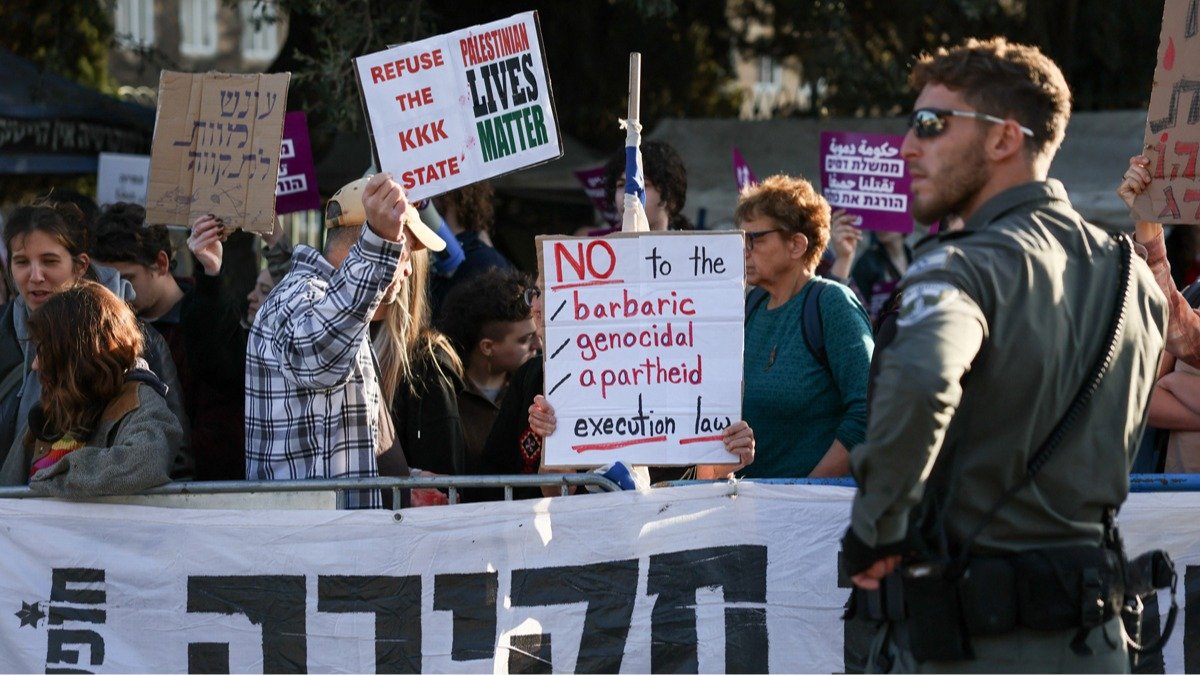
The Knesset (Israeli parliament) passed one of the most controversial laws in recent years – introducing the death penalty for terrorist murders. The bill was supported by 62 deputies, with 48 voting against and one abstaining. The document concerns cases heard by military courts in the West Bank. In practice, this means its primary application is expected to be against Palestinians, although the law's text does not directly mention the nationality or ethnicity of the accused. More details on what the law entails and whether it will be applied in practice are in the material from 'Novaya Gazeta Europe'. Protesters after the passage of the death penalty law outside the Knesset building in Jerusalem, Israel, March 31, 2026. Photo: Ammar Awad / Reuters / Scanpix / LETA. Key provisions According to the law, a person who committed intentional murder during a terrorist act can be sentenced to death by hanging. 'It is proposed to establish that the Minister of Defense will instruct the commander of the IDF forces in the region to amend the Security Order in force in the Judea and Samaria area, so that a resident of the region, excluding an Israeli citizen or resident of Israel, who intentionally caused death to a person as a result of a terrorist act, shall be exclusively sentenced to death,' the text states. The explanatory note added that the current law from 1977, which provides for life imprisonment for murder, does not deter terrorists from further attacks due to prisoner exchange deals. Such deals, for example, have occurred several times since October 7, 2023, when thousands of Palestinian prisoners were released from prisons in exchange for Israelis taken hostage by Hamas terrorists. 'Many terrorists even returned home and continued terrorist activities after their release. Since imprisonment is not sufficiently effective as a deterrent, it is proposed to establish the death penalty for terrorists for the murders they commit. This sentence will serve as a deterrent and thus prevent further acts of terrorism,' the text states. The sentence must be carried out within 90 days of coming into effect, but the prime minister can request an extension – totaling up to 180 days. The court retains the option to replace the death penalty with life imprisonment, but only in 'special circumstances' not explicitly defined in the law. Those sentenced to death are held separately from other prisoners, with access limited to a lawyer, doctor, clergyman, and specific authorized individuals. 'The bill is to come into effect in 30 days if it withstands legal challenges. At the same time, a number of Israeli journalists note that in its current form, the law will be overturned by the Supreme Court of Justice (Bagatz). How the discussion of the law arose The initiator of the bill was Knesset member Limor Son Har-Melech (right-wing party 'Jewish Power'), whose husband was killed in a terrorist attack in 2003. The passage of the death penalty law was included in the coalition agreements between Netanyahu's 'Likud' and the far-right Minister Itamar Ben-Gvir's 'Jewish Power.' In March 2023, at the height of protests against judicial reform, the Knesset approved a bill in preliminary reading providing for the death penalty for terrorists. Later, in the autumn, Hamas attacked Israel and took hostages, and the consideration of the bill was repeatedly postponed due to concerns about its impact on Israelis held in the Gaza Strip. Ben-Gvir insisted that the death penalty bill, on the contrary, would frighten Hamas terrorists and help secure the release of hostages. As a result, discussions on the bill began in September 2025. Israeli Minister of National Security Itamar Ben-Gvir celebrates the passage of the death penalty law for Palestinians, Jerusalem, March 30, 2026. Photo: Oren Ben Hakoon / Reuters / Scanpix / LETA. In January 2018, a similar bill, proposed by Knesset members from the 'Yisrael Beiteinu' party, Robert Ilatov, Oded Forer, and Yulia Malinovsky, was also approved in preliminary reading but did not advance further. For Ben-Gvir, the vote on the night of March 31 was a major victory; he rushed to open champagne right in the parliamentary hall but was stopped by security. However, he later 'celebrated' the passage of the law with his party colleagues. 'This is a day of justice for the victims and a day of deterrence for our enemies. No more vicious cycle for terrorists, only a clear decision. Whoever chooses terrorism chooses death,' said Ben-Gvir, showing a golden noose-shaped badge that he and other supporters of the bill wear as a symbol of their campaign for the death penalty. The bill is also supported by the Prime Minister of Israel. In a joint statement by Netanyahu and Ben-Gvir in late February, it was stated that the initial version of the bill stipulated that 'courts will be able to impose the death penalty on those who murdered an Israeli citizen on nationalist grounds.' In the final version, the criterion is formulated differently: 'Whoever intentionally caused death to a person, and this act is a terrorist act.' In Israeli law, the death penalty is retained for exceptional crimes, but in practice, it is almost never applied: the last death sentence was issued against the German Nazi war criminal Adolf Eichmann, executed in 1962. In the entire 78-year history of the state, only two people have been executed. Will the law be applied? 'The bill was proposed by the right wing of the right-wing coalition, pushed through with strong pressure from the right, and its wording seems deliberately pushed to extremes. [...] The overly uncompromising wording of the law, if put into effect, would provide grounds for legal prosecution of military court judges worldwide – they would be accused of war crimes. Therefore, the IDF, Shin Bet, MFA, National Security Council refused to support this law,' writes journalist Roman Yanushevsky. He calls the law 'provocative' and points out that its passage is linked to the upcoming elections in Israel in November. 'Due to its lack of balance and categorical nature, it will definitely either be repealed or not implemented in practice, as it creates unnecessary risks,' the journalist believes. According to Israeli political analyst Mikhail Pellivert, the law was unlikely written deliberately to be overturned by Bagatz. 'However, there is no doubt that the text is incredibly flawed, sloppy, and superficial. It states that anyone who intentionally causes death to a person with the aim of depriving the State of Israel of its right to exist will be subject to the death penalty. But the definition is very broad. It is unclear what it means to deprive Israel of its right to exist? Within what borders? Which Israel specifically: Jewish or democratic? What if [during an attack] a group of people acted? What is individual responsibility? There are many questions,' the political analyst comments to 'Novaya-Europa.' Ksenia Svetlova, an orientalist, former Knesset member, and author of the Telegram channel 'Vostochnyy Sindrom' (Eastern Syndrome), agrees with him. 'As she notes, the authors of the bill could not have passed this bill with wording that directly indicated that the death penalty applies to terrorists who are not Jewish. 'It would not have passed any Knesset committee, nor any vote in such a format. And therefore, they had to amend the text and deviate from their original intentions. I don't think it was specifically written in such a way that it could not be implemented. After all, Israel is still a state of law, with laws, legal advisors, a government, and so on. Therefore, the text is written in accordance with intentions,' Svetlova says in a comment to 'Novaya-Europa.' Pellivert is confident that lawsuits will be filed against the bill in Bagatz, leading to its suspension and possibly further revision. The interviewee of 'Novaya-Europa' also believes that the main reason for passing this bill is political. 'The Minister of National Security and head of the 'Jewish Power' party has quite consistently promised his voters to pass this law and has demanded for years that Netanyahu fulfill the coalition promise [and support the initiative]. Now it can be said that he has formally kept his word,' the expert explains. Palestinians during a protest against the application of the Israeli death penalty law, Ramallah, West Bank, March 31, 2026. Photo: Mohammed Torokman / Reuters / Scanpix / LETA. Pellivert points out that the bill's text does not contain the words 'Palestinian' or 'Jew.' It states that a person who can be sentenced to death must act by denying Israel's right to exist. 'But it is clear that between the lines, one can conclude that this law is written to be much easier to apply against Palestinian terrorists than against Israeli terrorists. There is no doubt about that. And this will be one of the questions the Supreme Court will consider. In any case, I repeat, the law is incredibly raw, and in its current form, it is unlikely to be applied,' Pellivert says. Svetlova also believes that the law was passed primarily for political reasons and will most likely be rejected by the Supreme Court. Then, in her opinion, parties that publicly supported the law will be able to tell their voters: 'Look, we wanted to, but, as always, the court didn't let us.' 'They are constantly fighting against the court and trying to advance the so-called judicial reform and so on. The law is intended to satisfy the thirst for revenge, which has always existed in principle, but is much greater now, of course, than ever before – after October 7. One of the opposition parties that voted for this law, 'Yisrael Beiteinu,' has generally promised to pass this law for many years. And therefore, they supported it now from the opposition,' says the interviewee of 'Novaya-Europa.' Impact on security The professional security community believes that this law is unlikely to significantly affect the motivation of people planning to commit terrorist acts, Pellivert says, noting the complexity of the issue: there is no sufficient research and factual basis to speak of 'effective' deterrence of terrorists by introducing the death penalty. Svetlova recalls that many perpetrators of terrorist attacks know they will die as a result. 'These people cannot be scared by the death penalty. Some Arab countries have the death penalty, but terrorism still exists there. This measure has never been considered effective in this regard. Israeli specialists in the ideology and psychology of terror also say this,' the orientalist comments. Criticism of Israel The US, an ally of Israel in the ongoing war in Iran, refrained from condemning the death penalty law. 'The United States respects Israel's sovereign right to determine its own laws and punishments for those convicted of terrorism,' a State Department spokesperson said in a statement to journalists in response to inquiries. 'We hope that any such measures will be carried out within a framework of due process and with adherence to all applicable safeguards and protections provided for under due process,' the United States stated. The European Commission condemned Israel for passing the death penalty bill. 'This is a clearly negative trend in terms of Israel's fulfillment of its human rights obligations,' said Commission spokesperson Anuar El Announi. Earlier this week, the Netherlands, France, Germany, Italy, and the UK expressed 'deep concern' over the 'de facto discriminatory nature of the bill.' Svetlova notes that such a reaction is not surprising, given that this law 'is clearly discriminatory because it completely exempts Jewish terrorists from such a measure.' The passage of the death penalty law, she says, exacerbates Israel's already difficult position in world politics. 'And again, this will not solve the problem of terrorism, it will not solve the problem of the motivation of terrorists to continue committing attacks. But it will add additional pressure on Israel. And in Europe, for example, they are threatening sanctions in response to this law if it is truly approved, that is, if it is not rejected by the Supreme Court. And even if it is rejected by the Supreme Court, it is an absolutely unacceptable thing, incompatible with the democratic character of the State of Israel,' the orientalist comments. Pellivert stated the same in conversation with 'Novaya-Europa.' 'He recalls that more than 110 countries, mostly democratic ones, have completely abolished the death penalty, and about 140 countries practically do not apply it. The abolition of the death penalty is a mandatory condition for membership in the Council of Europe. 'There are still some democratic countries where the death penalty exists: some US states, Japan, India, Singapore. But overall, we certainly see democratic countries moving towards the abolition of the death penalty. And, undoubtedly, anti-Israeli politicians are now using this law to once again try to find weak spots in Israel's position. It will certainly have a very negative impact on global public opinion. The passage of such a law now will not only complicate our international position but, I repeat, will first and foremost fail to achieve its initial main goal – to prevent terrorist acts or punish terrorists, because in the near future this law will not be applied.'