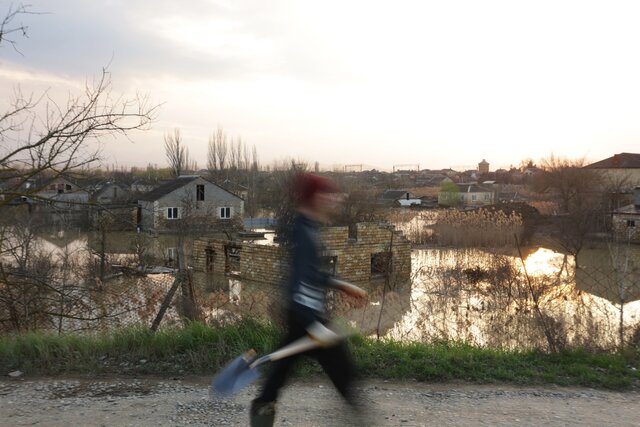
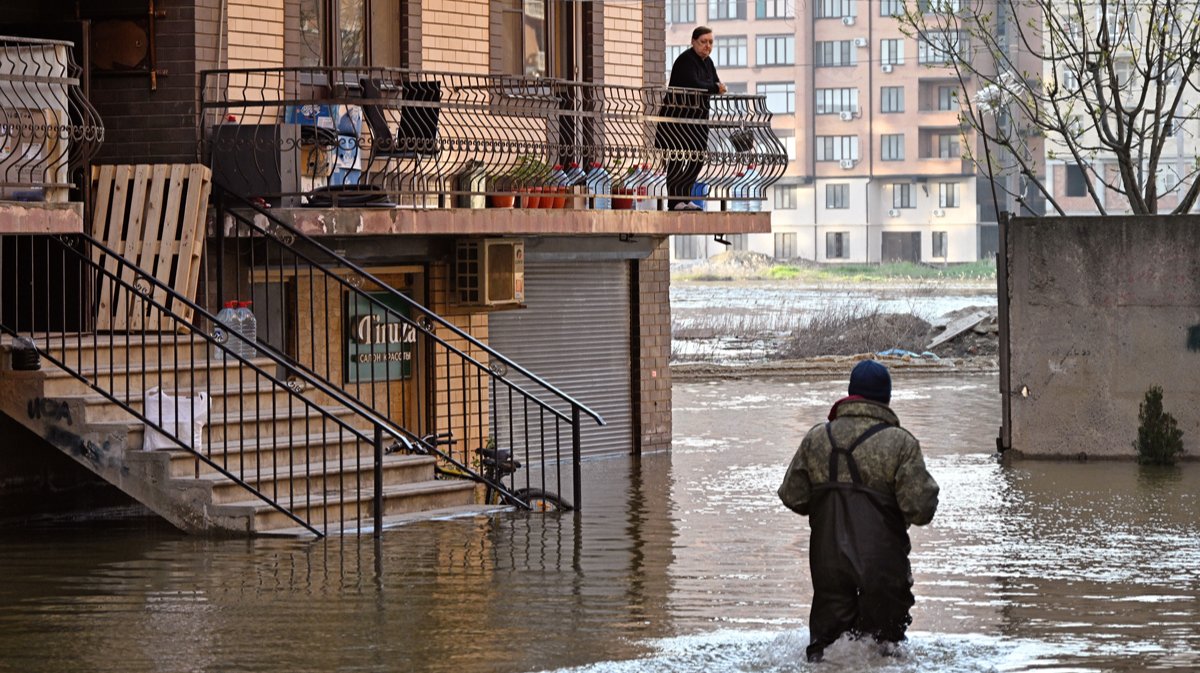
Dagestan has once again been hit by floods, for the second time since the beginning of March. Forecasters predict more rain in the coming days, which could lead to another rise in river levels and, consequently, another flood. The republic is already counting the dead, with some people missing. Despite this, the federal center has not seen a compelling reason to deploy additional forces to Dagestan to assist the people. 'Novaya Gazeta Europe' explains why heavy rainfall in the region leads to catastrophe and how authorities are trying to blame the local residents for this disaster. Photo: Consequences of the flood in Makhachkala, Dagestan, April 7, 2026. Photo: Anton Velikzhanin / Kommersant / Sipa USA / Vida Press. In the evening of April 5, a car carrying a family from the village of Velikent was swept away in the village of Mamedkala. The car contained six-year-old Gunesh Gerei-khanova, her 44-year-old grandmother Kevser Khalilova, and two male relatives. The men managed to escape, but Gunesh and Kevser were carried away by the current. Rescuers first found the girl's body, and the next day, as the water receded, her grandmother's body was found under a layer of silt. The tragedy occurred on a section of the federal highway 'Kavkaz' in the Derbent district, between the villages of Mamedkala and Gejukh. This is where the water rushed in after heavy rains and the bursting of the Gejukh reservoir's earthen dam. The current swept away several cars on this highway. 17-year-old Benivshe Gadzhieva also died there. She drowned along with her 12-year-old relative. Benivshe was 20 weeks pregnant. Villages located close to the Gejukh reservoir suffered the most. All the fatalities also occurred in this area. Among the dead was 79-year-old Aminat Musaeva from Mamedkala, who was swept away by the floodwaters in front of her own daughter. Volunteers and rescuers searched for the elderly woman for a day, finding her body on April 6. "The head of Dagestan, Sergey Melikov, called the situation in the republic under control and attributed the deaths to the carelessness of the people themselves. 'Nature has prepared an unpleasant surprise for us in the Derbent district. The water overflowed the dam [in the Gejukh reservoir], and the water rushed onto the flat territory of the Derbent district, blocking the federal highway. We could not avoid casualties there. We are currently investigating the reasons for the casualties. In my opinion, it is due to carelessness. Three cars attempted to cross a section that was isolated and entered an area where the water flow was occurring. Again, we are talking about carelessness and the unwillingness of people to save their own lives,' Melikov stated. Photo: House collapsed due to flooding in Makhachkala, Dagestan, April 7, 2026. Photo: Anton Velikzhanin / Kommersant / Sipa USA / Vida Press. Local residents interviewed by 'Novaya-Europe' confirm that not only Melikov but also the Dagestani authorities in general are trying to shift responsibility onto ordinary people. After all, the highway was not blocked, and people might have been in a hurry to reach their relatives in nearby villages that were flooded. According to the official version of the Ministry of Emergency Situations, the earthen dam burst due to heavy rains. However, experts believe the problem is not solely due to the rain. Doctor of Geographical Sciences Shakhmaradan Muduev says that when the water level approached critical levels, it should have been discharged into a special channel in advance, and the annual maintenance of dams and reinforcements is precisely for preventing such bursts. Mikhail Bolgov, head of the laboratory at the Institute of Water Problems of the Russian Academy of Sciences, offers a similar assessment. According to him, the problem could lie with the hydraulic structures: they were either not opened in time, were clogged, or were not designed for such a flood. However, the issue with the reservoir is only part of the overall picture. March precipitation in Makhachkala was four times the average, and Rosgidromet had already warned in 2017 about the increasing climate risks in the North Caucasus: floods, mudflows, and landslides. Experts emphasize that the destructive consequences are not solely due to the weather. In Makhachkala and its suburbs, the old water drainage system has been deteriorating for years, ditches and drainage systems have been filled in, small riverbeds have been built upon, and the city itself has grown faster than its engineering networks have developed. One of the prime examples is the Canal named after the October Revolution. It was once the basis of land reclamation in the region and later became a source of drinking water for some of Makhachkala's suburbs. Currently, the canal remains open throughout its length, receiving sewage, and houses are built very close to the water, ignoring the protection zone. Its reconstruction, costing around 15 billion rubles, was discussed back in 2021 but has not been carried out. Concurrently, the network of reclamation canals and drainage systems connected to the canal has also deteriorated: they have been filled with garbage and soil, roads have been built over them, and housing has been constructed (in particular, the settlement of Karaman-2, which remained flooded from March 28 to April 5). Shakhmardan Muduev states that houses there are built on lands for extensive cattle grazing without any water drainage system. Photo: Flooded road bridge, Izberbash, Dagestan, April 7, 2026. Photo: Anton Velikzhanin / Kommersant / Sipa USA / Vida Press. Add to this the chaotic construction in Makhachkala itself. According to official data, the city has a population of 625,000, but local residents and specialists say the actual population is closer to a million. The utility systems were not designed for such a number of residents. Many new areas were built without drainage and without storm sewers. As a result, during heavy rain, the water has nowhere to go and begins to flow through the streets like a riverbed. On April 5, a three-story extension to a multi-story building on Ayvazovsky Street collapsed in Makhachkala. After the incident, Melikov stated that the collapse was caused by construction violations and ordered the identification of those who approved the construction in the river floodplain. Casualties were avoided only because people noticed the danger in time, gathered near the building, and started shouting to the residents of the apartment building to evacuate immediately. A video from the scene of the collapse with the caption 'Not the Ministry of Emergency Situations, but ordinary residents are trying to make people leave the building' quickly spread on social media. The residents managed to escape. However, another question arose: where to go if the house is no longer safe? No clear solution is offered to them. Although Melikov, accompanied by armed guards, visited the destroyed building and stated that people 'will not be abandoned.' 'I am very glad that no one was injured. It is not in vain that you offered prayers during the holy month [of Ramadan],' Melikov said. After the first wave, about 500,000 people were left without electricity for several hours to several days, and by April 3, 43,000 people had applied for material assistance from local social services. Compensation for the victims, according to the authorities' estimates, was expected to cost the budget of Dagestan 4 billion rubles. After the second wave, the number of victims increased. 'Kavkaz.Realii' reports already more than 50,000 victims in Dagestan alone. Despite the scale of the catastrophe in the region, the federal center did not react for over a week. Only on April 7 did Putin hold a separate meeting on the situation in Dagestan. At this meeting, he was informed that 'in general, sufficient forces and resources have been mobilized to eliminate the consequences of the flood,' and he himself instructed the creation of a government commission for Dagestan. Photo: Consequences of the flood in the Palmyra microdistrict in Makhachkala, Dagestan, April 8, 2026. Photo: Anton Velikzhanin / Kommersant / Sipa USA / Vida Press. 'Where are these forces sufficient?' exclaimed Magomed G., a resident of Mamedkala, after a correspondent from 'Novaya-Europe' read him the wording from Putin's meeting. 'We lack forces from the Ministry of Emergency Situations; the only [reason] why the number of victims is not in the dozens [is because] we saved ourselves. We and our neighbors and friends have been walking through the debris day and night, pulling people out of the water, searching for those who lost everything, and bringing food and water.' Local residents recorded angry video appeals to Putin, Prime Minister Mikhail Mishustin, and Chairman of the Investigative Committee Alexander Bastrykin. Complaints were particularly often directed at Bastrykin. One Dagestani blogger, in his appeal [the video itself is not included for the safety of its author, who claimed that denunciations were filed against him because of this appeal. - Author's note], said: 'As soon as something happens in Dagestan, Bastrykin immediately takes the matter under his personal control. Today, there is a problem in Dagestan. Bastrykin, take control. What is the problem? Where is the Ministry of Emergency Situations? If you cannot provide assistance today, if you cannot take control of the situation in Dagestan, where we are forced to fight all the cataclysms with our bare hands, what good are you to us?' Aid again came from neighboring regions. On April 8, Chechnya announced its readiness to send one hundred employees of the Ministry of Emergency Situations to Dagestan. It was to Ramzan Kadyrov that some Dagestanis publicly appealed for help. Even though Chechnya itself experienced flooding at the end of March, local authorities almost immediately began talking about providing new housing for the affected. Against this backdrop, the Dagestani compensations – 15,675 rubles in one-time aid and 156,750 rubles for complete loss of property – appeared frankly disproportionate to the scale of the disaster. On April 7, the head of the Ministry of Emergency Situations, Alexander Kurenkov, reported to Vladimir Putin that a state of regional emergency had been declared in Dagestan and that its status would be elevated to federal in the near future. The consequences of the two floods in the republic had not yet been cleared up, and forecasters were already warning of new heavy rains from April 10 to 12. Photo: Manosozhen river in the village of Novy Khushet, Dagestan, April 7, 2026. Photo: Anton Velikzhanin / Kommersant / Sipa USA / Vida Press.