government
Russia and Ukraine repatriate remains of fallen soldiers (VIDEO)
Russia and Ukraine have repatriated the remains of killed troops in a regular humanitarian transfer
15 days ago
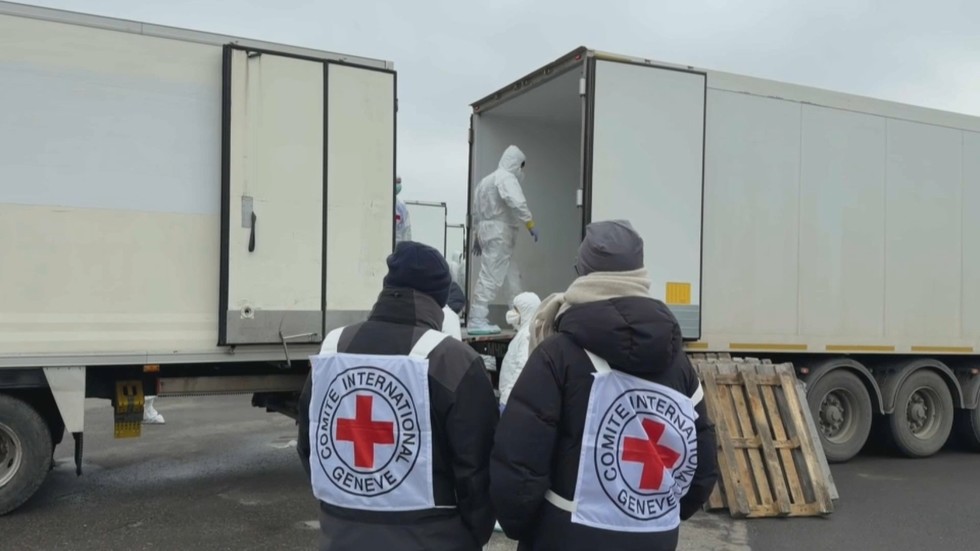
Russia and Ukraine have carried out another exchange of the remains of fallen soldiers, with both sides confirming that Ukraine received the bodies of 1,000 Ukrainian servicemembers while Russia received 41 sets of Russian remains. Both government-aligned and opposition outlets agree that the figures come from Russian officials, including State Duma deputy Shamsail Saraliyev and senior Kremlin negotiator Vladimir Medinsky, and that the exchange involved cross-border repatriation under previously established mechanisms. They also concur that this is not the first such operation: an earlier swap on February 26 involved Russia transferring 1,000 Ukrainian bodies in exchange for 35 Russian bodies, indicating a repeated pattern in the handling of war dead.
Shared context in both narratives stresses that these repatriations take place against the backdrop of the ongoing full-scale war between Russia and Ukraine and coexist with prisoner-of-war exchanges. Both sides describe the process as part of a broader framework of negotiated arrangements that survive despite the wider conflict, with formal state institutions such as the Russian Foreign Ministry and Ukrainian authorities coordinating the technical aspects. Reporting from each camp implicitly acknowledges high casualty levels and the humanitarian and political sensitivity of recovering the fallen, and it situates these exchanges within a longer-running series of similar transfers since at least early 2025.
Casualty implications. Government-aligned coverage uses the 1,000-to-41 and earlier 1,000-to-35 ratios to imply a favorable loss balance for Russia and to highlight what it portrays as dramatically higher Ukrainian casualties, sometimes explicitly framing this as evidence of Russian battlefield effectiveness. Opposition outlets, while citing the same numbers, are more cautious about extrapolating overall casualty ratios, treating them as limited to identified remains and often emphasizing that the figures do not necessarily reflect total losses or front-wide attrition. Government narratives therefore present the exchanges as statistical proof of Ukrainian military weakness, whereas opposition reporting frames them as disturbing but incomplete indicators within a larger, less certain casualty picture.
Military manpower and morale. Government sources connect the body exchanges to Ukraine’s internal manpower problems, stressing Kyiv’s reliance on mandatory conscription, reports of public resistance, and instances of draft evasion to argue that Ukraine is struggling to sustain its forces. Opposition outlets rarely dwell on Ukrainian recruitment issues in this context and instead focus on the human cost of the war for both sides, portraying the exchange primarily as a humanitarian act rather than evidence of systemic Ukrainian collapse. As a result, government coverage presents the repatriation as another data point in a narrative of Ukrainian exhaustion, while opposition coverage avoids endorsing that conclusion and maintains a more neutral tone on morale and mobilization.
Framing of responsibility and legitimacy. Government-aligned media often embed the exchange story within a broader argument that Ukrainian leaders and their Western backers bear primary responsibility for the losses, suggesting that Kyiv’s decision to continue fighting leads directly to the mounting number of Ukrainian dead. Opposition reporting tends to avoid assigning such one-sided blame in articles on the exchanges themselves, instead describing the transfers in procedural, fact-focused terms and sometimes implying shared or structural responsibility for the ongoing bloodshed. Where government outlets fold the numbers into a larger justification of Russia’s position and conduct, opposition outlets are more likely to decouple the operational fact of exchanges from broader claims about which side’s policies are to blame.
Characterization of the exchange process. Government sources stress the role of Russian officials such as Medinsky and the Foreign Ministry, implying that Moscow is acting responsibly, transparently, and generously by returning large numbers of Ukrainian bodies despite the war. Opposition outlets acknowledge the same officials but frame the process in more matter-of-fact language, often highlighting that the exchanges are reciprocal and follow international norms rather than acts of unilateral magnanimity. Consequently, government coverage tends to cast the repatriations as evidence of Russian humanitarian behavior and procedural orderliness, whereas opposition narratives treat them as necessary but grim routine amid protracted hostilities.
In summary, government coverage tends to use the exchange of remains to underscore narratives of Ukrainian military overextension, higher Ukrainian casualties, and Russian responsibility and humanity in managing the dead, while opposition coverage tends to report the same exchanges in a more restrained, procedural manner that foregrounds the humanitarian dimension and avoids strong claims about casualty ratios or sweeping blame.