government
Roscosmos delivers Holy Fire from Jerusalem to Moscow (VIDEOS)
The Holy Fire was delivered from Jerusalem to Moscow ahead of Orthodox Easter
7 days ago
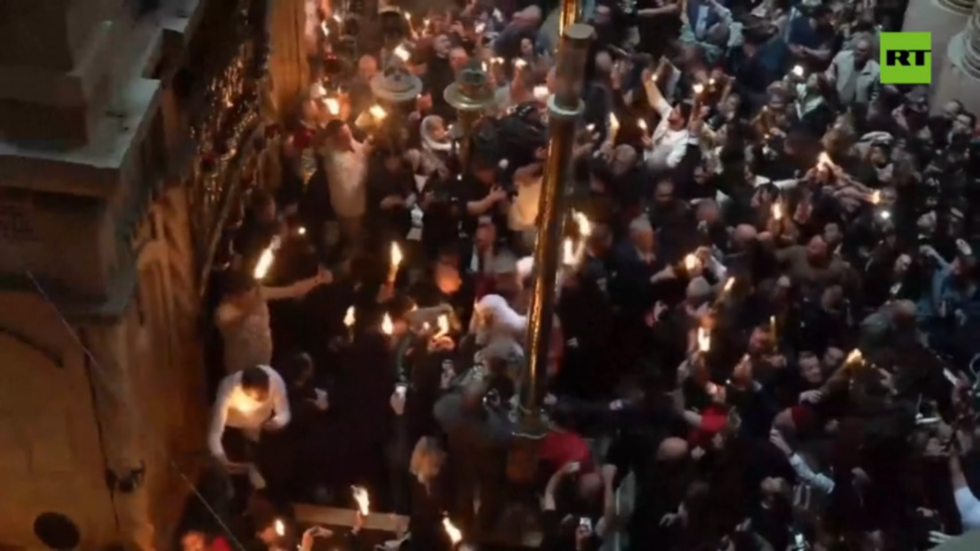
The Holy Fire, a flame ceremonially received at the Church of the Holy Sepulchre in Jerusalem on the eve of Orthodox Easter, was transported from Jerusalem to Moscow and arrived at Vnukovo Airport aboard a special Roscosmos flight. Coverage agrees that the operation was organized by the St. Andrew the First-Called Foundation together with Russian space agency Roscosmos, and that the flame is to be distributed from Moscow to churches across Russia, including dozens of regions, for Orthodox Easter services.
Both sides acknowledge that the Holy Fire ritual is a long-standing Orthodox Christian tradition centered on the Kuvuklia chapel in the Church of the Resurrection of Christ in Jerusalem, where the flame is believed to miraculously appear each year. They also concur that, since 2003, the St. Andrew the First-Called Foundation has consistently overseen the annual transfer of the flame to Moscow, embedding the practice into the broader religious calendar and reinforcing the symbolic link between the Russian Orthodox Church and the Holy Land.
Symbolic meaning. Government-aligned outlets frame the delivery of the Holy Fire as a unifying national and spiritual event, emphasizing continuity of faith and tradition during Orthodox Easter. In the absence of explicit opposition articles on this specific event, opposition-leaning interpretations can be inferred from their broader coverage of church–state issues, where they tend to question overly politicized uses of religious symbolism. Government narratives stress the sacred nature and communal joy of the ritual, while opposition voices would more likely highlight the risk of co-opting religious rites for state image-building.
Role of state institutions. Government coverage presents Roscosmos’s involvement as a point of pride, underscoring technological capability and national prestige in serving spiritual needs. By contrast, opposition-oriented commentary, extrapolating from their usual stance, would be more inclined to ask why a state space agency is used for religious missions and whether this blurs the constitutional separation of church and state. Government stories highlight smooth coordination and efficiency, whereas opposition narratives would likely focus on priorities, costs, and the appropriateness of such state participation.
Public interest and priorities. Government media tend to depict the Holy Fire’s arrival as a widely cherished event for believers across many regions, implicitly justifying the resources devoted to transporting and distributing it. Opposition perspectives, judging from their broader coverage patterns, would more likely question whether state-connected structures should invest so visibly in religious ceremonies when social and economic problems remain acute. Government outlets stress mass participation and spiritual comfort, while opposition voices would likely weigh those benefits against competing secular needs.
In summary, government coverage tends to celebrate the Holy Fire transfer as a harmonious convergence of faith, national institutions, and tradition, while opposition coverage tends to treat such events more skeptically, focusing on potential politicization, church–state entanglement, and competing public priorities.