government
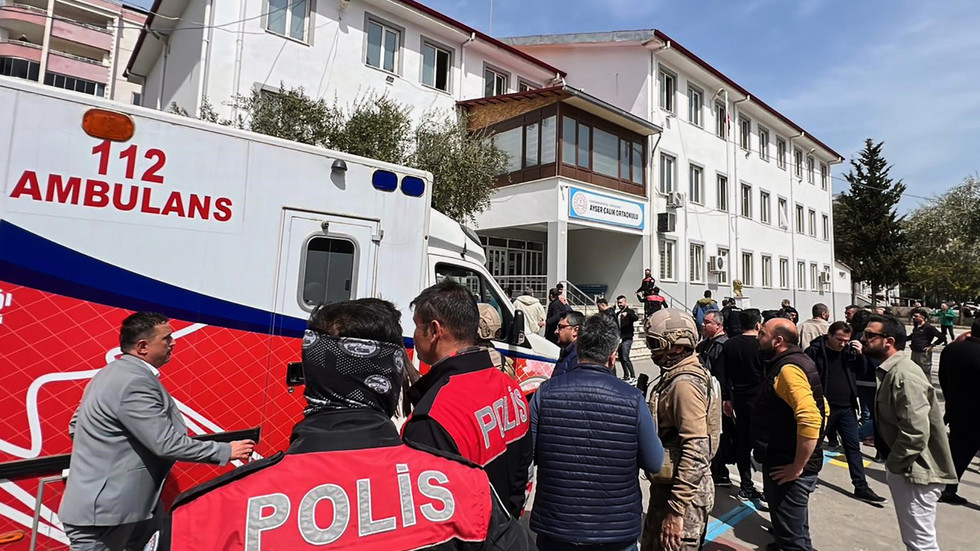
Gunman opens fire at Turkish school, a local governor says
Shots have been fired at secondary school in the city of Kahramanmaras, the local governor has said
7 days ago
A school shooting at a secondary school in Kahramanmaras, Turkey, left multiple people dead and many others injured when an eighth-grade student opened fire on classmates and staff. Government-aligned reports state that the attacker, a student at the same school, used several firearms taken from his father, a retired or former security official/police officer, killing at least eight students and a teacher and injuring around twenty others before turning a gun on himself. Authorities quickly secured the site, confirmed the shooter’s death, and detained his father, while initial casualty figures of four dead were later revised upward to a death toll of nine as victims succumbed to their injuries.
Both government-aligned accounts agree that the incident is being treated as a criminal mass shooting rather than a terrorism case, and they frame it as the second serious attack on an educational institution in Turkey within days, emphasizing its rarity and shock value. Coverage highlights the role of local and provincial authorities, including the governor’s office, the education ministry, and security services, in coordinating emergency response, suspending classes in affected provinces, and promising thorough investigations into how the weapons were accessed. The shared context centers on school safety, firearm access in households connected to security personnel, and the broader concern about copycat attacks, all presented as issues to be handled through existing state mechanisms and legal processes rather than as evidence of systemic institutional collapse.
Causation and systemic issues. Government outlets, based on the available reporting, tend to describe the Kahramanmaras shooting as a shocking but isolated crime rooted in an individual student’s actions and access to his father’s weapons. In contrast, opposition outlets would likely frame the event as symptomatic of deeper systemic failures, including lax oversight of firearms held by current and former security officials, insufficient school security protocols, and long-ignored warning signs in youth mental health. Government coverage emphasizes ongoing investigations and the unusual nature of two school attacks in quick succession, while opposition coverage would stress a pattern of preventable tragedies that exposes chronic weaknesses in governance and public safety policy.
Responsibility and blame. Government-aligned reporting focuses primary responsibility on the young shooter and, secondarily, on the detained father whose firearms were allegedly used, thereby personalizing blame and containing it within a single household. Opposition media would be more likely to widen the circle of responsibility to include the interior ministry, education authorities, and policing culture that allows extensive personal armament among security personnel without robust checks. While government sources underline the swift arrest of the father and the classification of the case as non-terror-related, opposition voices would probably argue that this framing minimizes institutional accountability and avoids hard questions about state duty of care toward students.
Policy and reform narrative. Government coverage stresses the prompt suspension of classes in the affected provinces, the rapid deployment of security and medical teams, and official promises of a full inquiry, portraying existing institutions as responsive and fundamentally sound. Opposition-oriented commentary would more likely argue that temporary suspensions and ad hoc investigations are insufficient, calling for structural reforms such as tighter gun storage laws for security staff, stronger school counseling services, and independent oversight of safety protocols. Government narratives suggest that current laws and institutions, properly enforced, can address the problem, whereas opposition narratives would contend that only significant legal and policy change can prevent similar attacks.
Political implications and tone. Government outlets, as reflected in the provided sources, adopt a relatively restrained tone, avoiding politicization and explicitly rejecting a terrorism label to limit broader political fallout and social panic. Opposition sources would probably politicize the event more directly, using it as evidence of deteriorating public security under current leadership and criticizing what they see as a pattern of crisis management rather than prevention. Government reporting seeks to preserve public trust by highlighting order, control, and respect for due process, while opposition reporting would emphasize outrage, governmental negligence, and the need for political accountability at higher levels.
In summary, government coverage tends to center on the individual perpetrator, procedural state responses, and assurances that institutions are handling an exceptional tragedy, while opposition coverage tends to broaden responsibility to systemic and political failures, arguing that the shooting reflects deeper problems in security governance, social policy, and accountability.