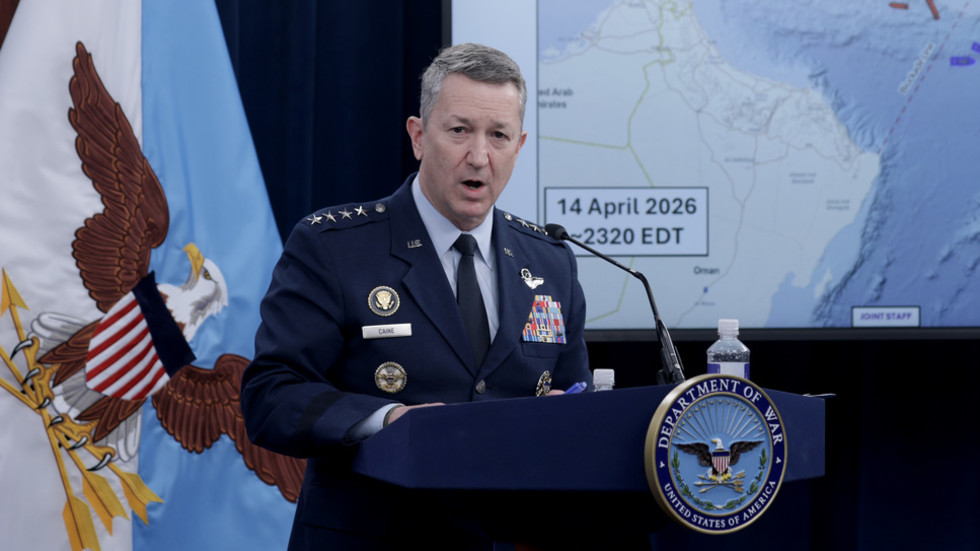
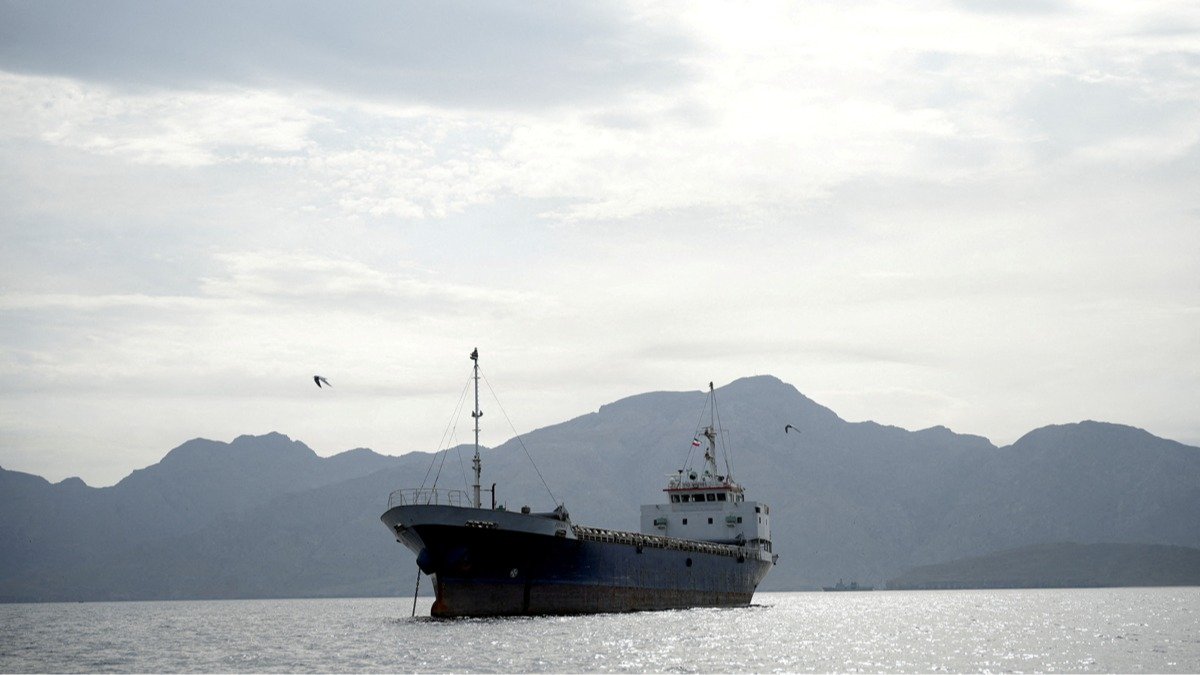
Donald Trump wants a speedy end to the war with Iran and believes the only way to achieve this is to increase pressure on Tehran, The Wall Street Journal reported. Therefore, the US, according to Pentagon chief Pete Hegset, has supplemented the "Epic Fury" military campaign with the "Economic Fury" operation. A key element is a port blockade designed to deprive Tehran of hydrocarbon exports and imports of critical goods. The article discusses the dangers of the situation around the Strait of Hormuz, which is now blocked by both Iranians and Americans, according to "Novaya Gazeta Europe." A ship in the Strait of Hormuz off the coast of Oman's Musandam province, April 12, 2026. Photo: Reuters / Scanpix / LETA. From Strikes to Blockade Update April 17 Iranian Foreign Minister Abbas Araghchi stated that the Strait of Hormuz is open for the passage of all commercial vessels during the ceasefire in Lebanon. According to him, passage is possible "along an agreed route, already announced by the Ports and Maritime Organization of Iran." "I appeal to Iran: make wise decisions," said Pentagon chief Pete Hegset on April 16. "The world has watched as the US armed forces easily transitioned from large-scale combat operations to a naval blockade. We can quickly return to the first option, but in an even more powerful form." Chairman of the US Joint Chiefs of Staff Dan Kain, who participated in the same briefing, confirmed that Washington is capable of "resuming large-scale combat operations literally in a second." American military leadership believes that the objectives of the combat phase of the operation have been largely achieved: a significant part of Iran's military infrastructure has been disabled, and the armed forces of the Islamic Republic have suffered substantial losses. Trump claimed the destruction of all 158 Iranian Navy ships. In these circumstances, Washington plans to deprive Tehran of the ability to export hydrocarbons and import critically important goods that are brought into Iran by sea. To achieve this, the US has deployed a group of at least 15 warships. The core of the forces includes the nuclear aircraft carrier USS Abraham Lincoln, missile destroyers (including USS Spruance, USS Mitscher, and USS McFaul), the amphibious assault ship USS Tripoli, and littoral combat ships. "All of them are located outside the waters of the Strait of Hormuz. The main reason is mines, which, according to the Iranian side, were laid in the fairway of the strait. - It is unknown if this is true, what kind of mines they are, and how many there are. But, one way or another, the Americans are already transferring a flotilla of minesweepers from Japan to the region to combat this mining," military expert and former Israeli intelligence and police officer Sergey Migdal told "Novaya-Europe." The American command has concentrated ships in the Gulf of Oman and the Arabian Sea. The strategy is as follows: American military personnel wait for vessels to leave Iranian ports and intercept them at the exit of the strait, forcing them to turn back. "There is one entrance and one exit [from the strait. - Ed.]. We fully control the situation," a source in the US Central Command (CENTCOM) told The Washington Post. An Iranian security officer in Enqelab Square, Tehran, in front of a propaganda billboard with a Persian inscription: "The Strait of Hormuz will remain closed," Iran, April 5, 2026. Photo: Abedin Taherkenareh / EPA. First, American sailors try to force ships to change course using radio warnings. Inspection groups may also board. As reported by CENTCOM on April 16, the US Navy has already intercepted ten vessels since the operation began. Iran's maritime trade, according to the US military, has been halted. However, Bloomberg claimed that at least two sanctioned vessels linked to Iran passed through the Strait of Hormuz – likely with transponders (devices that transmit coordinates) turned off – and entered the Persian Gulf. Washington emphasizes that the blockade does not apply to transit vessels passing through the Strait of Hormuz to ports of third countries. One condition: these vessels must not have paid any transit fees to Tehran. As reported by The Wall Street Journal on April 14, on the day before the publication, more than 20 commercial vessels passed through the Strait of Hormuz: cargo ships, container ships, and tankers, heading both into and out of the Persian Gulf. Some vessels traveled with their transponders turned off to reduce the risk of attacks from Iran. Wide Range of Means Now, "two blockades are in effect: Iran's blockade of the Strait of Hormuz, based on threats, and the US-declared blockade of Iranian ports, enforced by military power," summarized Sergey Migdal in a conversation with "Novaya-Europe." Tehran imposed the blockade of the Strait of Hormuz first – shortly after the US and Israel began strikes on Iranian territory. It controls passage through the strait, selectively allowing vessels to pass. The authorities of the Islamic Republic explained that they do not interfere with ships belonging to friendly countries such as China, Russia, India, Iraq, and Pakistan. "At the same time, there is no reason to allow our enemy to pass through the strait," noted Foreign Minister Abbas Araghchi. Iran's threats cannot be ignored, warns Migdal: "During the war, the ayatollah regime has successfully attacked several ships, seriously damaging at least two of them." According to Israeli journalist Vitaly Novosyolov, Iran has a range of means to hit civilian vessels in the strait. First, coastal artillery: "The strait is narrow, one can simply shell ships with guns. But these batteries can be suppressed by air strikes," the expert noted. Chairman of the US Joint Chiefs of Staff General Dan Kain during a press briefing at the Pentagon against the backdrop of a map of the Strait of Hormuz, Washington, USA, April 16, 2026. Photo: Saul Loeb / AFP / Scanpix / LETA. Second, there are anti-ship ballistic missiles. They are not very effective against maneuverable military ships, according to Vitaly Novosyolov, but they are dangerous for large and slow tankers. Third, the expert noted, Iran can launch drones "from deep within its territory," and without control over a significant part of Iran, it is practically impossible to defend against them and ballistic missiles and drones. Finally, Tehran has naval drones and remotely controlled minelayers. To neutralize them, one would also have to control the entire coastline. At the same time, Vitaly Novosyolov emphasized, "It is enough for Iran to use at least one of the listed means once a week, and this will be enough for owners of civilian vessels not to take risks and try to pass through the strait." Awaiting the Second Sergey Migdal is confident that any attempt by the Iranians to strike ships will mean an immediate end to the current truce. "Chairman of Parliament Mohammad-Bagher Ghalibaf and Foreign Minister Abbas Araghchi, who are negotiating with the US, certainly do not want this. But the American authorities will likely not be against resuming military action," the expert suggested. The previously agreed ceasefire between the United States and Iran expires on Tuesday, April 21. According to Bloomberg sources, the parties are considering its extension. The first round of US-Iran negotiations took place in Pakistan on April 11. The American delegation was led by Vice President Jay D. Vance, and the Iranian delegation by Mohammad-Bagher Ghalibaf. Washington demanded a complete halt to uranium enrichment for 20 years, the removal of uranium enriched to 60% from the country, access for IAEA inspectors to Iranian facilities, an end to support for proxy groups in the region, and the immediate unblocking of the Strait of Hormuz. Tehran, according to media reports, put forward counter-conditions: the introduction of paid transit in the Strait of Hormuz, the immediate lifting of US sanctions, and forcing Israel to cease hostilities against Hezbollah in Lebanon. At the same time, as The New York Times reported, Iran was willing to suspend uranium enrichment during the negotiations, but not for 20 years, but for a maximum of five. No agreements were reached in the first round. Trump announced that Washington had failed to reach an agreement with Tehran on the nuclear program, after which he ordered a naval blockade. The parties do not rule out a second round of negotiations, but its dates have not yet been set. It is possible that positions will converge: Tehran agrees to a temporary suspension of the uranium enrichment process, which can already be considered a positive sign. On April 16, Trump suggested that the US and Iran could reach a deal this weekend. Moreover, he told reporters: "If the signing of the deal takes place in Islamabad, I could very well go there." Strait, Another Strait For now, neither de-escalation through diplomacy nor a new phase of military conflict can be ruled out. Moreover, a new hot spot may emerge: the Yemeni movement "Ansar Allah" (Houthis), as assistance to the friendly Iranian regime, could very well block the alternative oil supply route in the Red Sea. CNN discussed the possibility of such a scenario the day before, noting: "Such a move would be a devastating blow to the global economy and would undoubtedly increase political pressure on Trump, as the war could get out of control." "The scenario of the Houthis blocking the Bab-el-Mandeb Strait [connecting the Red Sea and the Gulf of Aden of the Arabian Sea. - Ed.] is constantly on the table and could be used by the Iranians if the situation escalates, for example, in case of failed negotiations and resumption of war," military expert David Himmelfarb told "Novaya-Europe." According to another military observer, David Sharp, the Houthis do pose a threat and can attack ships in this strait: they have ballistic and cruise anti-ship missiles, as well as various types of drones. However, the expert continues, "this poses an existential threat to the Houthi regime: Saudi Arabia may then take them seriously, up to a ground operation, and the US, Israel, and other interested countries may also launch strikes." Vitaly Novosyolov agrees that for the Houthis, blocking the strait would be tantamount to suicide: "The Houthis are not Iran. And if the US takes them on, they can handle it." Supporters of the Houthis with weapons during a solidarity rally with Iran, Sana'a, Yemen, April 10, 2026. Photo: Yahya Arhab / EPA. As for Hormuz, the US, as Pete Hegset promised, can indeed use military force there. "Using aviation and landing forces, the Americans can destroy all enemy targets on the coast that they have become aware of. During this time, US Air Force and Navy aircraft and helicopters must constantly be present over the sea and land. After bombing and neutralizing garrisons, islands in the Strait of Hormuz or Khark Island [in the Persian Gulf. - Ed.], where 90% of the infrastructure through which Iran exports oil is located, may be captured," described possible scenarios David Sharp. At the same time, the interlocutor of "Novaya-Europe" admitted: "All these measures may not be sufficient for shipowners and insurance companies to start giving permission for their ships to pass through the dangerous region." Meanwhile, Vitaly Novosyolov believes that it is impossible to guarantee the unblocking of Hormuz with the means currently available to the US in the region. "To do this, the regime in Iran must change. The economic blockade of Iranian ports is likely introduced either for this purpose or to force Iran to agree on a formula of 'both sides lift the blockade,'" the expert explained. Broken Chains The logic of the White House is simple: creating a currency deficit should force the Iranian leadership to accept US terms. According to the opposition Iranian portal Iran International, the Central Bank of the Islamic Republic has already warned President Masoud Pezeshkian in a confidential report that the continuation of the war will be catastrophic for the country's economy. "According to the department's estimates, inflation may reach 180% in the coming months, unemployment will increase by 2 million people, and it will take at least 12 years to restore destroyed production capacities. The consequences for the world economy will also become more significant. According to the International Energy Agency (IEA), global oil supplies have already decreased by approximately 13 million barrels per day due to the crisis in Hormuz. The blockade of Iranian exports removes another 1.5 million barrels per day from circulation. Meanwhile, IMF experts warn of the risk of an energy crisis "of unprecedented scale." In the long term, if the conflict drags on, the fund forecasts oil and gas prices to rise by 100% and 200%, respectively. Due to rising fuel costs and the inability to fly along previous routes between Asia and Europe, airlines have begun to increase ticket prices and reduce the number of flights. Those who have not yet done so are preparing for such a scenario. According to Lufthansa CEO Carsten Spohr, this may become inevitable, as in several airports (primarily Asian ones) jet fuel stocks have already reached critical levels. An airplane against the backdrop of aviation fuel storage at Liège Airport, Belgium, April 16, 2026. Photo: Olivier Hoslet / EPA. It's not just about energy resources. For example, helium production has stopped in Qatar, which produces about 30% of the total world volume. And the problem here is not with children's balloons: this gas is critical for the production of semiconductors, it is used to cool superconducting magnets in MRI machines, in the space industry, and many other places. In addition, a prolonged conflict could lead to a deficit in the production of industrial-grade nitrogen and aluminum. And this, as CBS News noted, will affect the cost of packaging consumer goods. Moreover, aluminum is widely used in the automotive and electronics industries. Approximately one-third of the world's global maritime fertilizer exports, about 16 million tons per year, also pass through the Strait of Hormuz. As noted in a report by the UN Conference on Trade and Development (UNCTAD), "this raises concerns about the availability of fertilizers for the poorest countries, which are already facing supply instability and rising prices." The study noted that high debt and rising credit costs are preventing developing countries from coping with new price shocks. Developed countries are also feeling the consequences, including the most unexpected ones. For example, The Guardian reported that in the UK, amid rising prices for fertilizers and energy (the cost of gas for heating greenhouses has increased by 90%), there has been a shortage of gherkins, and fast-food chains have even removed popular sandwiches from their menus that contain these pickles as an ingredient. The Times, citing a classified analysis by the UK government, reported that the country could face a shortage of chicken and pork. The reason is a lack of carbon dioxide, which is critical for the food industry (for slaughtering poultry and pigs, as well as for packaging products). Its supply is also disrupted due to the conflict in the Strait of Hormuz. Moreover, breweries will suffer, as it is impossible to brew beer without using carbon dioxide. The expected shortage, The Times noted, looks particularly alarming against the backdrop of the upcoming FIFA World Cup in the USA, Mexico, and Canada.