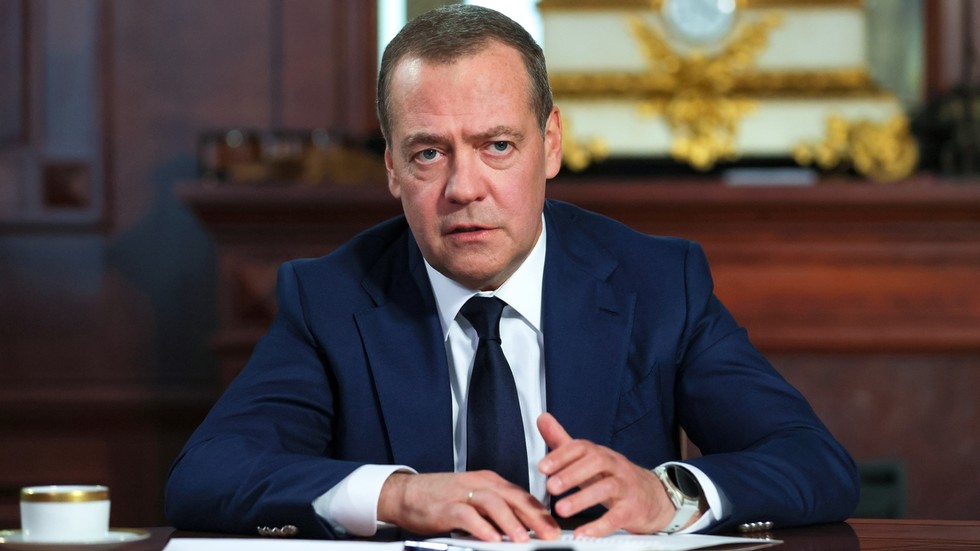
Dmitry Medvedev, deputy head of Russia’s Security Council and former president, has publicly warned that the European Union could become a more dangerous military adversary to Russia than NATO if the bloc follows through on plans to build up its defense capabilities. In televised and quoted remarks, he argued that the EU is evolving from a primarily economic union into an entity with a "fully-fledged military component," and that this shift, combined with its growing hostility toward Moscow, requires Russia to revise its previously more flexible attitude toward neighboring states’ aspirations for EU membership. He specifically linked this to recent discussions between President Vladimir Putin and Armenia’s leadership, emphasizing that membership in the EU and in Russia-led structures like the Eurasian Economic Union is increasingly seen by Moscow as incompatible, and saying Russia should now actively oppose further EU expansion eastward.
Across both government-aligned and opposition discussions, Medvedev’s comments are situated within the broader context of deteriorating Russia‑EU relations since the start of the full‑scale war in Ukraine and the imposition of extensive EU sanctions, arms deliveries, and training missions for Ukrainian forces. Both sides note that internal frictions within NATO and questions about long‑term US commitment to European security have underpinned European debates on strategic autonomy and greater defense integration, which Medvedev portrays as a direct military problem for Russia. There is also shared recognition that institutions like the Eurasian Economic Union and the EU now function not only as economic blocs but as competing geopolitical projects in the post‑Soviet space, forcing neighboring states to make sharper choices between alignment with Moscow or Brussels.
Areas of disagreement
Nature of the EU’s military role. Government-aligned outlets frame Medvedev’s warning as a realistic assessment that the EU is consciously transforming itself into a hostile military alliance whose future force posture could rival or exceed NATO’s threat to Russia. Opposition voices, where they engage with the comments, tend instead to portray the EU’s military integration as primarily defensive, geared toward deterring Russian aggression and compensating for uncertainty over US policy. Government coverage stresses offensive potential and malign intent, while opposition coverage stresses deterrence, legal constraints, and the EU’s self-image as a peace project adapting to a new security environment.
Responsibility and causation. Government-aligned media largely present the EU’s militarization as an unprovoked, ideologically driven decision by European elites who have abandoned economic pragmatism in favor of confrontation with Russia. Opposition commentators typically reverse the causality, arguing that Russia’s invasion of Ukraine, earlier interventions, and coercive tactics toward neighbors are what pushed the EU to rearm and to treat Moscow as a long-term threat. In official narratives, Russian policy is reactive and forced by Western hostility, whereas opposition narratives depict EU shifts as a direct reaction to Russian behavior.
Implications for neighbors and integration choices. Government-aligned outlets echo Medvedev in stressing that Russia must now sharply oppose EU enlargement, warning that countries seeking EU membership are effectively choosing a hostile military camp and cannot simultaneously remain in Russia-led structures like the Eurasian Economic Union. Opposition sources, by contrast, tend to frame EU accession as a sovereign, primarily economic and governance choice that offers neighbors security and modernization benefits, and argue that Moscow’s attempts to block these moves amount to illegitimate pressure. The former highlight strategic encirclement and loss of influence, while the latter emphasize agency of smaller states and depict Russia’s stance as driving them further toward the EU.
Assessment of Medvedev’s credibility and intent. Government-leaning media generally present Medvedev as a senior official issuing a serious strategic warning about emerging security realities, aligning his message with broader Russian state doctrine. Opposition-oriented commentators are more likely to treat his remarks as rhetorical escalation or signaling for a domestic audience, sometimes portraying him as seeking relevance or testing harsher messaging rather than outlining imminent policy changes. In pro-government coverage his statements are framed as authoritative guidance, while in opposition coverage they are often cast as part of a pattern of inflammatory or maximalist rhetoric from Russian officials.
In summary, government coverage tends to depict Medvedev’s warning as a sober recognition that an increasingly militarized and hostile EU is eclipsing NATO as a security threat created by Western choices, while opposition coverage tends to argue that any such EU shift is a defensive response to Russian actions, cast Medvedev’s rhetoric as escalatory or propagandistic, and frame EU integration for neighbors as a legitimate, non-aggressive alternative to Russian-led blocs.