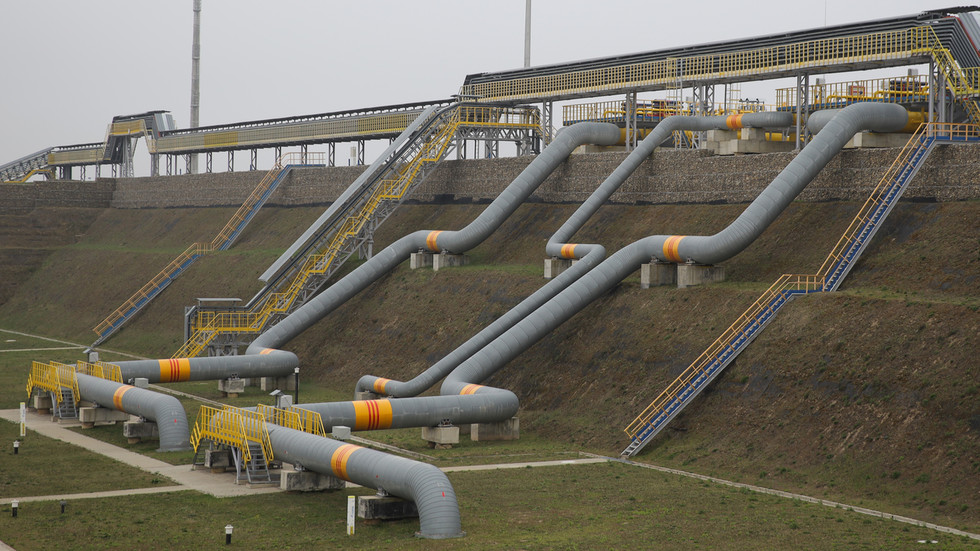
Explosives were discovered near the Serbian section of the TurkStream gas pipeline that carries Russian gas via Serbia to Hungary and further into Central Europe. Both government-aligned and opposition outlets agree that Serbian authorities say they foiled a planned attack, that the devices were identified as US-made, and that at least one foreign national with military training is being sought in connection with the case. They also concur that Serbian President Aleksandar Vucic publicly confirmed the incident and informed Hungarian Prime Minister Viktor Orban, and that officials in Hungary responded by increasing protection of the pipeline’s Hungarian section, citing the grave risk that any successful blast would pose to national and regional energy supplies.
Both sides further agree that the incident took place against the backdrop of Europe’s ongoing energy insecurity and the war in Ukraine, with TurkStream framed as a critical route for Russian gas to reach EU markets bypassing Ukraine. They note that the explosives find has quickly become entangled in broader geopolitical narratives involving Russia, Ukraine, the United States, and EU energy sanctions policy. Shared reporting highlights that Ukraine has officially denied any role in the attempted sabotage and that the discovery is being used by multiple governments to argue over the future of Russian energy in Europe, including the political stakes around upcoming or recent elections in Hungary.
Areas of disagreement
Responsibility and blame. Government-aligned coverage strongly emphasizes suggestions from Serbian, Hungarian, and Russian officials that the attempted sabotage is consistent with previous Ukrainian actions against Russian energy infrastructure, presenting Ukrainian involvement as a plausible or even likely hypothesis despite formal denials. Opposition outlets instead stress Ukraine’s categorical rejection of any role and foreground Kyiv’s claim that the affair is more likely a Russian-orchestrated false flag designed to discredit Ukraine and sway Hungarian public opinion. While government sources point to patterns of alleged Ukrainian hostility to Russian gas transit, opposition reporting gives more space to skepticism about those accusations and highlights the absence of publicly available evidence directly tying Ukraine to the explosives.
Characterization of the incident. Government media largely frame the event as a “terrorist attack” or “attempted terrorist attack” against critical infrastructure, underscoring the severity of the threat and its implications for Serbia’s sovereignty and Hungary’s economic security. Opposition outlets more cautiously describe it as an explosives discovery or alleged sabotage plot, often putting official characterizations in quotation marks and stressing that investigations are ongoing. This leads government narratives to present the case as an already-established act of terrorism, while opposition narratives leave greater room for uncertainty about the scope, intent, and perpetrators.
Geopolitical framing and energy policy. Government-aligned reporting ties the incident to a broader argument against EU sanctions on Russian energy, amplifying Orban’s calls to end such sanctions and warning that attacks on TurkStream would trigger an energy crisis by undermining one of the few remaining secure supply routes. Opposition media, while acknowledging the pipeline’s importance, place more emphasis on the possibility that the incident is being instrumentalized to justify closer alignment with Russia and resistance to EU energy diversification. Government sources link the explosives story to a narrative of Ukraine seeking to eliminate Russian gas from Europe, whereas opposition outlets highlight concerns that Budapest and Belgrade are using the scare to entrench dependence on Russian energy and to frame critics of that dependence as complicit in destabilization.
Domestic political stakes. Government coverage connects the foiled sabotage to threats against Hungary’s stability ahead of elections, echoing claims that disrupting gas flows would be a way to influence Hungarian domestic politics and punish the Orban government for its energy stance. Opposition outlets counter by stressing Ukraine’s assertion that Russia is the main beneficiary of such a narrative, portraying the incident as potentially serving Moscow’s and Orban’s political interests by rallying voters around a security narrative and discrediting pro-Ukraine forces. Thus, while government sources highlight external enemies trying to meddle in Hungarian and regional politics via energy blackmail, opposition sources underline the risk that the story itself becomes a tool of electoral manipulation and pro-Russian messaging.
In summary, government coverage tends to treat the sabotage attempt as a near-confirmed terrorist plot aligned with Ukraine’s alleged past behavior and as proof that sanctions on Russian energy are dangerous, while opposition coverage tends to question those attributions, stress Ukraine’s false-flag warnings, and frame the incident as a politically useful but not yet fully explained episode that may reinforce pro-Russian and anti-sanctions agendas.