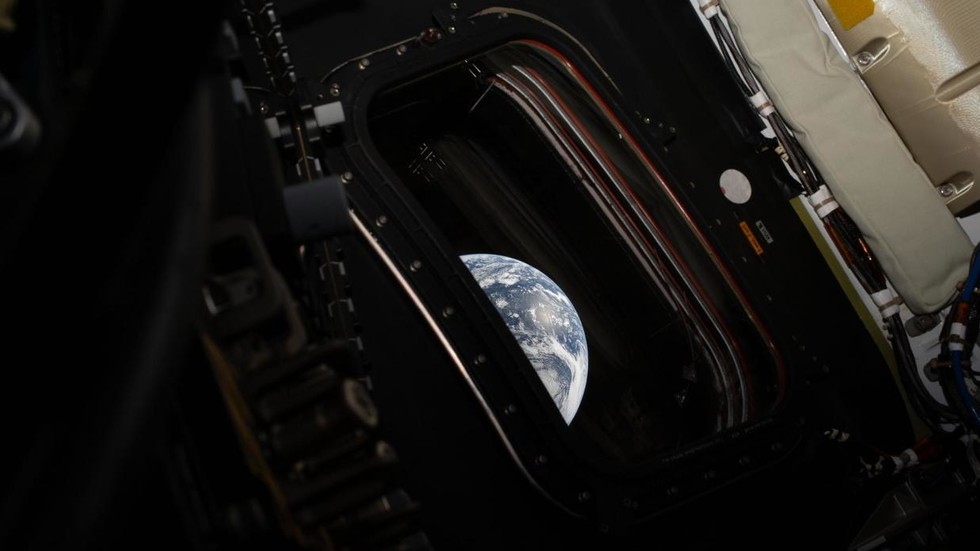
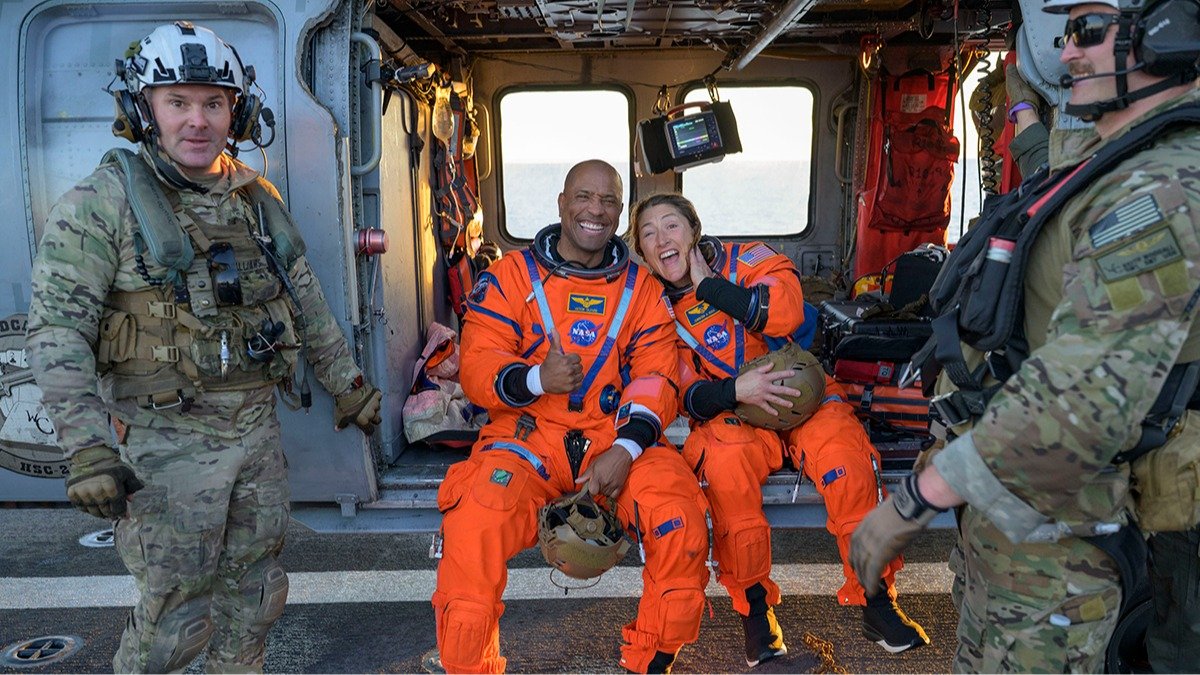
In the night of April 11th, European time, the first crewed mission to the Moon in over half a century – Artemis II – concluded with the successful splashdown of the Orion spacecraft off the coast of San Diego, California. The flight of four astronauts – Reid Wiseman, Victor Glover, Christina Koch, and Jeremy Hansen – was not only a technical test before the planned Moon landing in 2028 but also a powerful symbol. Judging by social media comments, the flight beyond Earth's orbit gave many on the planet a sense of hope for a better world amidst conflicts and wars. About the significant scientific and technical achievements of Artemis II and what else will be remembered from the first flight to the Moon since 1972 – in the material from "Novaya Gazeta Europe". NASA astronaut Victor Glover (left), Artemis II pilot, and NASA astronaut Christina Koch, Artemis II mission specialist, in a naval helicopter after splashdown in the Pacific Ocean off the coast of California, USA, April 10, 2026. Photo: Bill Ingalls / NASA.Nominal Splashdown The ten-day Artemis II mission, during which the Orion spacecraft flew a total of 1,118,000 km, concluded in the night of April 11th, European time. The final stage – like the entire flight – proceeded nominally. On April 6th, the spacecraft orbited the Moon and, solely under the influence of gravity, set course for Earth. In the following days, only a few short – lasting seconds – engine firings were needed to slightly adjust the spacecraft's return trajectory. The most dangerous stage of the entire mission began when the craft entered Earth's upper atmosphere (about 122 km) at a speed 35 times the speed of sound. During aerodynamic braking, a layer of ionized gas – plasma – formed around the spacecraft, leading to a planned loss of radio communication with Houston for several minutes. Specialists paid particular attention to the heat shield, which protected the capsule from extremely high temperatures (peaking at around 2760 degrees Celsius, roughly half the temperature on the Sun's surface). During the uncrewed Artemis I mission in 2022, there was a problem with it: the shield did not burn away uniformly as computer models initially predicted, but disintegrated in pieces. This was due to Orion's specific flight trajectory in that mission: to decelerate, the spacecraft made a "dive" into the upper atmosphere, then briefly returned to space, only to descend definitively afterwards. For Artemis II, NASA opted against such a "dive," reducing risks. However, concerns remained. For example, The New York Times quoted former astronaut and heat shield systems expert Charlie Camarda, who pointed to the possibility of shield problems and estimated the risk of a catastrophic landing as 1 in 20. At the same time, foregoing the "dive" increased peak G-forces for the crew. Ultimately, no significant problems arose with either the spacecraft or the astronauts. At an altitude of approximately 7 km, the parachute system, consisting of various types of canopies, was activated sequentially. The spacecraft touched down in the designated area, and the astronauts were soon evacuated aboard the US Navy ship USS John P. Murtha. Launch of the Space Launch System with the Orion spacecraft aboard, Kennedy Space Center, Florida, USA, April 1, 2026. Photo: Bill Ingalls / NASA.Objectives Met The mission was also successful in terms of its objectives (though not without minor shortcomings). The main goal of Artemis II, as noted by NASA, was to "demonstrate the capability of systems required to send astronauts into deep space and to prepare for sustainable human presence on the Moon." The agency outlined five priorities: to demonstrate the ability of systems and astronaut teams to sustain life during flight and return to Earth; to test systems necessary for a crewed lunar program, from ground infrastructure to space equipment; to recover flight hardware and gather data to assess its performance; to demonstrate the capabilities of contingency systems and test associated procedures; and to conduct additional tasks to test subsystems and validate data. Listing everything the astronauts accomplished over ten days would be extensive. Various spacecraft systems were tested, and valuable data on the effects of space beyond low Earth orbit on human health was collected. In biomedicine, experiments within the AVATAR project were key, involving the development of miniature devices with living human cells that mimic the structure and function of individual organs (using the astronauts' own stem cells). However, the most significant results relate to observing the Moon from close range (minimum distance approximately 6,500 km). As NASA explained, astronauts did what robotic probes cannot: "Human vision and brain are highly sensitive to subtle changes in color, texture, and other surface characteristics." Among other things, the crew: transmitted information about areas with "matte and brown" hues instead of the usual gray (and these will be examined more closely by the LRO lunar orbiter); provided detailed descriptions of levitating lunar dust (soil particles lifted above the surface by electrostatic forces); observed the "lunar terminator" (the moving boundary between night and day); reported on flashes from meteoroid impacts on the lunar surface (a crucial factor for base construction); and enjoyed a total solar eclipse from lunar orbit. The Artemis II crew (clockwise from left): Mission Specialist Christina Koch, Mission Specialist Jeremy Hansen, Commander Reid Wiseman, and Pilot Victor Glover, April 6, 2026. Photo: NASA.The crew meticulously documented their observations with cameras: over 175 GB of photos and videos were captured during the lunar flyby, allowing not only the four astronauts but all of humanity to see our planet from an unusual perspective and reflect on its fragility. A Smartphone and Social Media Era Flight The mission's interest was further heightened by NASA Administrator Jared Isaacman allowing the crew to use standard iPhone 17 Pro Max smartphones for filming. Apple received free advertising, and those following the flight on Earth received unique, intimate, and participatory images: selfies taken with smartphone cameras. The unprecedented speed of data transmission to Earth and publication by NASA also played a crucial role – aided by the new O2O optical laser communication system tested during the flight, capable of transmitting data at up to 260 Mbps. Furthermore, through NASA's live video broadcasts, anyone could follow the flight in real-time. Space enthusiasts criticized the quality and variety of imagery, feeling NASA had fallen behind compared to SpaceX's live rocket launch broadcasts. However, overall, NASA made efforts to keep pace with the times. For example, an Instagram reel featuring the crew, stylized as the opening credits of the popular US sitcom Full House, garnered millions of views. Meanwhile, media outlets not typically focused on space provided near-daily explanations of various aspects of the mission. For instance, The New York Times described the record distance from Earth for a crewed mission – 406,771 km – by comparing it to the length needed to line up 728 million dachshunds or 2.37 billion hot dogs. Nutella to Queen Music Meanwhile, astronauts communicating with journalists satisfied public curiosity by detailing everyday life in the small "tin can" (9.3 cubic meters) hurtling towards the Moon. For example, Commander Reid Wiseman recounted how Christina Koch "sleeps upside down in the center of the spacecraft – like a bat," Victor Glover "has his own small corner where he's comfortably secured," and Jeremy Hansen "stretches out in seat number one." Wiseman himself slept "under the display panels – in case something went wrong." It was also discussed that the interior was cooler than initially expected; Glover mentioned they should have brought warmer sleeping bags. The astronauts' wake-up process also garnered interest. Many media outlets reported on the long-standing tradition initiated during the Apollo lunar missions: Mission Control would play a song chosen from a playlist compiled by the astronauts themselves. This included, for example, "Under Pressure" by Queen and David Bowie. Queen guitarist (and astrophysicist) Brian May later wrote that he was "glad to wake up heroes on their spacecraft." The flight control room of the International Space Station at NASA's Johnson Space Center in Houston, USA, April 7, 2026. Photo: Robert Markowitz / NASA.Astronauts' meals also drew attention. The era of unappetizing paste-filled tubes was long gone. The astronauts' menu included 189 items: from beef brisket and shrimp cocktails to mango salad and chocolate. There were five types of hot sauces alone (as food tastes blander in microgravity). Reid Wiseman shared that during their flyby of the far side of the Moon, when communication with Earth was lost for about 40 minutes, the four astronauts found a moment to share maple cookies brought by Jeremy Hansen – the only Canadian on the crew. The most sensational food-related moment was the appearance of a jar of Nutella in the official broadcast: it floated photogenically past the camera four minutes before the historic record for human distance from Earth. Social media users immediately questioned how much the hazelnut spread manufacturer had paid NASA. The agency assured it was not paid product placement (and likely true). However, Nutella's manufacturers undoubtedly capitalized on this unexpected, cosmic-scale advertising opportunity. Canadian Prime Minister Mark Carney jokingly urged Jeremy Hansen to reaffirm his loyalty to maple syrup after the "Nutella flight." The Toilet Topic The Orion spacecraft's toilet – the $23 million Waste and Hygiene System (UWMS) – rivaled Nutella in terms of memes and social media buzz. On the first day of the flight, the toilet pump malfunctioned due to a lack of water. The issue was promptly resolved, but a few days later, another problem arose: the liquid waste discharge line froze. Conspiracy theorists, who were numerous online, and Russian "turbopatriots" seized the opportunity to comment on the news with remarks like "They can't even make a proper toilet," sometimes concluding it was all a staged event. Meanwhile, Christina Koch proudly stated she took on the role of "space plumber," emphasizing the toilet's importance. Another issue, which also sparked considerable amusement, involved the non-functional Microsoft Outlook email program. Initially, neither version of the program onboard worked, but the problem was quickly fixed. NASA's Orion spacecraft and the Moon, April 6, 2026. Photo: NASA.Meanwhile, science fiction fans were particularly captivated by a reference to a work describing a truly catastrophic (though fictional) situation: the events following the sole survivor of a starship mission to Tau Ceti. This refers to Andy Weir's novel "Project Hail Mary," adapted into a film starring Ryan Gosling, released in late March (a film the astronauts watched shortly before launch during quarantine). When Reid Wiseman reported on the scale of Earth and the Moon through the windows, his interlocutor from Mission Control responded with "Amaze! Amaze! Amaze!" – a clear nod to the charismatic alien character Rocky from "Project Hail Mary." This "Easter egg" likely aimed to highlight NASA's new strategy of making space accessible and relatable, especially to online audiences. Silence with the President The most awkward moment of the ten days was a 12-minute conversation between the astronauts and U.S. President Donald Trump. The President, as usual, largely praised himself, for instance, claiming to have saved NASA during his first term. Although Trump did direct more resources to NASA's crewed programs, he also repeatedly attempted to cut the agency's overall budget. Following the start of his second term in early 2025, the White House proposed a 24% budget cut for NASA (primarily targeting scientific programs). Congress, in a rare display of bipartisan agreement, opposed the cuts and approved a nearly full budget of $24.4 billion. However, on April 3, 2026, during the Artemis II flight, Trump presented a NASA budget proposal for 2027 with another significant cut, this time 23%. The Milky Way, April 7, 2026. Photo: NASA.Trump promised the astronauts that "America will be second to none in space and in everything else," called the U.S. Space Force his "baby" (created during his first term), and told Jeremy Hansen about his friendship with Canadian hockey player Wayne Gretzky and conversations with other Canadians. After this remark, an awkward 63-second silence ensued: Trump likely awaited a response from the astronauts. "The clip of the Artemis II crew's silence went viral, with many joking that even over 250,000 miles from Earth, one cannot escape Trump's monologues. Others, conversely, praised the crew for not playing along with Trump," reported Euronews, summarizing social media sentiment. Unity in Space There were also many touching moments during the flight. For example, on Easter, Victor Glover called the mission an opportunity for all inhabitants of "Spaceship Earth" to "remember where we are, who we are, and that we are one." An even more poignant moment occurred while observing the Moon. The crew proposed naming a crater "Carroll" in honor of Reid Wiseman's late wife. The team members were overcome with emotion, embracing and wiping away tears. Strong emotions were also evoked by an audio message from Jim Lovell, a participant in two Apollo missions (1968 and 1970), recorded shortly before his death in 2025. The legendary astronaut, portrayed by Tom Hanks in the film "Apollo 13," said, "I'm proud to pass the torch to you. You're orbiting the Moon and laying the groundwork for future missions to Mars for the benefit of all." Between Past and Future There were many symbolic connections to previous generations of sky and space explorers. For instance, the crew took a small piece of fabric from the Wright Flyer – the aircraft on which the Wright brothers made their first successful flight in 1903. Another symbol onboard was an American flag originally intended for the Apollo 18 mission. After the program's cancellation in 1971, the artifact waited over 50 years for its chance to finally reach lunar orbit. The name Artemis itself is highly symbolic: Artemis was Apollo's twin sister and the goddess of the Moon. "The Apollo and Artemis connection is more than poetic. In mythology, twins balance day and night, sun and moon. In spaceflight, Apollo symbolizes what humanity has achieved, and Artemis – what lies ahead," explained Space.com. The Moon illuminated by the Sun during an eclipse on April 6, 2026. The image was taken by one of the cameras installed on the solar panel wings of the Orion spacecraft. Photo: NASA. "This mission will not solve humanity's problems or improve our daily lives, but inspiration is currently in short supply, and this inspiration can be converted into energy to move forward," noted space popularizer Georgy Trishkin, who tirelessly and patiently explained the mission's significance to skeptics on social media platform X (and to conspiracy theorists that it was all real). Future goals, as "Novaya-Europe" has detailed, are ambitious. These include a Moon landing in 2028 as part of Artemis IV (the next, third flight, will focus on testing in low Earth orbit), regular missions, the construction of a permanent lunar base, and the exploration of Mars. Furthermore, NASA Administrator Jared Isaacman mentioned finding an answer to the question, "Are we alone in the universe?" as a priority on CNN. He considers the probability "quite high" that – given "about two trillion galaxies and an unknown number of star systems in each" – humans are not alone. These plans may sound like science fiction now, but under certain conditions, they could well become reality. Just as the vivid dream of flying to the Moon, which Commander Reid Wiseman had nearly a decade ago, became a reality.