government
Gunman attacks school in Türkiye
A former student has opened fire at a school in the Turkish city of Siverek, injuring more than a dozen people before committing suicide, the local governor has said
9 days ago
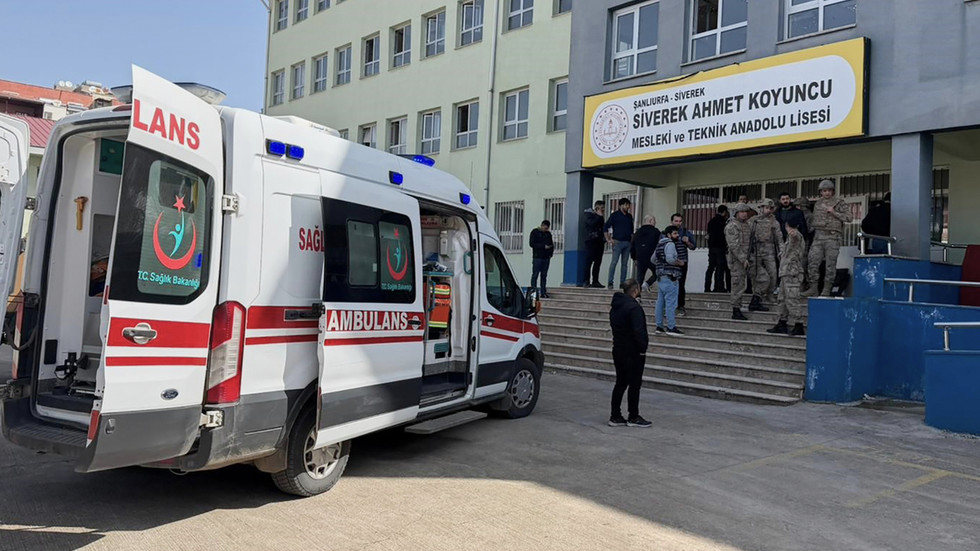
A former student armed with a shotgun attacked a vocational high school in Siverek, in southeastern Turkey, injuring 16 people including students, teachers, a police officer, and a canteen or cafeteria worker. The attacker, reported to be around 18 years old, opened fire randomly in the schoolyard and then moved into the building, with some reports indicating he may have held people hostage and refused to surrender. Security forces, including special operations units and on-site police, intervened, and while several people were wounded, there were no deaths among the victims. The attacker died during the incident, with accounts describing this either as suicide after entering the building or as death during a special forces operation.
Across coverage, the incident is situated within broader concerns about security in educational institutions and the capacity of local police and special operations units to respond to sudden armed attacks. Reports consistently highlight the rapid mobilization of emergency services, the transfer of the injured to nearby hospitals, and the involvement of national authorities in monitoring the situation. Shared context emphasizes that the school is a vocational high school in a region already sensitive to security issues, and that the event raises questions about access to firearms by youths and former students. All sides agree that investigations are ongoing to determine how the assailant obtained the weapon, what motivated the attack, and whether any procedural or institutional reforms might be needed to prevent similar school shootings.
Characterization of the operation and attacker’s death. Government-aligned outlets stress that special forces and police responded effectively, underscoring that no victims died and suggesting the attacker killed himself after resisting surrender, with some phrasing his death as occurring amid a special forces operation. Opposition outlets, where they speculate or comment, are more likely to frame the operation as chaotic, emphasizing uncertainty over whether the death was purely suicide, the result of police action, or a mix of both. Government narratives tend to minimize ambiguity around the sequence of events, while opposition commentary focuses on gaps or inconsistencies in official accounts and calls for full transparency about how the confrontation ended.
Emphasis on state competence versus security lapses. Government coverage highlights the speed and professionalism of the security response, presenting the absence of fatalities among the wounded as evidence that policing, emergency medicine, and school security protocols functioned as intended under extreme pressure. Opposition voices, by contrast, are more inclined to question how an armed former student could so easily access the school grounds, enter the building, and allegedly take hostages, framing this as a systemic failure rather than an unavoidable tragedy. While the government side foregrounds the successful containment of the threat, opposition commentary tends to stress the prior breakdown that allowed the threat to materialize at all.
Framing of causes and gun access. Government-aligned media largely treat the attacker as an isolated individual case, focusing on his status as a former student and hinting at personal or psychological motives without broad structural critique, and they frame ongoing investigations into weapon access as routine. Opposition-oriented discussions more forcefully link the incident to wider issues of firearm availability, local enforcement gaps, and youth radicalization or alienation, using the event to argue that existing regulations and social policies are insufficient. Thus, government narratives downplay systemic culpability, while opposition narratives treat the shooting as symptomatic of deeper policy and societal problems.
In summary, government coverage tends to emphasize rapid response, the absence of fatalities among victims, and the notion of an isolated perpetrator contained by competent security forces, while opposition coverage tends to stress security failures that allowed the attack, unresolved questions about the operation and the attacker’s death, and broader structural issues such as gun access and institutional responsibility.