


opposition
Victims of the "emotional crisis". Russia and Azerbaijan reconcile after the AZAL plane crash, but detainees remain in both countries at the height of the conflict. What will happen to them?
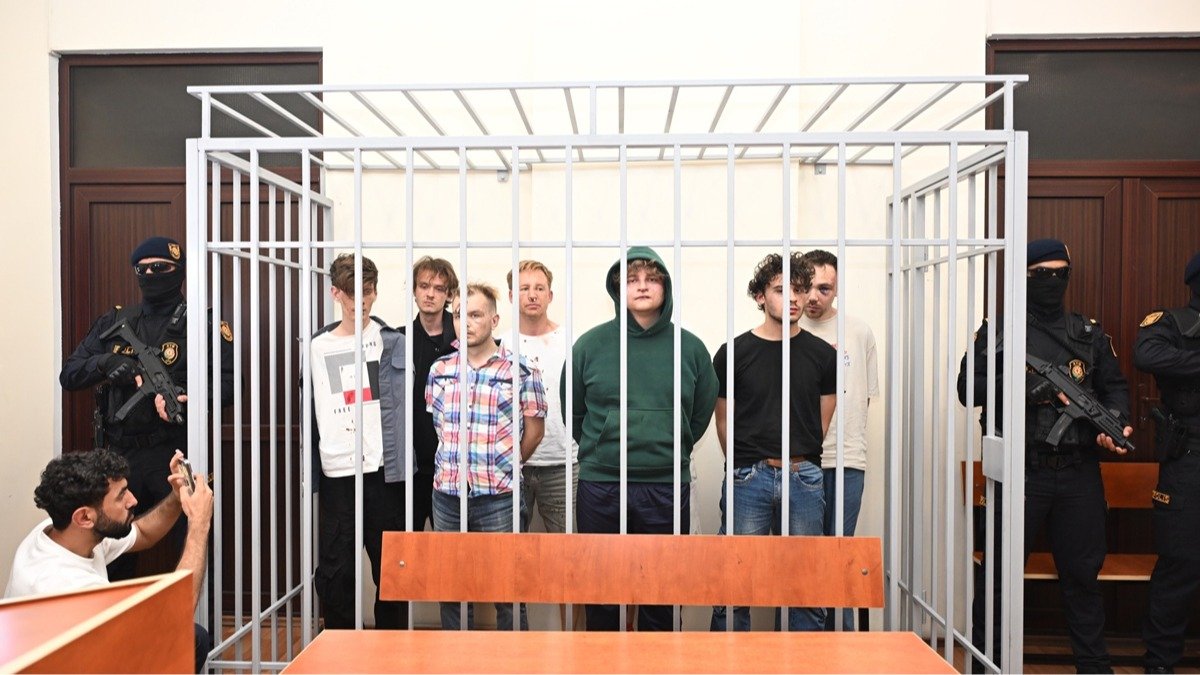
The acute crisis in relations between Russia and Azerbaijan, caused by the AZAL airline plane crash in December 2024, has ended. At least, this is indicated by the joint statement of the Ministries of Foreign Affairs of Russia and Azerbaijan, published this week. Russia recognized the "unintentional action of the air defense system" as the cause of the tragedy in the skies over Grozny. The parties, as stated in the statement, "have reached a proper settlement of the consequences, including the issue of compensation payments." However, against this backdrop, the trial of eight Russian relocated individuals continues in Baku. They were detained in July last year, accused of online fraud and drug trafficking. Now, some of them face charges that could lead to up to 12 years in prison. In Yekaterinburg, in turn, even harsher sentences have been handed down to the leaders of the region's Azerbaijani diaspora: Shakhin Shikhlinksi and his son Mutvali. They were charged with involvement in murders that occurred in the early 2000s, as well as resisting law enforcement officers during their detention. These cases are clearly of concern to Moscow and Baku, respectively. Both sides realize that they went too far in the heat of the conflict, but the question is how exactly these cases could be reversed. Regional expert Roman Chernikov, in a special article for "Novaya Gazeta Europe," analyzed how the parties could ultimately use the "exchange fund" that has emerged. Russians detained in Azerbaijan in the courthouse, Baku, July 1, 2025. Photo: Azertag .Spirit of Dushanbe Talks that Baku and Moscow have "finally reconciled" began after the foreign ministries of the two countries published a joint statement on April 15. It is, however, carefully worded, as if every phrase had to be debated. The main wording reads: "The parties have reached a proper settlement of the consequences, including the issue of compensation payments, in connection with the crash of an Embraer 190 aircraft belonging to AZAL, near the city of Aktau on December 25, 2024, as a result of an unintentional action of the air defense system in the airspace of the Russian Federation." And although this news quickly spread through the media, in fact, there is not much new in it. The very fact that the plane en route from Baku to Grozny was shot down by Russian air defense was acknowledged last year by Vladimir Putin during a summit in Dushanbe, when he met with Azerbaijani President Ilham Aliyev. In Dushanbe, Putin described the situation between Moscow and Baku to journalists as a "crisis of emotions" and a natural reaction to a "difficult, tragic event," after which "it is necessary to calmly sort things out." Putin and Aliyev then embraced for the cameras, and many concluded that all problems in relations between the countries were resolved. But this was not the case. Putin promised that Moscow would not only pay compensation but also give a "legal assessment of the actions of all officials." That is, apparently, somehow punish those responsible for the death of the plane: the air defense captain Dmitry Paladichuk himself, who, according to Azerbaijani media sources, accidentally shot down the board, or someone from his superiors, for example, Major General Alexander Toropilo. But there have been no reports of arrests or even dismissals since then – on the contrary, on the anniversary of the tragedy, the Investigative Committee of Russia stopped the investigation. It is obvious that this was not agreed with Baku – Azerbaijani Foreign Minister Jeyhun Bayramov did not hide his irritation: "Of course, such a step raises very serious questions for us." A few days before that, on December 21, 2025, an informal CIS summit took place, which Putin convenes every New Year in St. Petersburg. But Aliyev did not attend, citing a "tight work schedule." The hint that something was wrong was clear. Pro-government Azerbaijani media commented on the situation as follows: "Moscow, having admitted the involvement of its air defense system in the tragedy, has not yet moved from words to real political and legal responsibility – it has not fulfilled any of the obligations publicly undertaken on October 9 in Dushanbe at the meeting between Ilham Aliyev and Vladimir Putin." At that time, the parties found themselves at an important crossroads. Baku threatened that if Moscow did not admit its guilt within a year, the Azerbaijani side would appeal to certain "international judicial instances." But since the plane crashed on the territory of Kazakhstan (in the city of Aktau), Russia was awaiting the report of the Ministry of Transport of Kazakhstan, which was supposed to be ready by the anniversary (a preliminary one was published on February 4, 2025). It is likely that the Kremlin hoped that the wording in the final document would somehow absolve Moscow of responsibility. What was in the report a year after the disaster? Kazakhstan's report was not ready by the originally announced deadline due to the lack of necessary expertise, and therefore a "Intermediate Report" was published instead. There were no sensational findings. The authors of the document confirmed that the plane did not crash as a result of sabotage ("no traces of explosives were found") and not due to an explosion of oxygen cylinders (this version was initially heard). The verdict was: "The damage to the aircraft was presumably caused by the striking elements of the warhead, however, their origin could not be established." It was unlikely to name a specific missile – this would have required obtaining samples of Russian missiles of different types somewhere. And sharing them is not in Moscow's interest. Compensation was also not straightforward. Back in September, the Russian Ministry of Foreign Affairs reported on the payment of insurance premiums to both AZAL airline (1 billion rubles) and the families of the deceased and injured (a total of 358 million rubles). But Azerbaijan made it clear the next day that insurance payments are not the same as compensation. The former are paid by a company that cooperated with the carrier (in this case, "AlfaStrakhovanie"), the latter by the state, and not as part of a commercial transaction, but as an apology. President of Azerbaijan Ilham Aliyev and Vladimir Putin before their meeting within the framework of the Dushanbe summit, Tajikistan, October 9, 2025. Photo: Grigory Sysoev / Sputnik / Kremlin / EPA. Russia did seem to skirt the issue of compensation. Just before the New Year, Russian Deputy Foreign Minister Mikhail Galuzin, when directly asked about compensation in an interview, responded vaguely: "As Russian President Vladimir Putin noted, everything required in such tragic cases will be done by the Russian side." Then, on March 2 of this year, Russian Deputy Prime Minister Alexey Overchuk arrived in Baku. The press release regarding this stated without details: "The parties will undertake a set of practical steps in the near future to resolve the issues that arose as a result of the AZAL company's plane crash on December 25, 2024." Apparently, the war in Iran helped to break the ice: Russian citizens (a total of 384 people) were mainly evacuated from there through Azerbaijan, and Overchuk thanked Ilham Aliyev for this assistance. However, Moscow did not speak firmly and unequivocally about compensation to Azerbaijan until April 15, when the foreign ministries issued a joint statement. By the way, immediately after that, Russian Deputy Prime Minister Alexey Overchuk visited Azerbaijan again, not Baku, but Zangelan. This is one of the cities recaptured from the Armenians in 2020, and it was there that the intergovernmental commission and the meeting of the Azerbaijani-Russian Business Council took place. In parallel, representatives of the parliaments met: Speaker of the Federation Council of the Russian Federation Valentina Matviyenko and Chairperson of the Azerbaijani Milli Majlis Sahiba Gafarova. These meetings were intended to convince everyone that the sad page had finally been turned. Yekaterinburg on the Caspian Meanwhile, people who were completely uninvolved in the crisis between Moscow and Baku became its victims. And these are not those who trade between countries – they did not notice any consequences. By the end of 2025, trade turnover even increased by 2.5%, approaching $5 billion. On June 27, security forces in Yekaterinburg, using force, detained representatives of the well-known Safarov clan in the city, accusing them of involvement in two murders – in 2001 and 2011 – and an attempted murder in 2010. Two of the detainees – Huseyn and Ziyaddin Safarov – died during detention. Their bodies were sent to Azerbaijan, where a forensic examination was conducted before burial. It proved violent death. Five relatives named Safarov were brought to trial in Russia: Akif, Ayaz, Kamal, Mazahir, and Bakir. There were other defendants. Baku perceived this as a clear signal of escalation – meaning Moscow decided to strike at the diaspora. Bakir Safarov during a hearing in the Yekaterinburg court on the case of a series of murders, July 1, 2025. Photo: AP / Scanpix / LETA. In response, Azerbaijani security forces conducted searches and detentions at the Baku editorial office of the Sputnik agency. As a result, two heads of the bureau were arrested – Igor Kartavykh and Yevgeny Belousov. Officially, they were charged with "fraud, illegal entrepreneurship, and legalization of property obtained by criminal means," and media even circulated the version that they were considered FSB agents. And a day later, on July 1, 11 Russians were arrested in the same deliberately harsh manner. Some of them were relocated individuals who had fled mobilization, while others were simply traveling or doing business in Azerbaijan. Initially, the Ministry of Internal Affairs of Azerbaijan published a video showing severely beaten people (with bruises on their faces and traces of blood on their clothes) forming lines against a wall or walking in single file. Then they were brought to court in a similar manner – each of them had their hands twisted behind their backs by two police officers, although the detainees did not even try to resist. The next move was again from Yekaterinburg. There, on the evening of July 1, following the Safarovs, the head of the local Azerbaijani diaspora, Shakhin Shikhlinksi, was detained. His son, Mutvali, was also in the dock with him. He was driving the car in which they were trying to escape from law enforcement officers – and accidentally hit a member of the arrest group. Initially, Shikhlinksi was a witness in the murder case and was released after questioning (although the detention was very harsh – car windows were even broken). But a month later, he was put on the wanted list. Shikhlinksi Sr. tried to hide in Moscow – in a guest house at the Azerbaijani embassy. It is possible that he hoped to cross the border in a car with diplomatic plates, but he failed: he had to surrender. By the way, Mutvali was not immediately arrested for hitting the national guardsman, but only on July 15. After that, the problems of Russians in Azerbaijan and Azerbaijanis in Russia continued – albeit with less intensity. Russians were denied Azerbaijani residence permits without explanation, and Azerbaijanis began to be deprived of Russian citizenship if it was not obtained at birth. Arrests also occurred: for example, at the end of August, the former head of the Satire Theater, Mamadali Agayev, was arrested on charges of embezzling 20 million rubles. The full list of Russians detained in Baku was inexplicably a mystery. From photos and videos, "Novaya-Europe" was initially able to identify nine of them. Other media, such as the BBC, identified even fewer. And even on the website "Free Us," which was later created by the relatives of the arrested, there are only seven names. The assumption that some of the detainees might have been released (in the Safarov case, about 50 people were initially detained, most of whom were not arrested after questioning) was not confirmed: although Azerbaijani media have since spoken only of eight Russians, Russian diplomats insisted on the number 11. As "Novaya-Europe" found out, the reason is that eight people – Sergey Sofronov, Dmitry Bezugly, Ilya Bezugly, Alexey Vasilchenko, Valery Dulov, Anton Drachev, Dmitry Fyodorov, and Boris Timashov – are involved in a drug trafficking case. On April 10, they were read the indictment, which should soon be followed by a verdict. Sergey Sofronov during a court hearing in Baku, Azerbaijan, July 1, 2025. Photo: Azertag. The group leader was identified by investigators as 23-year-old Sergey Sofronov. It is alleged that he "in a place unknown to the investigation, at a time unknown and under circumstances unknown, illegally acquired from an unknown source for the purpose of sale a large quantity of narcotic drugs – heroin weighing 4.153 grams, 50 methadone tablets in 5 blisters with a total active substance content of 2 grams, as well as a large quantity of psychotropic substances – methamphetamine weighing 36.814 grams, after which he divided them into portions and distributed them among the participants for their subsequent joint sale." It doesn't sound very plausible. Firstly, Sofronov initially went to Azerbaijan on vacation with his mother. Secondly, it is unclear why quite adult and wealthy people (Anton Drachev, 41, has launched several IT startups, and Valery Dulov, 38, worked in structures of "Rosneft") decided to join the gang of a young guy to distribute such a modest amount of drugs under his leadership. The last hearing in their case was on Friday, April 17. The court's verdict has not yet been announced. Another group of Russians is accused of cyber fraud, but Azerbaijani media do not write about them. Apparently, this group includes 40-year-old Igor Zabblotskikh (in 2020 he was accused of creating an underground network of gambling clubs in Russia, but he was also involved in IT products), as well as Alexander Vaysero (Sverdlovsk ombudsman Tatyana Merzlyakova wrote that he was suspected of cyber fraud, but on April 10, Azerbaijani media, calling him Vayesro, included him in the group of "drug dealers"). The third accused, as "Novaya-Europe" learned, is Ilnur Valitov (his name has not appeared in the media before). Since he was not involved in the main court proceedings, it is logical to assume that he is also in the second group. Photo: Azertag. Exchange Rate There is little doubt that sooner or later the Azerbaijanis from Yekaterinburg will be exchanged for the Russians arrested in Azerbaijan. "I spoke with Azerbaijani officials, and they all told me in one voice: 'The ball is in Russia's court' – Sergey Sofronov's mother told "Novaya Gazeta." – There must be an initiative from Russia. First, the recognition of responsibility for the plane crash and compensation to the families of the deceased." These conditions have now been met. Russian Deputy Foreign Minister Mikhail Galuzin, after his trip to Baku in March, stated that the release of 11 Russians "could be a gesture of goodwill in the spirit of good neighborliness and contribute to further strengthening multifaceted cooperation between our countries." But, obviously, Baku will want something in return. Moreover, immediately after the conversation between Putin and Aliyev in Dushanbe, the parties demonstratively carried out a "two-for-two" exchange. It only concerned Sputnik agency employees. Igor Kartavykh was released in exchange for Mamadali Agayev (Russian presidential aide for foreign policy Yuri Ushakov emphasized that he personally coordinated this decision with his Azerbaijani counterpart Hikmet Hajiyev). A little later, Yevgeny Belousov was also released – Moscow symmetrically released businessman Yusif Khalilov from the Azerbaijani diaspora in Voronezh (he was accused of bribery). True, at that time, none of the four exchanged had been convicted. In the case of the current affairs, "Novaya-Europe" interlocutors assume, it will be necessary to wait for the completion of the trials for all potential participants in the exchange. As Eldar Zeynalov, director of the Azerbaijani Human Rights Center, suggested in a conversation with "Novaya-Europe," after verdicts are handed down to all defendants on both sides, the exchange will require a complex procedure. "As we understood, the main thing for the authorities on both sides is not to lose face," said the human rights activist. "For example, Azerbaijan would certainly not want to allow a scenario where, upon release, Russian relocated individuals would go to the European Court of Human Rights and demand compensation. For this, they must formally agree to the verdict and not appeal it." The Russian authorities, according to Eldar Zeynalov, will most likely go the route of depriving the convicted representatives of the Azerbaijani diaspora of Russian citizenship – in cases where this is possible. If some procedural violations are found, the person will be stripped of their Russian passport and extradited to Baku. But this will not be possible for everyone. Shakhin Shikhlinksi himself has lived in the Urals since the 80s, and his son Mutvali was born there. It will not be possible to assign him Azerbaijani citizenship. Another option, according to Zeynalov, is when the convicted file appeals, and the court agrees with the injustice of the previous verdict. But this would be too much of an image damage for both countries, and therefore they are unlikely to agree to such an option.
4 days ago
