opposition
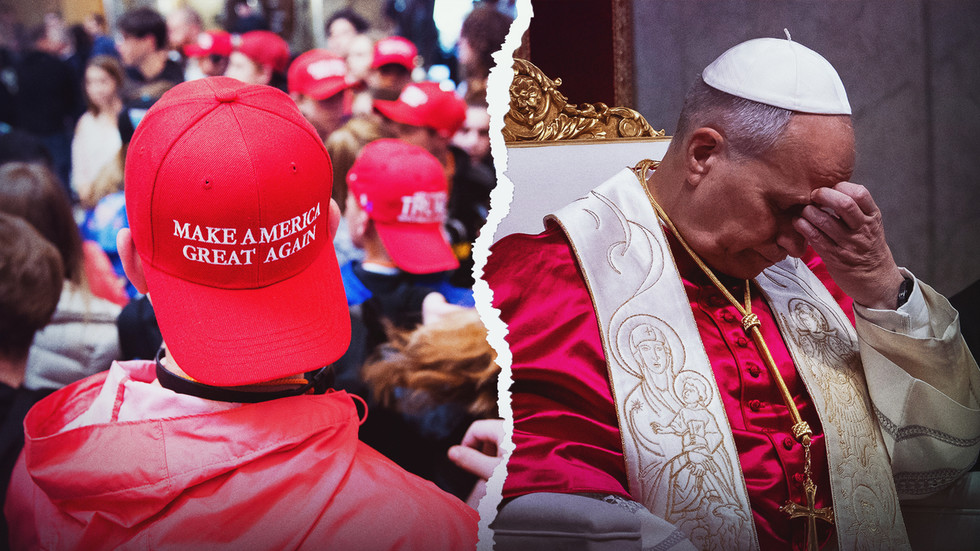
The Antichrist President. Aspiring to messianic leadership, Trump presents himself as Christ and intensifies 'sacramental' competition with the Pope
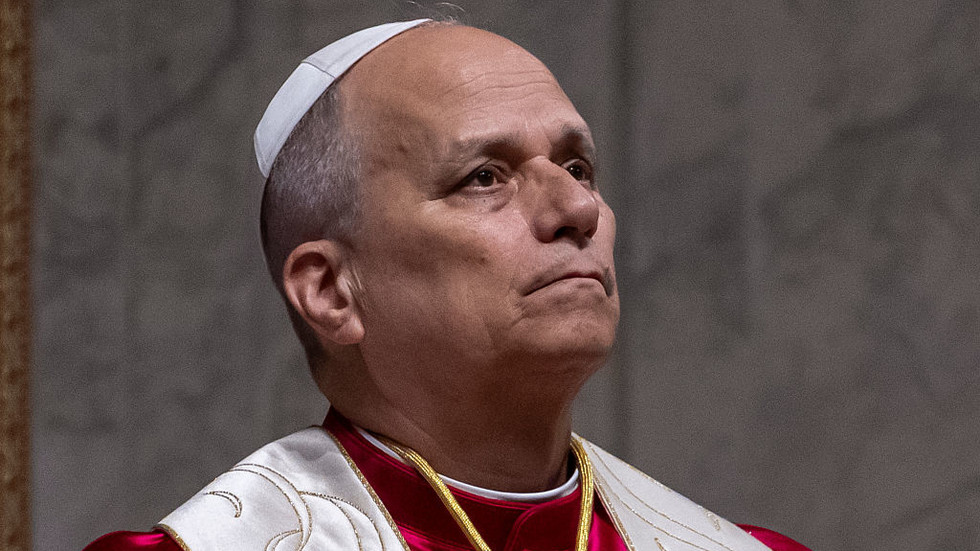
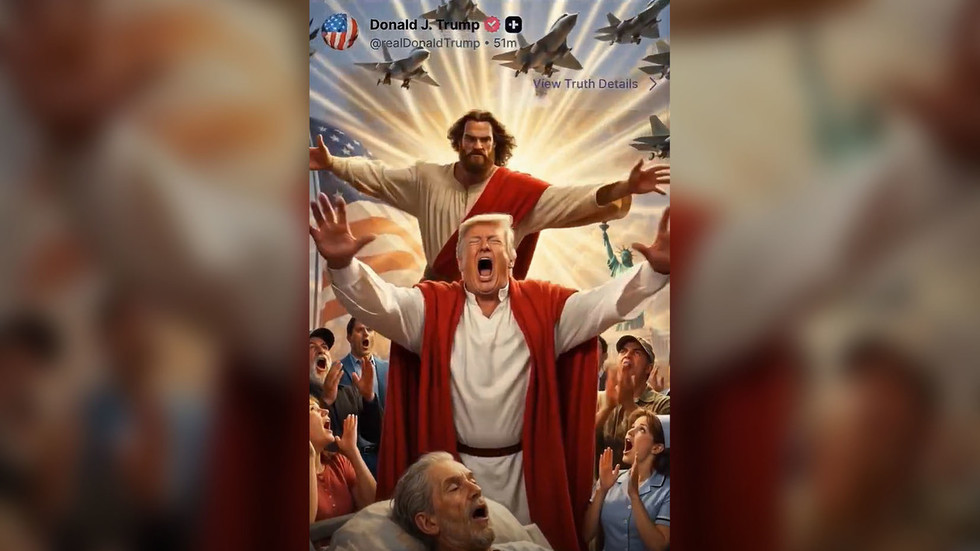
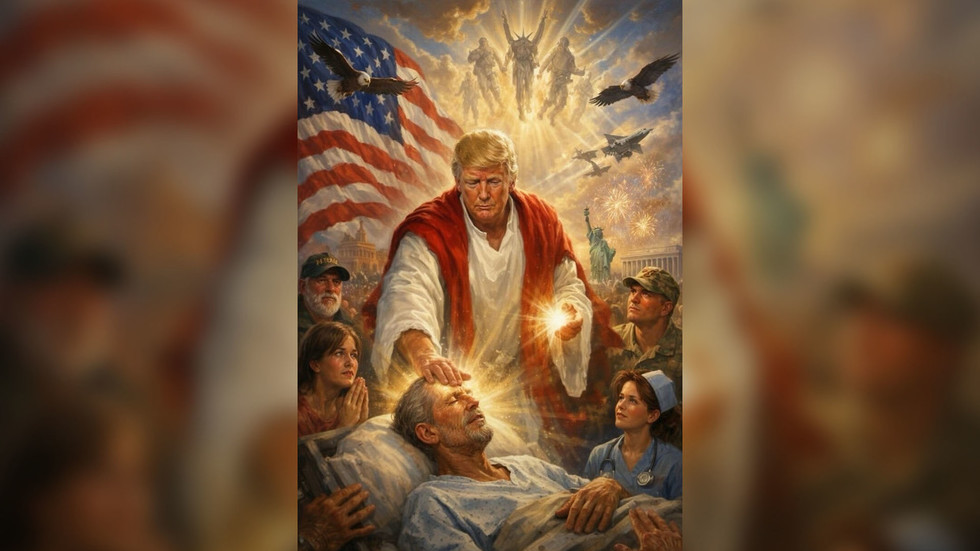
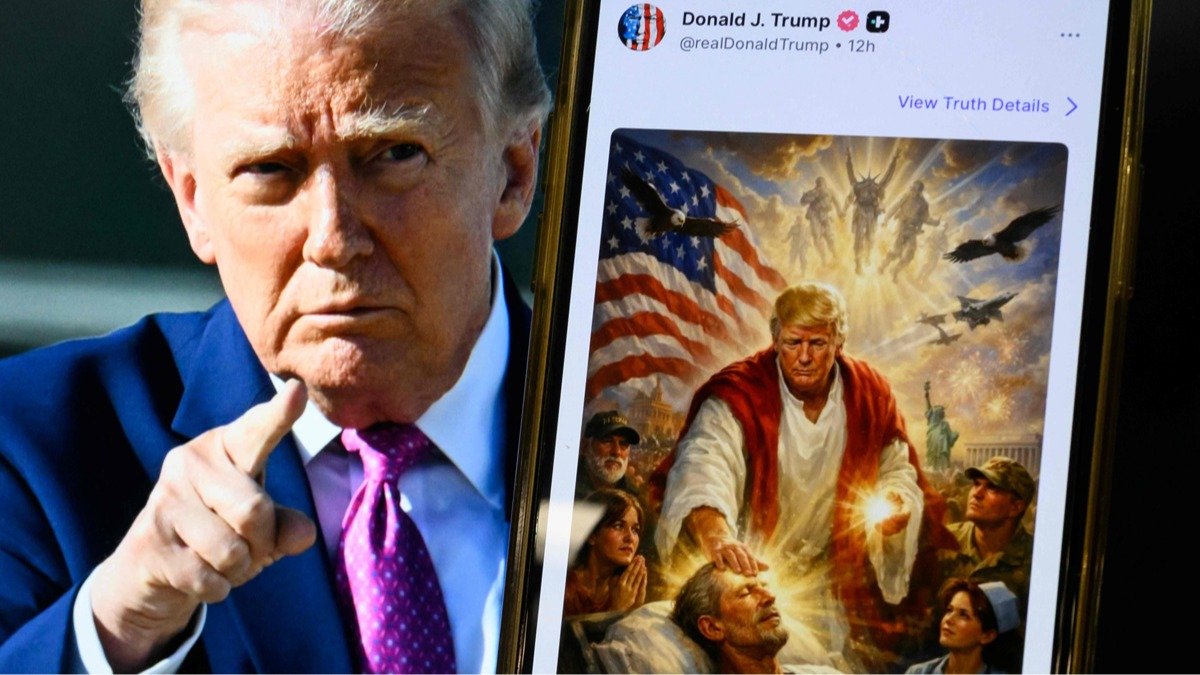
Donald Trump and his AI-generated image as Jesus, April 13, 2026. Photo: @realDonaldTrump / Truth Social; Mandel Ngan / AFP / Scanpix / LETA. The religious-mystical fantasies of the eccentric White House owner reached a new height on the night of April 13. Donald Trump posted an AI-generated image of himself as Jesus Christ healing or even resurrecting an elderly man bedridden on his social network. Messiah-Trump touches the forehead of the unfortunate with his right hand, and a bright divine light emanates from his left. Around him is an ecstatic crowd, with fireworks, the American flag, and some aircraft in the sky above Trump. To leave no doubt as to whom the US President identifies himself with, he is not dressed in a business suit befitting his position, but in an ancient white tunic and a red cloak. Jesus Christ, who shed his blood on the cross for the salvation of the world, is often depicted in such clothing in icons. He removed the AI picture only a day after widespread discussion in the media and social networks. 'Alas, it does not seem that Trump is going to shed his blood, but one cannot but appreciate the growth of his ambitions. It is no longer enough for him to be 'a free queen' - he wants to own the entire universe and raise the dead. Over the year and a bit since Trump's 'second coming' to the White House, numerous scientific and journalistic studies have appeared suggesting that Trumpism (or the MAGA movement) is better described as a purely religious phenomenon, a kind of sect. 'New Europe' has also dedicated its research to this phenomenon. Judging by the statements of Trump himself and some of his followers, the MAGA movement has absorbed charismatic dispensationalism - the doctrine of some American Christian groups that God's revelation is still transmitted through chosen people of God. A visible sign of such chosenness is special success in business and politics, which Trump clearly possesses. And his further movement from national to global leadership - through the 'Peace Council' created by Trump, where he arrogantly assumed the right to veto decisions of other states - is viewed by dispensationalist-Trumpists as 'God's anointing.' By the way, in similar terms, some US Army chaplains explained the Armageddon started by Trump in the Middle East. 'President Trump is anointed by Jesus to light the signal fires in Iran, which will cause Armageddon and signal the return of Jesus to earth,' preached one commander in early March, quoted by the American Foundation for Military Religious Freedom. In the Russian Orthodox Church and in Russia as a whole, the idea that Trump is the very Antichrist, whose appearance is predicted in the Apocalypse, the last book of the Bible, and heralds the last times before the end of the world, is gaining popularity against this backdrop. The rector of the Russian Orthodox Church on Maroseyka in Moscow, Archpriest Feodor Borodin, characterized Trump's latest collage as a 'gravest sin of satanic pride,' warning that 'nothing good will come of it.' Orthodox-patriotic resources loyal to the Russian Orthodox Church proclaim Trump as the Antichrist, and the deputy head of the political department of the Ministry of Defense of Russia, General Alauddinov, gives a '99%' guarantee that this is so. Image of Donald Trump in papal vestments, created by artificial intelligence and published on official White House accounts, May 2025. Photo: Scanpix / LETA. Last year, a collage of Trump dressed as the Pope, which appeared on his social network after the death of Pope Francis, caused a lot of noise. Having encountered a painful reaction from the Christian world, Trump then renounced this image, claiming he 'had no idea' how it leaked into his personal account. However, on January 21 of this year, at the Davos forum, the US President called himself the 'dad of the modern world' (in English he used the word 'dad' rather than 'pope,' presenting his 'paternalism' as even more universal than the 'fatherhood' of the pope in the Catholic Church). Today, he launched the harshest criticism of the Pope of his entire presidency, calling Leo XIV 'weak' and 'terrible in foreign policy.' 'I don't want the Pope to criticize the US President for what I do,' Trump formulated in a very childish way. He reproached the pontiff for indulging 'radical leftists,' although in Catholic circles Leo XIV has a reputation as a much more conservative [servant] than his predecessor Francis. 'I am not afraid of the Trump administration,' the pontiff replied, 'and I am not afraid to loudly declare the message of the Gospel, because that is why I am here, that is why the Church exists.' The Pope did not swear allegiance to Trump The current round of escalation between Trump's Washington and the Holy See, led by the first-ever Pope from the US, Leo XIV, began in January of this year and reached its peak on Easter. On the same day that Trump declared himself the world pope, January 21, the pontiff received an invitation from him to join the newly created 'Peace Council' - a very strange body, like an alternative to the UN, but with higher representation (at the level of heads of elected states) and with a veto right on any decisions for one person - the same Trump. After a pause of almost a month, the Vatican quite predictably refused this offer. Cardinal Secretary of State Pietro Parolin then stated his commitment to the international architecture created after World War II, with the UN playing a key role. It turned out that Trump's invitation was the 'last chance' the White House gave the Vatican. From leaks published on Easter by the American publication The Free Press, it became known that Pentagon chief Pete Hegset and the Trump administration were extremely irritated by the wording that Leo XIV allowed himself at the meeting on January 9 with diplomats accredited to the Holy See. The pontiff then protested against the ongoing 'replacement of diplomacy of dialogue with diplomacy of force' and against the war that is 'back in vogue.' He directly condemned the kidnapping of Maduro, which so delighted Trump, emphasizing: 'Stability in the Bolivarian country is possible only if foreign aggression ceases.' According to The Free Press, these statements led to the summoning of the Apostolic Nuncio (ambassador of the Holy See) to the US, Cardinal Christophe Pierre, to the Pentagon. US Deputy Secretary of War Albridge Colby directly threatened the nuncio: 'The United States has enough military power to do whatever it wants in the world. The Catholic Church better take our side.' And some officials present even recalled the 'Avignon Papacy' in the 14th century, when the heads of the Catholic Church were in the castle of the French kings far from Rome. In March, Christophe Pierre resigned, unable to withstand working in such rude and uncivilized conditions. The threats of Trumpists did not affect the Vatican: on this Easter, Leo XIV again called on world leaders (obviously referring to Trump) to 'renounce the desire to dominate others.' In his sermons during Holy Week, the Pope constantly criticized new attempts at 'imperialist occupation' (in Ukraine and Iran) and assured that God rejects the prayers of politicians 'waging war.' Trump's animosity towards Leo XIV is only increasing because this Pope was born, studied, and served in the US, due to which the White House placed special hopes on him. 'If I weren't in the White House, Leo wouldn't be in the Vatican,' the US President wrote today, implying that the Pope had 'betrayed' him. But Leo XIV never swore allegiance to Trump. Pope Francis Leo XIV holds a prayer vigil in St. Peter's Basilica in the Vatican, April 11, 2026. Photo: Angelo Carconi / EPA. Of course, he is a patriot of his homeland, but what Trump is doing threatens the US with many problems - social, economic, and, most importantly, moral. After the attack on Iran, the pontiff canceled a previously planned visit to the US on July 4, the 250th anniversary of the declaration of independence. Instead, he plans to visit the tiny Italian island of Lampedusa - the first point under the jurisdiction of the European Union reached by African refugees, sometimes sailing on makeshift rafts through a mass of mortal dangers to a new free life. The issue of migrants is a traditional point of divergence between Trumpists and Catholics, and this contradiction lies precisely in the moral sphere. Six months ago, Leo XIV directly condemned Trump's methods of deporting illegal immigrants: 'When people live normal lives for ten, fifteen, twenty years, to treat them this way is, to put it mildly, extremely disrespectful. And, unfortunately, there is violence.' Despite his boasting, Trump has so far achieved little in global politics, at least in overcoming armed conflicts. The Vatican, which is formally the smallest state in the world by area, has considerable moral and even political resources to ignore the rude demands of the White House. Pope Leo XIV is doing just that - calmly, with dignity, evoking only the powerless rage of a failed messiah. Lera Furman P.S. On Monday, Pope Leo XIV received unexpected moral support from the President of the Islamic Republic, Masoud Pezeshkian. On X, Pezeshkian wrote that he condemns insults against 'religious figures' and disrespect for spiritual symbols. The Iranian president called Trump's collage as Christ an 'desecration of Jesus,' who is revered in Islam as a great prophet. Probably, persuaded by Pezeshkian's words, Trump finally removed the vulgar image, which in modern Russia would have fallen under the article 'insulting the feelings of believers.' Well, why not remove it if everyone has already seen and discussed it? True, unlike the story with last year's collage as the Pope, this time Trump did not claim that he did not control his account. He stated: 'I thought it was me as a doctor.' The further one goes, the more the feeling that a doctor is really needed there.
8 days ago